

The Scent of Snow
In less than an hour, three inches of snow piled up neatly on the deck and I took a moment to appreciate it before sweeping it aside and off into the grass.
The tiniest snowflake landed in my eye on the morning walk last Wednesday, and I went immediately to that place of wonder that the nerve endings in my cornea are sensitive enough to even register such an infinitesimally small and simple change in temperature and pressure. It felt cool for an instant as it melted, and I blinked it out of existence in a flash. Wonder on top of wonder, because I was also well into the dead goldenrod stalks when the snow started falling. That’s rare and cherished, to be right there when it all begins.
The last time it snowed, I was tucked in and wearing my work-from-home uniform (red plaid pajamas, aka Extremely Casual Friday), watching the flakes fall as I stood on the warm dry side of the living room windowpanes until it was just too stunningly beautiful to resist and I just HAD to be standing in the middle of it. Three and a half minutes later: sweatshirt, coat, leggings and boots on and I was making tracks, my mouth a near-permanent “oh!”—the only appropriate response to the view in every direction—as the acres pulled me forward. Every curve on the path unfolded to reveal a snow-christened scene more spectacular than the one I just passed through; the pure silence swallowed me whole.
I don’t really check the weather report much anymore since I’m mostly at home and don’t need to dress for a 22-minute commute in a vehicle that finally blows heat by the time I arrive in the parking lot. Here at home, the mileage from the breakfast table to the workplace is all indoors and involves a steep but short flight of stairs (shoes and socks are optional). Sure, you need to let the chickens out at dawn and lock them back up when the fields go all dusky gray. But you can slip on your boots, slide the quilted flannel coat hanging on the cast iron bell in the mudroom right over your pajamas and dash out to do the job long enough for the hems of your pantlegs to skim over the tallest blades of snow-dampened grass. I’m back inside before I even know it was chilly out there, using the hair dryer on those hems (the after-chicken-chores reward is sitting on the far left corner of the couch, legs tucked underneath me while I sip hot green tea and eat the day’s hard boiled egg. Nothing deflates the charm of that moment more than soggy pajama pants hems soaking one’s behind).
If I hadn’t needed to be in a work meeting that Wednesday morning, I could have easily talked myself into sitting at the feet of a young black walnut sapling just inside the entrance to the meadow, watching the sky unpack its load of snow one fistful of flakes at a time. I settled for an upstairs window-framed view of the snow as it fell thick and fast, coming to rest on the hood and windshield of my brother’s ‘68 Chevy truck parked in the grass between the old old goat barn and the field to the east. Hand-painted holiday cards don’t get more charming than that tableau (when I scavenge the neighborhood the week after Christmas for discarded trees by the curb, I’ll pick the greenest one to toss in the bed, then snap the photo for next year’s card). In less than an hour, three inches of snow piled up neatly on the deck and I took a moment to appreciate it before sweeping it aside and off into the grass.
There’s a scent to fresh snow that almost defies description (a fellow writer recently offered the phrase “frozen petrichor”—such a medieval-sounding collection of letters, isn’t it? Thanks, Augie). It’s a watery, mineral-infused aroma with an immediate sharpness to it, traces of earth and rarefied atmosphere mixed in, and now we’re bordering on those elegant but sometimes bizarre wine catalogue write-ups that use phrases like “forest floor”, “sagebrush undertones”, and “wet stone”. All I know is when I catch that first scent of new snow, I go sniffing hungrily for more of it, and that usually leads me as far away from the house as I can go while still staying within the surveyor pins that mark the boundaries of our property. It doesn’t take long before I’m distracted by the stark beauty of the snow-fluffed scene that surrounds me, filling the rest of my senses with more data than they can process. I can see where the deer have crisscrossed the cut paths (or created some of their own), browsed here and there on whatever green they could find among the brown grasses, and chewed strips of bark from the curly willow by the sweat lodge. I was thirty-six years old when I saw my first set of deer tracks in snow; twenty-some years later, this morning actually, and I’ve added “deer nose prints in the snow” to a growing list of All There is Still Left to See and Learn and Be Delighted By. Another reason why I’m not that afraid of getting older. There’s so much I still don’t know yet.
Predictions for this year’s season are already grim and meeting our anxious expectations. We don’t dispute them or take them lightly. But wrapped in the warmth of a good home and beckoned by the unrelenting beauty of a landscape that knows no end to its own gifts, we still willingly step into winter, eyes wide open to catch the sights, and perhaps a few more stray flakes. What else can we do but be present to what the moment gives us?
I lace up my boots, pull on my gloves and inhale that frozen petrichor one more time. Ahhh…
What Will You Make Today?
Yesterday was marked by a quick trip into town to exchange food with Patrick’s mom and sister, then back home for an afternoon of unbridled creativity.
The sun found me this morning sitting on the massive trunk of a fallen black walnut tree in the woods in complete stillness. That’s something I’m not very often, and it was delicious. As I received the silence of the forest around and above me, my eye caught the swift tawny motion of a grown-up doe in retreat, zigzagging her way through the saplings to the northwest to get as far away from this two-legged intruder as she could. I took off my earmuffs as she got smaller in the distance, and still couldn’t hear her hooves on the soggy brown leaves. If she broke any branches on her way out of the woods, they must have been mush and punky already. How could something that big and in motion not make a sound? I have a lot to learn.
I woke up this morning as I usually do, wondering if my congestion was a sign that COVID had come to claim me, and then remembering that I’ve had congestion for most of my life and it never once sent me to the hospital to be intubated. Reassured and calm once more, I set about the morning tasks: straighten the living room, wash last night’s dinner dishes, wash the stovetop and counters down with a soapy scrub pad, and dress for the morning walk. The sunrises have been yellow and gray these past several days, and I imagine those colors in a future quilt I’d like to make. I also note here that Pantone’s new colors for 2021 are are “Ultimate Gray” and “Illuminating”, hailed as gifts from the hue gods for our pandemic-weary spirits. We humans think we’re so clever, when here Mother Nature has had the color palette well in hand for-EVER and doesn’t need to make any grand announcement when a new shade of green shows up in the spring. I love being reminded of my place in the grand Scheme of Things. It keeps my life right-sized and manageable (and I’m grateful, really, that Pantone is trying to ease a burden here, in some small way. Watch for new nonprofits to adopt these two shades as their brand colors in the months to come).
Yesterday was marked by a quick trip into town to exchange food with Patrick’s mom and sister, then back home for an afternoon of unbridled creativity. For the food exchange, we’ve got quite the air-tight system in place: pull up in the driveway, Molly, masked and cheerful in her eyes, opens the garage door, we place our bags of food in front of the open door and back away at least six feet (also masked) and she retrieves them before putting down her offerings for us to pick up in similar fashion. The whole transaction wraps up with a phone conversation, Molly back inside with Joann, the glass of the front door or the patio doors between us and our masks removed in the safety of our respective places. It’s lovely to see their smiles and their lips move as they talk. It hurts not to be able to hug them. Raw and real, I look forward to the day when the rough edges of all this have softened even a little. For now, it’s enough that Molly made us a tuna ball (white albacore and cream cheese decadence, spiked with horseradish and cayenne pepper sauce, sprinkled with dill for curb appeal on the appetizer table. Patrick and Molly’s late father, Larry, introduced this pre-meal delight at a family dinner once, and I ate so much of it that I had precious little room for the main event that followed. “Liz is here—hide the tuna ball” became the joke at every future family gathering. Larry also introduced me to caviar and creme fraiche. Let them laugh all they want, I’ll be content and noshing for the rest of my life), and sent us home with cinnamon rolls. The carb pile on the counter is growing without apology.
As for the unbridled creativity, there’s a gorgeous walnut and cherry pizza cutter handle on the cusp of completion in Patrick’s studio, and the beginnings of at least two rings on the drafting table. Meanwhile, three hand-bound journals rest in pressed silence in my creative workspace, a stack of cloth journal covers await their beaded embellishments and a dozen-plus fabric bird ornaments are ready to be stuffed with poly-fil. I’m also a sucker for any book with an added pocket on the inside cover, so we’ll see what today brings as I consider the use of envelopes I made out of road maps and old wrapping paper. Suddenly, the stillness of this morning’s fallen-black-walnut-in-the-woods moment seems like a dream…
I’ve reflected (as I do on occasion), and all this busy-ness, this motion in my life isn’t an avoidance strategy to keep me from facing down some neglected part of my psyche. I’ve done battle with my dragons and am still here, victorious and appropriately scarred (which means, no longer bleeding and now healed and getting on with it). Lessons tucked firmly in my my heart and my daily practices, it’s a divine privilege to make something that didn’t exist last week, to glue or stitch two things together that maybe nature never intended but darn it, turn out to be pretty ok. The fun of seeing an idea become flesh is still available to us, dear readers. Put yourself in that grand seat of design, of trial-and-error and laissez les bon temps rouler!
And if you must, go still and silent for a while. See what rises to the surface, gently takes your face in its hands and asks for your attention. It’ll be ok. In fact, it will be wonderful.
You are precious and loved. Remember that.
Where the Entertainment Lives Alongside the Bargains
In all my decades of shopping at thrift stores, I have yet to interact with anyone who isn’t kind or quirky, creative or just browsing.
Conversation between two employees overheard in a thrift store one October Sunday morning:
“I’m gonna be moving slow today, Janet. I rode the mechanical bull last night.”
“I hear that, Connie.”
It was enough to make me linger a bit longer than usual in front of the mismatched dinnerware from the ‘80’s section, conveniently situated right next to the open door of the store’s stockroom.
Unfortunately, the rest of Janet and Connie’s exchange was inaudible and I needed to keep moving lest it become obvious I was loitering and hoping for more eavesdropped details, or better yet, a glimpse of Connie making good on her declaration as she hobbled about the aisles, stooping stiffly to place newly-priced inventory on the shelves, groaning as she stood upright again. There’s a fine line between curiosity and “none of your business”, and I didn’t want to cross it. I frequent that store weekly (or used, to pre-pandemic). Plus, you know, basic human decency.
Years ago—circumstance and setting unimportant—a co-worker and I got to talking about human behavior. She told me how she enjoyed observing people in social settings and hearing how casual conversations took shape. Once, she sat quietly at a party and unobtrusively jotted down snippets of the exchanges going on within earshot of her perch. She then strung them together as one discussion and the results were hilarious. Fortunately, the friends she listened in on were good sports and eager to hear their individual contributions to the mixed up word salad she’d created. It quickly became a game for this circle of folks and I suspect they’ve archived some doozies in the years since. Given our present circumstances of more distanced and virtual gatherings, I doubt we’d get the same results. Zoom has its limits. Another reason to keep praying for an end to this pandemic.
We’re a fun bunch, humans. In any setting, we offer up what essentially comes down to our ongoing attempts to figure out the life we’re living and we occasionally accomplish this in the presence of unknowing spectators, also trying to figure out life. If you enjoy people-watching, what’s your favorite setting? For me, it’s thrift stores, hands down. The customers (of which I am one, and fully aware that someone may be observing me) are givers, representing a wide and varied swath of circumstance, background and purpose, as well as skill sets and word choices (spoken aloud if unruly children are present). In all my decades of shopping at thrift stores, I have yet to interact with anyone who isn’t kind or quirky, creative or just browsing. Sometimes we chat about the headlines, but most often we trade comments about the items we’re picking up, turning over in our hands, and then putting back on the shelf. At the store I (used to) visit weekly, one of the regulars sings gospel songs as she travels through the aisles, witnessing to everyone and no one in particular. She’s cheerful and harmless, and doesn’t ask for anything from the rest of us except a smile. I’d go every week just for that.
As a writer, there’s a bonus here—endless story prompts as I try to imagine the history of the items donated. The coconut husk monkeys, an entire rack of XXL t-shirts with the misspelled company name over the left pocket, the inevitable Blue Boy figurine (or painting) and the odd 90’s wedding dress. We donate items to the Goodwill nearly as often as we buy them, and it’s funny to see a set of plates we no longer needed sitting among the unfamiliar dishes that might once have held our neighbor’s dinner. We always check the price, nod in agreement that yep, that’s about what we’d pay for them now. It’s also important to note that every single room in our house boasts at least one if not seven thrift store purchases; let’s not even talk about what’s in the barn and the outbuildings. But where do those coconut monkeys come from? They’ve got “bad vacation souvenir” written all over them (just like the glued-up seashell sculpture I found in a tote in our attic a few years ago). And why doesn’t anyone want Blue Boy in the house anymore? Let yourself noodle around on that for a few hours.
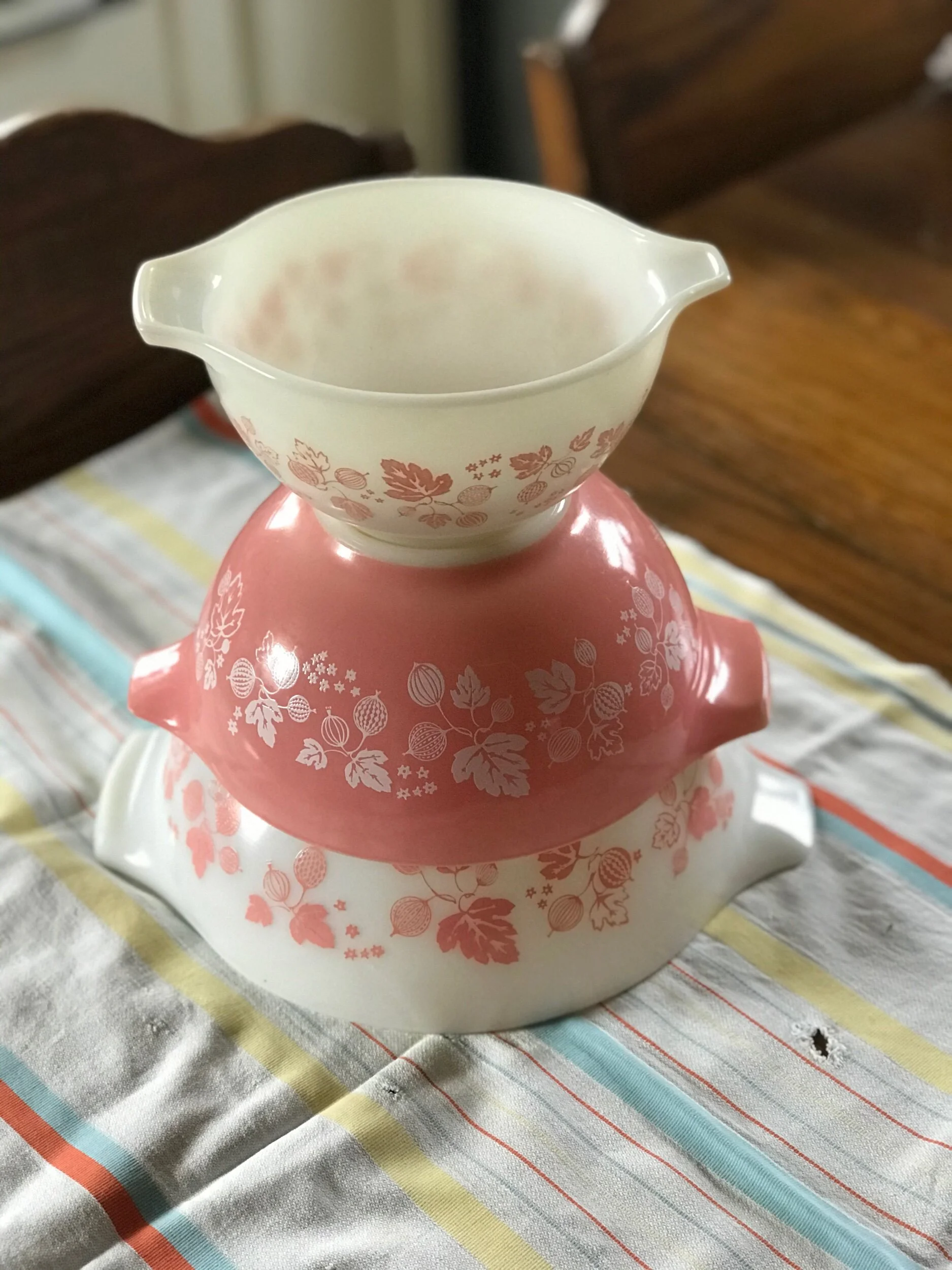
Some weeks after I shut down our antiques business, I stopped by the Goodwill near our house on the way home from work and came across a complete three-piece set of Pyrex mixing bowls in the Gooseberry pattern. Not a scratch or stain on them, and after parting with $6, they were mine (the current price on eBay for the same set is clocking in at $152.50. Retirement plan anyone?). They are fully employed because I live in a functioning house, not a museum, and the largest one is the perfect size for making no-knead cold-rise artisan bread. When dough needs to sit for 18 - 20 hours, might as well look charming while doing it, right? But who donated them and why, I’ll never know. I’m just grateful they did, contributing a prize gem to my retro kitchen vibe.
I’d like to suggest that thrift stores are the great economic leveler. If we shop there, we do so for such different reasons it’s impossible to draw a hard and fast conclusion or establish any sort of sociological pattern. The act of buying anything second-hand stretches across the continuum of desire and need, and even those can be dissected into limitless variables until one wonders why one is asking the question in the first place. The answer doesn’t matter. What does matter is finding what we were looking for (insights and light humor via people-watching or that thingamajig without which we can’t repair the walk-behind lawn mower properly) and trading creative repurposing ideas with folks who just might be our neighbors the next block—or farm—over. When this pandemic is over, I’ll gladly return to the shelves and aisles of other people’s stuff, listen to a woman sing her joyful faith out loud without a trace of self-consciousness and smile knowingly in front of the coconut monkeys.
I just hope Connie is feeling better.
To Move a Chicken. Or Seven.
I climbed into the pen while Patrick held the blue plastic tarp down over the top to discourage any panicked flight risks.
On the metabolic strength of a single hardboiled egg, three teaspoons of crunchy peanut butter, a Honeycrisp apple just about gone off, and a cup of hot organic green tea, I refortified the chicken coop. It took just a little over two hours by myself, putting me a day ahead of schedule on the plan to move our new flock of egg layers into their winter home.
If I liked beer, it would be Miller time.
I primed my energy pump on the pre-dawn walk around 17+ acres of frosty dead goldenrod stalks and naked sycamore saplings before sitting down to that humble breakfast and a few New York Times mobile app games (Vertex is my favorite, then Spelling Bee, and the Mini crossword). Most days that’s enough to make me feel virtuous about my daily activity level and get me out of the house on Mondays for the only day I work from the office. By the time I connect that last set of numbers on the Vertex puzzle to create the image (they give you a cleverly-worded clue, but sometimes it’s the opposite of helpful), I’m ready for a comfortable chair and some noble nonprofit tasks that don’t require boots or work gloves.
But on a Saturday morning that’s sunny, with seven egg layers in a pasture pen in the field just beyond the now-tucked in garden, my mission was clear and involved the use of all my limbs: upgrade their living quarters to a slant-roofed coop that would keep them safe and warm, and make egg-gathering in the spring so much easier. I collected the tools and supplies I’d need, put on my big girl work jeans and boots, and breathed in a gentle Zen approach to the work ahead. No rush, Sunday was supposed to be just as sunny and a bit warmer in case of work plan overflow, and by Monday morning no matter what, those girls would be moved uptown.
We have two coops, one we inherited and one Patrick built when we expanded our laying flock to number in the low 30’s. The inherited one is a beauty, made of cinder blocks and clapboard, with a charming double-slant corrugated roof and three cut-out windows covered in chicken wire inside and out. The new one took on more of a floating deck with walls design and a single-slant roof made from those wavy plastic panels one finds way in the back of Lowe’s in the lumber section. Patrick smartly installed a clear section in between two solid white ones to give some light and hope during the gray winter months (layers need about fourteen hours of light to produce an egg). Add two 1” x 6" boards for roosting at night and a floor all fluffy with pine shavings, and you’ve got a poultry palace, a chicken version of the Ritz with daily room service provided by the two-leggeds.
Both coops have been vacant for more than a year. The last of our meat chickens spent their final days in the cinder block structure before resting comfortably in the upright freezer. A weasel (or maybe it was a fisher?) took out all but one of the layers, turning the new coop into a crime scene of feathers and headless carcasses; we moved the one surviving girl to the largest empty rabbit hutch behind the potting shed where we could coddle her through the trauma of it all. After a thorough investigation of the structure, we knew it needed to be reinforced with all manner of hardware cloth and chicken wire to close up the gaps where a weasel (or fisher?) would flatten its ribcage to gain access.
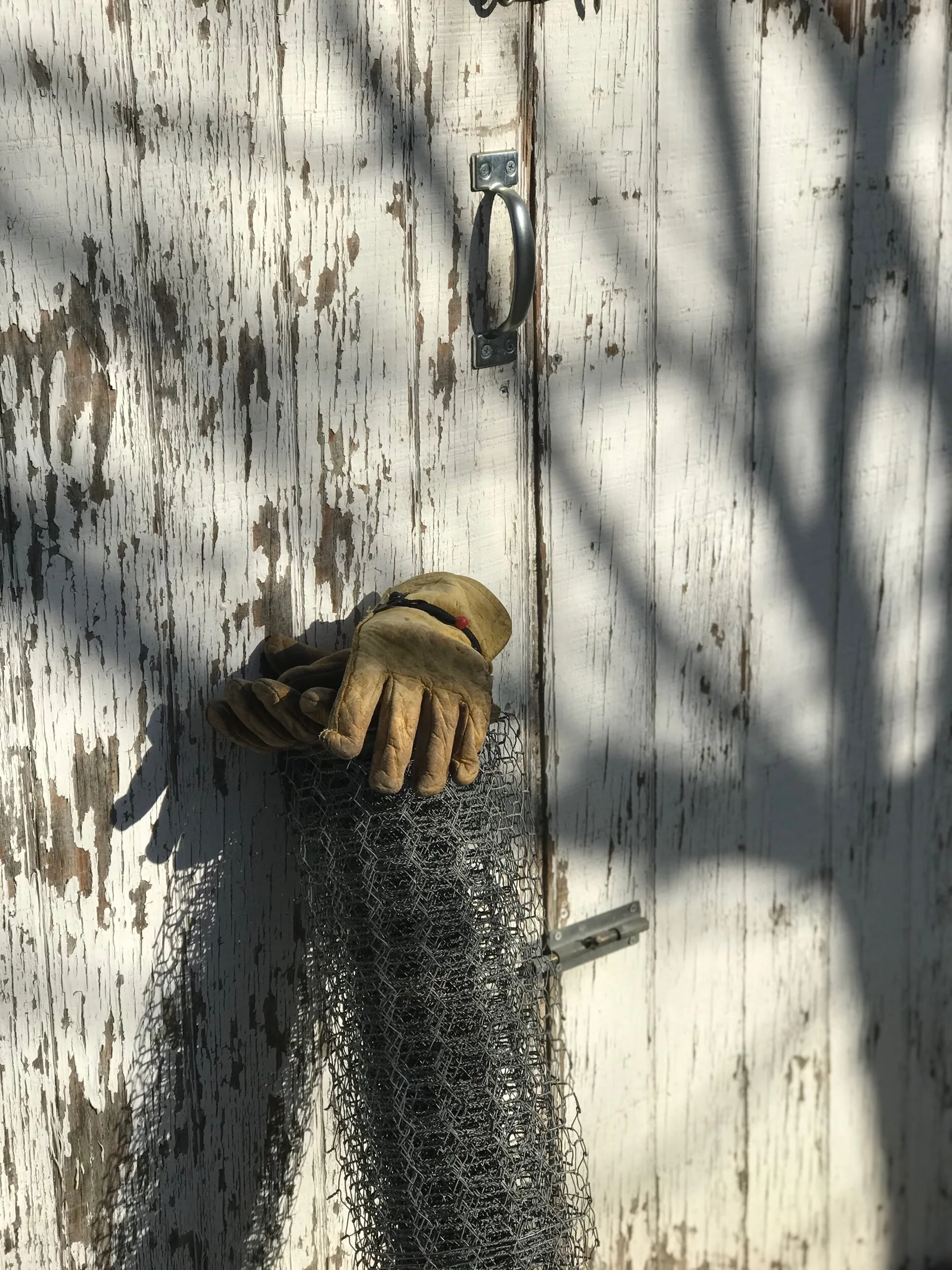
I’m not what anyone would call a carpenter. My go-to tools for most construction jobs include t-posts, zip ties and bungee cords (you’d be surprised what you can build with all that). Time and weather had created larger gaps between the flooring and the walls of this newer coop, so closing those up was Job One. That meant chicken wire and a staple gun. I was up for it but needed to consider the torque it would take to deliver the staple to its destination. I looked down at my arthritic hands. Patrick was asleep and recovering from a disagreement he’d had last weekend with his bandsaw and two of the fingers on his right hand, so I was on my own (a rare short stint in the ER and six stitches later, we were back home that rainy Saturday with pain meds on board and a full pot of tea steeping on the kitchen counter. But here’s some added fun: guess which finger needed to be splinted? We’ve already gotten some great humor mileage out of that). I breathed in that Zen approach again, and not surprisingly, the job went smoothly. More than a dozen staples missed the target on the chicken wire screen door I installed, but I wasn’t leaving that coop until it was fisher, weasel, mink and stoat-proof. Patrick stopped by offering encouragement and his keen but skeptical engineering eye as I was attaching the tin-snipped edge of the wire to some nails pounded into the bottom of the doorframe. The design concept was to ever so slightly pull the wire down to catch on the nails, making it fully enclosed but removable to refill the feeder and watering can (we’ll see…).,I lugged the two bales of pine shavings into the coop, sliced them open, and kicked the chunks of fluff around just enough to cover the random “restroom” areas of the floor; the girls would scatter the remaining piles of shavings once their curiosity and instinct for scratching kicked in. The dining area set up on some old milk crates and open for business, it was time to get the layers from their pasture pen up behind the house and settle them in.
It went more or less to plan. I climbed into the pen while Patrick held the blue plastic tarp down over the top to discourage any panicked flight risks (the chickens, not me). I crouched down, talked reassuringly to them about their new living quarters, and then reached for their feet and grabbed. Lots of squawking and flapping (the chickens, not me) and I climbed out gingerly, holding a chicken in each gloved hand and maneuvering my way out of the pen with my elbows and legs (grateful for my morning yoga practice). Only two of the seven girls escaped and I cleverly lured them back into the pasture pen at dusk, propping it up on a storage bin so they would crawl back in to roost. By that time, Patrick was back in his studio making peace with his bandsaw, so I plucked them from the pen myself. Same technique, but a little slower having to manage the tarp with my head since my hands were full of chickens. Sometimes I think we should have a YouTube channel.
We’d been talking about this project since early spring. It felt good to see it done and working its purpose, without injury or permanent setbacks. Of course, the real test would come in the morning when I opened the door to the now Fort Knox of chicken coops to find them all thriving and thankful as only egg layers can be. Coming back from my morning walk before dawn, the fields all soft and frosty against a backdrop of cotton candy pink and blue skies to the east, I expanded my final orbit to include this morning-after inspection, calling out a cheerful “good morning, girls!” as I approached their new digs. They’re all fine, I’m happy to report, and I’ll refill the waterer after lunch. They’ll stay inside for a couple weeks to get them used to roosting there. That’ll give me time to design and build their enclosed “patio” so they can peck about in the sunshine and snow with nary a care about predators as the winter months unfold.
Best go check on our inventory of t-posts and zip ties.