

If We Were Just Chatting On the Porch...
Runner beans, even in their youth, do look as if they want to wrap ‘round your neck and stay there.
I just took delivery on a set of popsicle molds, and they’re already in the freezer, filled with a mixed berry protein smoothie blend, doing their job. An extravagance, I know. No one really needs popsicles, much less the added step of freezing your liquid breakfast so you can eat it from a stick with one hand, the other one on the steering wheel as you commute to work. But I believe in being prepared for whatever may come, and summer is on its way.
It’s not nostalgia that brought this new—what, appliance? Gadget?—into our kitchen. Growing up, ours wasn’t That House in the neighborhood that drew children from blocks around us in a line to our front porch waiting for frozen handouts as soon as schools closed for the summer. We had the normal flow of friend traffic from June to September, and sometimes they stayed for lunch or we shared a bowl of pretzels, but the reason for our get-togethers was mostly to play, not eat. I do recall one play day with a young pal, involving our attempt to create an exotic treat based on something we watched in a National Geographic episode about a group of folks incorporating insects into their meals. We all need protein, right? Inspired and not at all squeamish, we poured Hershey’s syrup into a spoon, completely covering a dead bee we’d found next to a dandelion blossom in the un-sprayed back yard, and put it in the freezer to set before giving it to another friend’s mom to try. It wasn’t a prank, honest. She was a nice lady, we knew she loved chocolate, and we wanted her opinion on our attempt to expand our youthfully-limited culinary palates. Imagine our horror when the bee’s stinger connected with her lower lip on the last bite. We watched it swell up as she handed the spoon back to us and headed to her own kitchen for a baking soda poultice. She must have shared the story with our parents at some point that summer; I have a blurry memory of mom coming back from having coffee with her a few weeks after the incident, asking what in the world we were thinking, freezing a bee in chocolate. “You’re just damn lucky she wasn’t allergic—honestly, you kids!” Of course, my friend and I had immediately decided to stick with the food and flavors we knew as we watched our friend’s mom’s lip double in size before our eyes, and hung up our test kitchen aprons in pursuit of other experiments. I can only imagine the words my own mom tried to find as she unspooled the deepest of apologies to our neighbor across that shared pot of coffee (Note to self: take a few moments to reflect on other lessons in forgiveness from your formative years. It’s time well-spent).
This year’s summer plans are still on the drafting table, and they don’t include that level of experimentation. But who knows? Three months ago, I didn’t own a cloth face mask. We must be open to the movement of spirit-plus-necessity and adjust our agendas accordingly. If you work well on shifting sands, this could be your finest hour. I encourage you to seize it with both hands.
Last night before dinner, I harvested a large plastic bowl full of wild garlic mustard. It’s wonderfully plentiful along the banks of our creek, beneath the pines along the ridge, and at the feet of the young mulberry saplings gathered in a semi-circle just off the front porch. In other words, everywhere. The work of plucking each heart-shaped leaf from the stem is offset by the way it expands our salad supply and lowers that line item on our grocery bill. And, it’s just the two of us at home, so what’s a little garlic breath between two married people? The behind-the-mask ricochet effect isn’t pleasant, but it’s nothing to get fussed about either. See? My culinary palate has matured. Finally.
I am looking forward to our first garden harvest this season, considering all the work we’ve put into coddling the seedlings that sprawl their thin green stems across their respective (and repurposed) planting trays to visit with one another in the bright sunlight of the guest room’s south-facing window. Viewed as one, it resembles the day care version of Little Shop of Horrors, and even if we were hosting loved ones from afar, I doubt they’d want to sleep in the oak sleigh bed a mere three feet away. Runner beans, even in their youth, do look as if they want to wrap ‘round your neck and stay there. Thank goodness the tomato starts are too small to give away their eventual vining tendencies. They’ll be outside and beneath the soil line long before they look like the wandering souls that they are. I’ll try to tame them at first, like I do every year we’ve grown them, but I surrender to the sheer volume of suckers that sprout from seemingly every “elbow”, and let them continue through the season as their wild and gangly selves. Makes me wonder what kind of parent I’d have been.
Keeping all of these moving parts moving is a sizeable part of our days, and we made note of that after dinner the other night. What did we do before the pandemic closed in the walls of our otherwise to-and-fro existence? It’s strange…I miss a few things about that rhythm from back in late February/early March, but feel quite at peace tending to what’s important and right in front of us from one day to the next. Now it’s about keeping the compost turned and fluffy, rotating the seedlings toward the sun, and splitting my work days between office and home. There’s still plenty to do there, and I’m damn lucky to have a job. Not a day passes when I don’t offer that up to the skies before I dig into a still-hefty to-do list. Every day has something to do with the handmade masks our volunteer staff are making for members of our clinical teams. We discuss adjustments to the patterns we provided and who’s got a line on a source for elastic. Whether the straps should fit around the head or around the ears. There’s no “once and for all” anymore, not even in sewing. Then I think about the colleagues who will wear them, and my gaze is skyward again. Keep them safe, please.
So, dear readers (if you’ve traveled this far with me), we’ve gone from popsicles to chocolate covered bees to face masks, and there’s probably still more to be said. If the sun comes up tomorrow, if we’re granted another day to try and get it right, we can pick up where we left off. I’d be ok with that.
Raise Your Hands
I remember the first time I ever tried to flip someone off.
In the driver’s side door pocket of the blue Tundra is a large bottle of hand sanitizer. The pump works smoothly to deliver that recommended quarter-sized dollop of liquid that’ll do in a pinch when soap and running water are still miles away at home. A mere eight weeks ago, I knew the bottle was there but didn’t pay homage after each time I touched the steering wheel or the gear shift. I still don’t partake that frequently but I’ve also never been more conscientious of what I’ve touched in the course of a day than I am now. Perhaps we have that in common.
Lately, I’ve been assuming my place in a long line of ancestors who struggled with arthritis, noticing that each day, my left thumb doesn’t step up to the plate (or, in some instances, the pickle jar) like it used to, and the choice before me is either ask Patrick for help, or not have pickles. For a lot of reasons, I’m glad Patrick is in my life. Sometimes, it’s as simple as zesty dill sandwich stackers. But I’m losing my grip, literally, and in those moments, I cradle one hand in the other, and muse about where both of them have been.
This morning, they worked in concert to remake the bed, grasping the top hem of the sheet and quilt in one glorious swoop to billow down flat and refreshed over the mattress. Just yesterday, they were both gloved and grasping fallen sycamore branches out in the old chicken pasture, breaking them deftly across my left knee. Each and every morning, they feel the silken flat strand of dental floss tighten around both index fingers to create a taut bridge of gum-cleaning wonderfulness that I’m sure not many folks appreciate with as much zeal as I do. And we haven’t even talked about feeling the vibrations of the Sonic toothbrush in the palm of my right hand, giving its all to keep my quarterly professional cleanings as short as they can be.
Settled into our respective places on the couch after dinner, I reach my right hand across the small bit of space between Patrick and me, and squeeze his left hand in thanks for the way his fingers pinched just the right amounts of turmeric and salt to add to the potatoes, carrots, corn and broth that he turned into soup. His left hand returns the squeeze while his right thumb scrolls through the selection of new work gloves available on Amazon. I know he knows I’m there, no matter how it may appear.
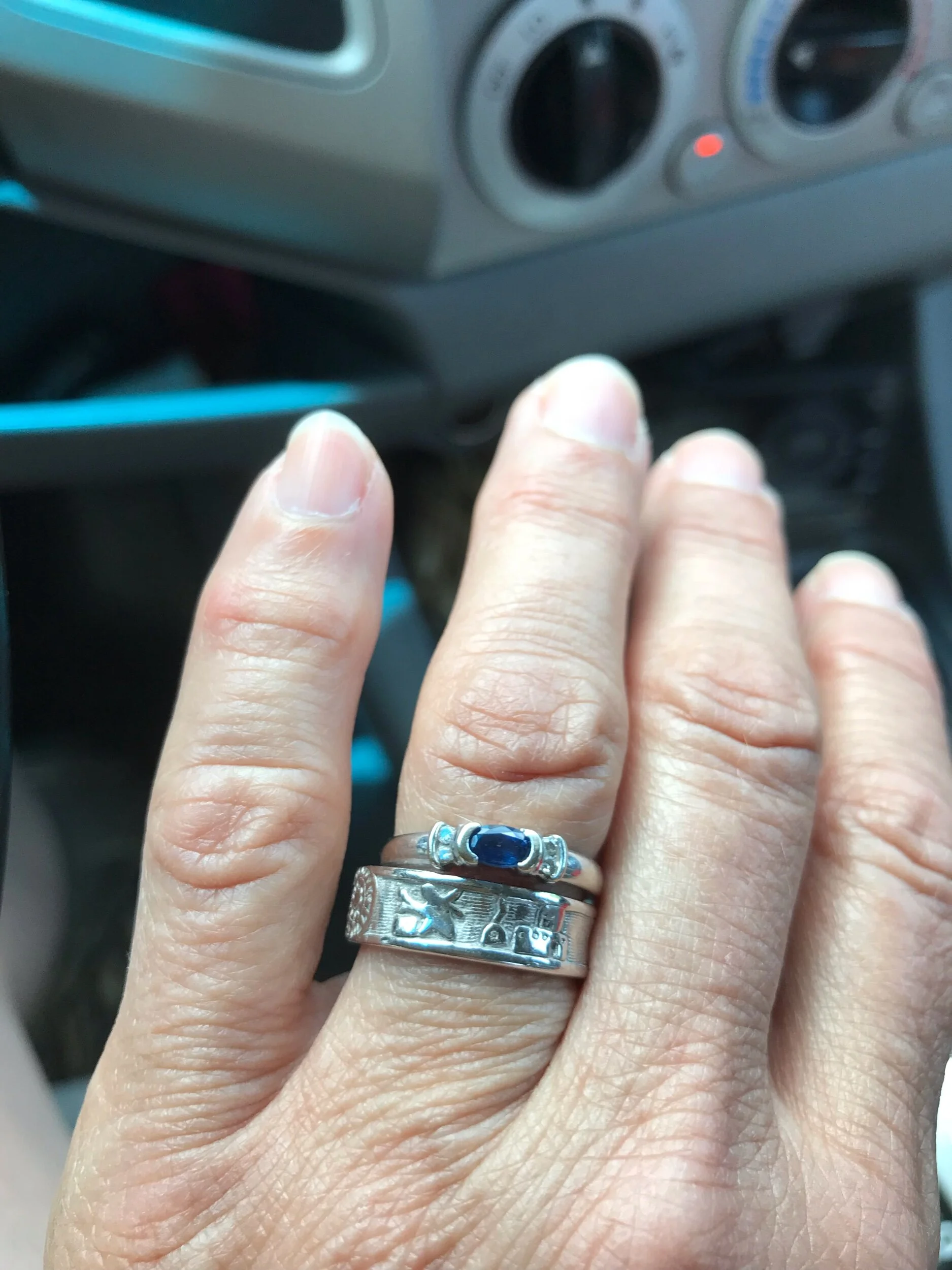
Both of our left hands “outgrew” the wedding bands my brother Mike made for us nearly thirty years ago. His skilled hands etched and carved white gold with native storyteller-type images of how Patrick and I met, fell in love and joined our separate lives into one. The grooved spiral center lines of a Navajo wedding basket design have been smoothed into one flat circle, the edges no longer distinct, but I remember what they looked like before our ceremony when Mike opened the jeweler’s box in which they traveled from LA. Quite by accident, he’d molded the bands so that they nested perfectly one inside the other.
In June 2018, I joyfully put mine back where it belonged after the hands of a skilled local jeweler sized it up just large enough to pass over the arthritis-stricken knuckle of my ring finger. Patrick’s still lives in the bottom of an undisclosed trinket box waiting it’s turn.
Our cats seem to think our hands exist solely to rub their furry jowls and scoop food into their dishes. From their perspective, they’re right, of course, and we dutifully obey. They’re less interested in how we snap the lids back on the Tupperware or reach our gloved fingers into the chicken hutch to pluck the solitary egg from our one layer’s belly-rounded nest of last year’s hay. Just fill the bowls, please, and we’ll leave you alone.
My dad used his hands a few times to show us less-than-polite sign language after we begged him to interpret a Saturday Night Live skit that spoofed “The Exorcist”. His time at Gallaudet and his good work at the state school for the deaf may have suffered a bit in the dignity category, but I know how to say “your mother eats kitty litter and wears combat boots” in ASL. Not on my resume, but in my hip pocket should the need arise.
And the stories go on…all the things my hands—our hands—can do. Get to do. Have to do. It’s a helpful pause in the current state of affairs to consider your own pair and take in the full impact of their employment. From simple functions like reaching up to brush those few strands of hair out of your eyes to the rhythmic pushing and pulling and folding of bread dough for at least 8 - 10 minutes, our palms with their attached digits perform remarkable and wondrous tasks. If you’ve ever changed your own oil or spark plugs, pushed an electric lawn mower with one hand and flipped the long orange cord over your head with the other hand to keep the cord away from the blades when you turned into the next row, or balanced the mail and your car keys and the full but handle-less bag of groceries on your way from the car (kicking the door shut with one foot. We can do a bit on feet later, I promise) to the front porch without dropping anything, you know what I mean.
When was the last time you made a fist? Cupped a child’s face? Removed a splinter? I remember the first time I ever tried to flip someone off. I was in eighth grade, walking to a friend’s house a few blocks from my house and a car rolled through the stop sign as I was crossing the street. Adrenaline rushing, I raised my hand, checked around to see if anyone else was looking, and flicked the necessary finger into the air. Along with its companion index finger, flipping the offending driver the peace sign. A mixed message, to be sure, if my facial expression was allowed to throw in its two cents. I dropped my hand immediately, smiled weakly at no one, and took my blushing face the final steps to my friend’s front porch. I’ve told no one about that incident until now. I regret to inform you that I am better at executing that gesture now, though it still feels wrong and incomplete, to “wave” at anyone using only select fingers. I thank my mother for teaching me discretion.
We’re keeping our hands clean nowadays, with near-obsessive regularity. I realize that for some of us, it’s a new practice, and will require more practice for some time to come. I can’t remember when I last shook anyone’s hand or touched a door handle without thinking “where’s the closest restroom with soap and water?”, but here we are. I only hope we don’t let the current urgency for safety and cleanliness overshadow the miracle of fifty-four bones and over sixty muscles working daily in concert to open our beer bottles, shampoo our hair, and type each sentence of the next great American novel.
Two of the best tools we’ve got, folks. Hands down.
Finding Things
Lifting the lid on that Rubbermaid tote sure did reveal a lot more than silk ties and manila folders.
I found out this past week that we own far too many dish towels.
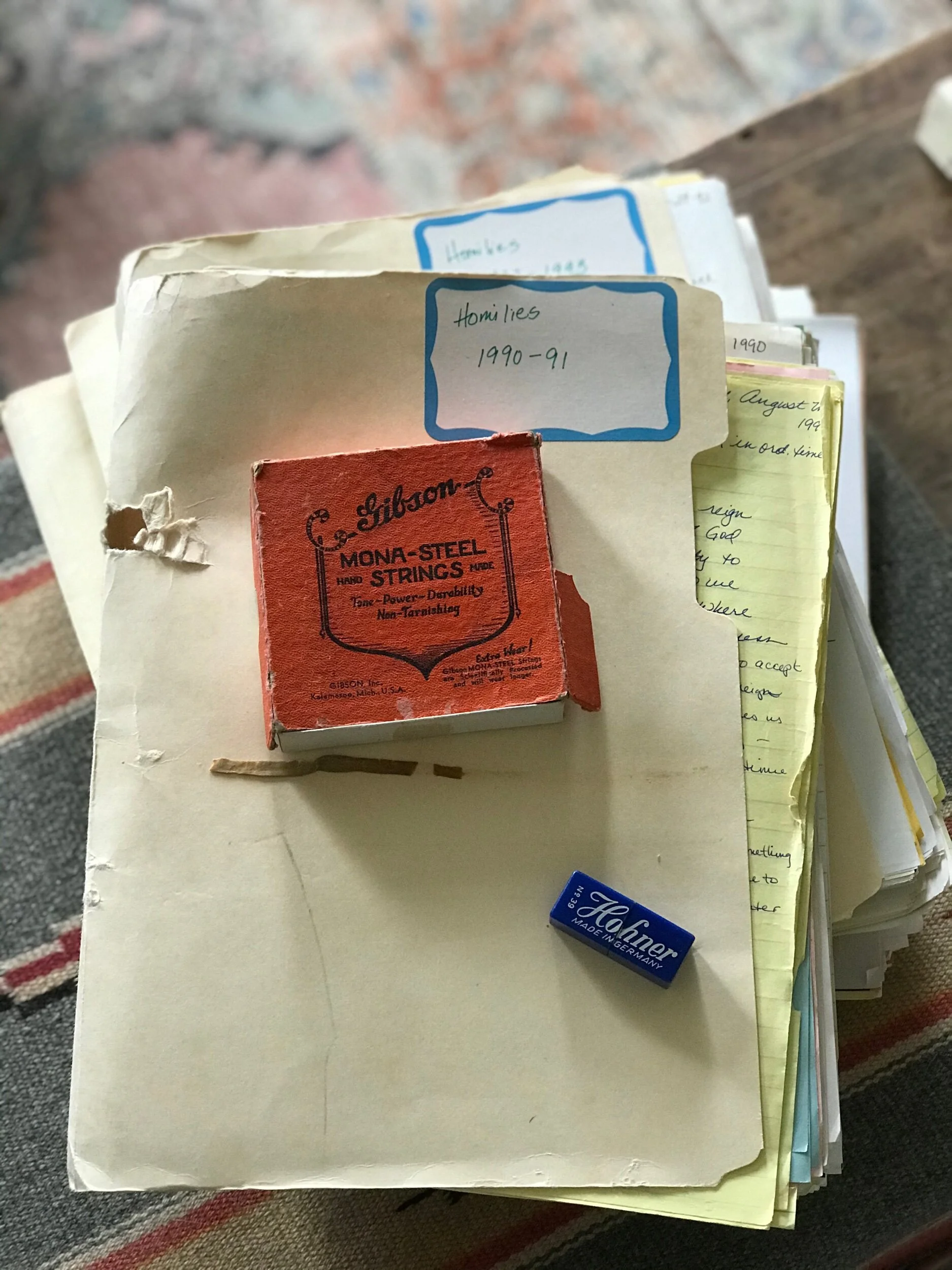
I also found the originals of all the homilies I gave when I was a member of the pastoral staff at The Newman Center back in the early 90’s. Five years’ worth of homilies, and an adult lifetime of dish towels. There’s no correlation, save for the span of time in which each of these discoveries was made. Some may find it interesting, though, that there are far more homilies than towels. The word “priorities” comes to mind…
Living through a modified quarantine (I still go into the hospice office a few days a week), with both of us spending more time at home than we used to, Patrick and I find ourselves smack in the middle of myriad discoveries, and they’re not confined to what lies within the walls of our home (though, on rainy days, the attic is the perfect place to start). Inside or out, we are always stumbling over, unearthing (literally) or finding something new here. The first few days of lockdown, we did what most folks probably did—turned our attention to the dusty stacks of collected detritus from our equally-dusty youth, determined to move it along to a Better Place (i.e. the burn pile down the hill from the house, or Goodwill, or incorporated into our living room décor). But after a few days, that’s work, folks, and so we paged through some treasured cookbooks and started baking breads and making bean soups. More fun, less time, and we could eat the results of our labors. The stuff in the attic had been sitting there undisturbed for ten years; it wouldn’t evaporate if we left it alone another six days.
It’s both humbling and embarrassing to see what two people can accumulate in nearly three shared decades, even after moving seven times before we settled here at the acreage. Most moves push us to jettison what we simply don’t need anymore (or don’t want to pack and unpack), but we’re slow learners in the “touch nothing twice” classroom. At least seven times, we’ve packed and unpacked tools that may come in handy, raw materials for too many future and noble repurposing projects, a few pairs of jeans we hope to downsize into someday, and a collection of kitchen utensils that any Iron Chef winner would be lucky to own. A thin but strong line of sentimentality runs through everything because we affixed our dreams to each item, and it’s hard to peel that romantic veneer away, even though we’ve moved far beyond the initial spark that pulled these things to us.
Pre-pandemic, we had the luxury of jobs that took us away from the prolonged daily visual of all that we’ve tucked in around us, begging for attention. It was easy on our way down the driveway to make note of the pile that used to be the old dairy barn and promise to sift through it the next dry and sunny weekend that presented itself. But after 8+ hours of meetings and driving school children to and from their lessons, the trip back up the driveway to the house was all about respite and unwinding; the old dairy barn pile became blurry around the edges. Now, there’s no avoiding its persistent gaze. So earlier today, we found ourselves standing where the old barn stood, dragging sections of the metal roofing into the clearing near the banks of the creek, promising to sort through the rusty twisted panels and tin-snip smaller pieces into birdhouses. The toe of my boot kicked a small and perfectly clean Tonka truck wheel across a patch of crumbly barn floor soil. I wonder if we’ll find the rest of it beneath the rotted and punky rough-cut beams that once towered over our heads.
Back inside, in the upstairs guestroom, the homilies rested in an 18-gallon blue Rubbermaid tote, along with some old silk ties, my dad’s red plaid flannel bathrobe, pretty much every music and pop culture magazine from the 80’s and 90’s bearing Sting’s photo on the cover, a mini Hohner harmonica on a chain, and all four yearbooks from my college days. Digging them out from beneath all of that, I saw that my leanings toward order and organization had been well-established and well-employed. The homilies were first hand-written, then typed, then paperclipped together with printed copies of the readings for that particular weekend. I do not recall the moment they were relegated to that tote, or what it was like to sort them by year and label the manila folders that held them. I only remember what it was like to stand behind the lectern in the cavernous worship space and speak the words I’d written in front of 1000+ faithful fellow Catholics (terrifying the first couple of years, then merely intimidating, but always humbling). I practiced for hours in the days leading up to my assigned preaching rotation until I had the words, pauses, transitions and flow memorized. Sometimes my parents would be there, trading their more familiar and traditional Sunday Mass for a progressive prayer and songfest that boasted a 30-member choir, trumpets, drums, and applause after the final benediction was offered. They sat close to the front, throwing me encouraging smiles, and hugged me tightly in the after-Mass reception line at the back door to the parking lot.
Lifting the lid on that Rubbermaid tote sure did reveal a lot more than silk ties and manila folders.
Living here, we’ve grown quite accustomed to one or two discoveries in the course of our usual 9 - 5 (roughly) work week. It happens organically on a morning or evening walk, or when we head down to the still-standing old goat barn to fetch the pruners. We’ll notice a new patch of wild raspberry vines just past where my brother’s ‘68 Chevy pick-up is parked, see clear signs of a new resident mole tunneling her way around the front tires. And we’re always on the lookout for the new buckeye saplings on the west side of the driveway. But in the past five weeks, the sheer volume of “new” that happens here, most likely every day right under our unaware noses, leaves us confounded and a bit sheepish—have we really been that distracted by whatever the heck else is taking place to our left and right, above us and below us? Yes. We have. And more startling is the realization that it can manage just fine without an ounce of help from either of us.
What we’re finding in these days of land and home-focused existence is more than our stuff in the attic. We’re rediscovering pieces of ourselves that we’ve carried with us all along but set aside, stories and memories and unexamined values that need a good airing out, dusting off, pruning and reshaping. In its overwhelming and frightening hands, this pandemic is giving us the unexpected gift of concentrated time, introspection and self-discovery the likes of which we’ve not explored, ever. Even with 41 acres of classroom surrounding us. It’s as liberating as it is uncomfortable, and we’re finding that we welcome the creative tension of it all. To move through this time in human and earth history without being profoundly touched and changed by it is not an option anymore. I’m not sure it ever was.
As we continue to pass through the immediate worst of this, and into whatever the next iteration of “normal” is, I look forward to finding you there. Bring your bins and totes with you. We’ve got some catching up to do.
Retirement Practice
Patrick has been home since early March, like so many others whose lives have been interrupted and rearranged by the pandemic, and has not let the spring grass grow beneath his feet.
It’s been a month now since Patrick and I went for a somewhat spontaneous stroll down the path to the sweat lodge before dinner and found the old garden beds, overgrown with multiflora roses and dead burdock stalks. All he wanted was to show me how he had worked to get the compost tumbler unstuck from the mud and working again, and I applauded his efforts enthusiastically, of course. But we lingered just long enough for my curiosity to pull me toward the tangled mess, and soon we were breaking the thick dried-out stalks across our knees and chatting happily about bringing the space back to purpose and life.
They were humble raised beds, clapped together with scrap wood in an instant, or nearly so, four or five years ago, and then wrapped haphazardly but functionally with a length of plastic orange snow fencing propped up with slim rebar posts threaded here and there through the mesh. Protected by this MacGyver-like set-up were six or so tomato cages that held the most delightfully-named varieties: Sunrise Bumblebee, Blue Berries, Berkley Tie-Dyed Green, and Atomic Grape (someday, I want to sit at the table in that room where botanical experts make these decisions, just so they can see me smile broadly at their cleverness). We had also tried a lovely purple variety of cauliflower, which the groundhogs loved, but not enough to finish an entire head of it. As I have still not figured out the actual reason for groundhogs, I shake my fist at the entrance to their underground hovels and curse the hedonistic randomness of their eating habits.
But over the years, we’d turned our attention to a larger meat chicken enterprise, and the garden quickly became a promise we kept making as we walked to and from the sweat lodge, back and forth to the portable chick pens to rotate their pasture grazing area. We’d cast wistful and guilty glances in the direction of the raised beds, now overtaken by the sturdiest weeds the land could offer, and head back to the house where a package of thawed chicken thighs waited patiently in the fridge, marinating. The ghosts of homegrown greens and cabbage and zucchini were long forgotten.
We earned our dinner though, that evening a couple weeks ago, pulling out the rebar stakes, disentangling the snow fence and saving the tomato cages for this year’s crop. It took less than an hour, and our dreams that night were filled with images of the French Breakfast and Watermelon radishes we would tug from the soil to slice and scatter atop the corn mache and baby kale of our future salads. Back in the house, cleaned up and fed, we sifted through the seed packets we’d purchased last year, and set them to sprout in flats and peat pots placed on top of an old wooden crate that sat below one of the bathroom windows.
Patrick has been home since early March, like so many others whose lives have been interrupted and rearranged by the pandemic, and has not let the spring grass grow beneath his feet. He’s been hand-clearing the ridge just to the west of our house, raking the fallen branches and piles of yard waste I’d dumped there last year, filling the two-wheeled garden cart and making multiple trips back and forth to an impromptu burn pile near the now-cleared garden area. The ashes would be added to the compost tumbler to help balance the acidity of the mix and encourage those delightful compost worms so necessary to the whole process. Each day I’d come home from work to a tour and a full account of his ridge-clearing progress, his red-cheeked and smiling face a testament to his determination to keep the garden project on track. He did not disappoint, and I love him even more for his industriousness. If you’ve ever hand-cleared any overgrown patch of land with the intent to grow food there, or pushed back a thicket of stubborn, sinewy grapevines and thorny blackberry stalks that catch at your shirtsleeves and stick to your gloves, you know what he’s accomplished. It’s hard hands-and-knees type work, crawling and stooping and trudging your way to that grand and satisfying view of bare earth where a jungle once existed.
Is it any wonder then, that when I took a break late yesterday afternoon from a day of sewing facemasks to stretch my legs and breathe some of that excellent fresh air that only this place can offer, I found him armed with a propane tank and a blow torch, burning the area around and beneath the hooped trellises I’d installed over twelve years ago using ten-foot cattle panels, t-posts and zip ties? Apparently, the pioneer romance of hand-clearing had evaporated for him and he’d moved onto the “quick results” plan. I joke often that Patrick needs constant surveillance, but he knows his way around the business of fires, having served a long stint on the local volunteer fire department, trained up and everything. I trust him and yet, it’s still a startling to see the flames bursting from the metal torch, roaring and chewing through five years’ worth of dried vegetation. Through the smoke and bits of floating ash, I saw the blackened edges of the raised beds we’d built at the bases of each trellis, intended to help the pole beans and cucumbers climb their way to harvest time. I think we can save the planks for this year. Just need to reposition them a bit and look past the burned spots.
We’re in “make-do” mode, all of us, I think, if Facebook posts are any proof of our human tendency toward creativity in times of adversity. I suspect we approached the initial days of lockdown as some sort of socially responsible spring break, finding projects and crafts and self-sufficiency strategies that would make our ancestors nod approvingly, and give us great stories to share over lunch with our colleagues when we all returned to our regularly-scheduled workplace routines. But that hasn’t happened yet, and I’ve seen strong and heartening evidence that our own romantic gardening efforts are now focused on sharing what we grow with our neighbors, doing porch drop-offs of greens and baseball bat-sized zucchini and Principe Borghese tomatoes, waving and smiling at each other through the windows as we walk away. As staying at home stretches into a third month and who knows how many more beyond that, we come to a deeper appreciation for what it takes to live. And survive. As community.
When Patrick’s late father, Larry, was settled and tucked into a life beyond the 9 - 5, he often remarked “retirement has nothing to do with doing nothing”. I suspect he may have initially imagined a post-workplace life through the lens of idle leisure and anticipated more than a few episodes of boredom. At times, with this lockdown “social” distancing strategy in place to flatten the curve sooner (could we please consider revising that to “physical” distancing? It’s more accurate, and a lot more soothing to my ears), it feels like Patrick and I are in some strange sort of forced retirement practice, figuring out how to be with each other for extended periods of time, tending to what needs our attention outside the comfortable old walls of our living room, and learning what we’re capable of physically as we take on the more neglected areas of the land that lets us be here. So far so good, my friends, I’m happy to say. Inside, the sprouts have officially become plants, and outside, the two-wheeled garden cart awaits its next load of blow-torched ironweed and blackberry stalks.
We’ve all gotta do what we can. Right?