
Life Going On
In any project like this—part engineering and part emergency response—even the most solid of relationships can be tested.
There’s nothing like a broken sump pump in the bowels of the muddy crawlspace beneath your house during a torrential downpour at 10:30 p.m. on a Saturday to take your mind off a global pandemic.
Between finishing a late dinner and selecting a season five episode of Downton Abbey (the one where Lady Rose gets married), the red and orange storm we were tracking on our weather apps came down the driveway and parked its rainy self over our acreage for as long as it took to unload at least two inches of turbulent gushing water onto everything beneath the skies. At first, the lightning was a brilliant flash-purple color and I persuaded Patrick to join me in turning off all the lights (yes honey, phones too…) to watch it backlight the just-in-bud sycamores on the western edge of the creek. Our living room windows framed it spectacularly and we ooohed and ahhhed like kids at a fireworks show. But when the rains came, and kept coming, we transformed our awe into responsible homeowner concern, keeping an ear to the hum of the sump pump below the floorboards.
Silence.
Just before the part in Lady Rose’s reception where she confronts her mother about trying to stop the wedding (sorry…should have written “spoiler alert!”), I suggested to Patrick that maybe we ought to check the basement. He pulled one of the rechargeable emergency lights from the outlet by the mudroom door, creaked open the old crawlspace door, and came back into the living room grim-faced. “Uh-oh, Spaghettios”, he said softly, exhibiting an unnatural calm given the circumstances (ten years ago, I’d have heard a string of expletives coming from below the house that would have continued as he emerged from the basement and made his way back through the mudroom, the kitchen and the living room on his way to the bathroom to get the Tylenol. I loved him then and love him still, grateful for the growth that’s brought him to where he is now). There were several inches of water making a slurry of mud and other floating bits of crawlspace debris, creeping dangerously higher toward the furnace that lives and functions atop a small concrete slab, an island of warm protection against our cold winter nights. It is important to add that this is a new furnace, installed by two stalwart and brave service technicians in February who insisted that they’d seen worse locations for such a machine than our humble dirt hole under the joists.
To the right of the unit was our back-up trash pump; Patrick quickly set it down in the swirling brown water and snaked the attached green garden hose up to where I stood at the top of the stairs (not really “stairs” but a couple of precarious concrete ledges that gave you some sort of footing before you dropped into the dank and slippery abyss) so I could drag it out the back door and shove the soon-to-be flowing end of the hose into the catch basin that drained down the hill. It worked like it was supposed to, buoying our spirits for the next step in the repair operation.
In any project like this—part engineering and part emergency response—even the most solid of relationships can be tested. We’ve had our share of nature-meets-house catastrophes over the years, and we’re not still together simply because it’s convenient. We’ve used those experiences to carve new depths into our respect for one another, and expand our reservoirs of forgiveness beyond what we thought they could offer. We’re both strong managers with excellent ideas. And if you’ve ever worked in such a dynamic, you know that there’s often more than one right way to get a job done. When the stakes and tensions are high, though, the luxury of time to discuss and arrive at consensus isn’t anywhere in your toolkit, and you learn quickly, sometimes painfully, to defer to the one holding the hammer (or, in last night’s case, the short-handled shovel used to dig out the sump pump that was stuck in the mud that had collected just above the gravel bed of the sump pit). I stood at the top of the basement concrete ledges, sending words of encouragement down to the shadowed outline of his hunched-over 5’ 9” frame (unless you’re a small child, you can’t stand upright in this space. So far, no child has accepted our invitation to give it a go), and tried not to ask bothersome questions. In my chicken boots, I trudged through the sludge outside the back door to fetch buckets and bricks, reposition the drainpipe poking out from the foundation, and toss dry microfiber towels down to him to wipe off his hands and the electrical cords that we hoped against all hope would deliver the juice needed to keep draining that water away from the base of the furnace. In a crisis, we all have something of value to contribute.
Turns out the pump unit needed a thorough flush in a bucket of clear water to get it working again. A quick reconnection of the drainpipe sections and a plug-in later, we pulled off our muddy wet clothes, hung them on the line outside for an au naturel rinse by Mother Nature herself, put on pajamas and sank into our places on the couch. Below the floorboards, the reliable hum told us we’d done the job right, and we exhaled as one.
For about three hours, we didn’t trade words or worries about the swift and frightening spread of the novel coronavirus, projected estimates of new infections in Ohio or elsewhere across the country, or comment on the heartbreaking stories from that hospital in Brooklyn featured in a New York Times article we’d both read the day before. Instead, we marveled at how quickly we’d moved from a couch-view purple light show to a furnace rescue operation, and didn’t hurl a single frustrated or sharp word in the other’s direction. Not a miracle, but certainly an outcome worth noticing.
Dear ones, our lives are still going on underneath and around and in between the news reports of this horrible viral outbreak. They must if we are to land on the other side of its insidious and relentless pace with a solid grasp of what really matters and how we infuse that into our next iteration of “normal”. I do hope you are taking breaks from whatever your news sources are to hear that wind howling through those just-in-bud branches of the Bradford pear tree by your front deck. Or to notice that the grass has suddenly become new and green again—wasn’t it brown just the other day? Look at your hands resting in your lap and consider all that they have seen and done to be helpful to someone else—family member, stranger or friend. And now they’re going to tear lettuce leaves into smaller pieces and shred carrots and create a meal that will keep you alive for another day. It’s just as important as holding frontline healthcare staff in your hearts, fiercely praying for their safety. I recommend doing both.
Here at Naked Acres, the dirt floor of our crawlspace is a little bit dryer and less slimy. That’s enough for now.
Oh, and the finches have returned. Time to fill the thistle socks hanging from the young mulberry trees off the front deck.

How Are You?
Listening to the robins organizing their days, and the sparrows arguing, it’s easy to imagine a different world than the one we’re currently experiencing.
There’s an old black walnut tree in the wooded part of the meadow that I can’t wrap my arms around.
There’s an international health crisis happening right now that I can’t wrap my head around.
So this morning, after an uncharacteristic sleep-in that saw the sunrise at least two hands above the eastern horizon, I went to visit that tree and offer it our troubles. Surely this seasoned and sturdy relative would have some wisdom, some calming perspective to help right-size an over-anxious heart like mine. On the south side of its massive grooved-bark trunk is an indentation that my back fits into perfectly. I nestled in and, still standing, faced the bend in the creek, wondering what would be different for us all when the sunset was two hands above the tree line to the west.
Listening to the robins organizing their days, and the sparrows arguing, it’s easy to imagine a different world than the one we’re currently experiencing. Out here, everything is fine and moving as it should. I let that feeling settle in, knowing it’s only partly true, and bow my head.
Just two days earlier, the skies let loose with torrential rains, and gave us our first flood of a spring not even twenty-four hours old. The raging waters cut through and collapsed a section of a five-lane road near the office, stranding residents and commuters alike, and several elderly folks were rescued by boat and moved to safety. Pandemic and flood in one day; no one wants to even whisper what’s next? The answer would be more than we could bear.
After brunch (a steaming bowl of comfort—creamy oat bran with walnuts, butter and maple syrup), I hung a load of laundry outside on the line, glad for a brisk wind that would snap the wrinkles from my damp work clothes and leave the fabric cool to the touch. With “normal” up for grabs right now, I’m at least trying for familiar.
But…how are you doing? I mean that. My own social circle isn’t so vast and active that I see everyone I know every day. But knowing that I can’t makes it even more compelling to check in, reach out, offer reassuring words of comfort with some irreverent humor tossed in where it’s appropriate and appreciated.
How are you coping? Isn’t this all just the weirdest thing ever? And tragic, and surreal, and unsettling? Jump in here with your own descriptors. It’s also filled with unexpected gifts that could change forever the way we function in the workplace and the effort we give to our relationships. I don’t know what we’ll be, collectively, when we’ve muscled through to the other side of this, but I know for sure we won’t be the same. In some ways, that will be really good. And in others, there will be losses to grieve. Whatever the task, I hope we can face it together with the best of ourselves intact and ready to work.
I think I can wrap my heart around that.

What's Wrong With This Picture?
Nimble and responsive we must be, and that leaves precious little time for noticing, much less reflecting on how we’re coping with it all.
On the morning of Monday, September 10, 2001, at our 8:30a.m. weekly huddle, I sat across from a co-worker at the American Red Cross, and from a small but solid certainty in my gut, said “something big is coming. I don’t know what, but something big.” She nodded slowly, a trace of curious concern shadowing her eyes. I didn’t elaborate. Couldn’t, really, because I’d shared all the information I had at the moment.
Twenty-five hours later, our phones in the Volunteer Services department started ringing and didn’t stop for at least three days, jammed with the hearts and worries and panic of 2000+ souls offering help, needing a break from the barrage of media images and replays of towers falling, people running, fatal dust everywhere. We’d clear seventy messages from our voicemail, and another eighty-nine would take their place. I remember one message from a woman, her voice shaky with tears, asking what she could do to help and could someone please please call her back right away? Four hours later, a second message, this time her voice more tense and strained, asking if we’d received her message and could we please call her back? Our phone system crashed just after retrieving that second batch of messages, and I wondered how she dealt with that as she dialed and dialed, over and over again, not connecting to our outgoing message that had only been changed once, asking callers to maintain their resolve as this national crisis continued to unfold.
Phones back up and working again on 9/12/2001, we plucked her third and final message from the voicemail bank, an unmistakable suggestion that still echoes in my memory: “Well, I can see you need someone to answer the phone!” I moved her to the top of the call-back list, and an hour later, she sat in the chair in my office, her tearful apologies filling the space between that chair and my desk. When we needed copies made, or a room prepped for a meeting, she was on her feet in an instant. I can’t remember her name now, but her spirit is with me still.
On Wednesday, March 11, 2020, those memories and more rushed to the surface and came to rest in my heartbeat as I filled the familiar Volunteer Services seat at the emergency response table again, this time with hospice colleagues to my left and right, most of them nurses, all of them with more than a trace of concern on their faces as we stared into the face of COVID-19’s unfolding impact on every aspect of our work. Our collective purpose and operations were about to change, and in ways that, perhaps mercifully, we couldn’t fully comprehend. We did what excellent health care providers do—immediately immersed ourselves into triage thinking, gathering the data we had and moving it forward to inform our planning for the worst, the best, and the ever-changing.
Somewhere amid the CDC reports, nursing home lockdowns and modified distribution of PPE (personal protective equipment: masks, gowns, gloves, face shields), it seemed necessary to remind us all that we must tend to our own feelings and fears, set aside for the common good, yes, but present still below the adrenaline-saturated daily briefings and increasing phone calls from families, field staff and our sturdy band of volunteer team members. In those rare moments of pause between activities, those fears wanted our attention. I offered amnesty for unfiltered expressions of doubt, anxiety, gallows humor and tears, without judgment. Only love. I’ve tried to keep up my end of the bargain by listening and offering what I can in the moment that presents itself. Thing is, the moments and the needs keep changing. This is the fastest moving target I’ve ever known. Whatever I write and post today will be miles away from the decision we need to make in 72 hours. Nimble and responsive we must be, and that leaves precious little time for noticing, much less reflecting on how we’re coping with it all.
Just a week ago today (Sunday, March 15), I could walk into any local grocery or drug store and view a shelf filled with hand sanitizer and canned green beans. A day later, a listing on eBay showed 40 watchers on an 8oz bottle of Purell priced at $76. I know we’re made of better stuff than this, and my eyes hungrily rake the headlines for proof. It soothes my soul to watch videos of Italians singing to each from their balconies, guitars and tambourines fully employed in soothing, heart-healing joy.
Another 9/11 memory rises to the surface: on my way home that night from the office, around 11:30, I spoke with a friend who had just witnessed several fistfights at the gas station where he was trying to fill his tank for his long commute home an hour away. He had thought more highly of his tribe until that moment, and sounded broken for his fellow human beings. I invited him to come to my office in the days ahead and listen to the compassion coming through the phone lines, the relentless offers of help, creative ideas for managing a line of blood donor hopefuls that stretched around the block. He couldn't come, of course, but hung up knowing that for every altercation over a gallon of gas, there were at least two, maybe ten more stories of people not having to dig down that deep to find and offer the love we all needed during those fear-darkened days.
I don’t know (again, mercifully) what June will be like. Or Tuesday this week. That $76 bottle of Purell has disappeared from the seller’s page, dozens of others taking its place. I’ll be at work tomorrow, attending our daily briefing with a pen in one hand and my heart in the other. If I anticipate too far into the future, with despair behind the wheel, I’ll arrive at a dark and bleak destination. I don’t want that. So I won’t choose it.
Instead, I’ll choose videos of Italians. And Spaniards. And Israelis. And Americans. Singing to one another the songs that will push us through to whatever is on the other side of this Test to end all Tests of humankind’s ability to be just that: kind.
And kindness doesn’t cost no $76 for 8oz, I can tell you that.
Paying Attention
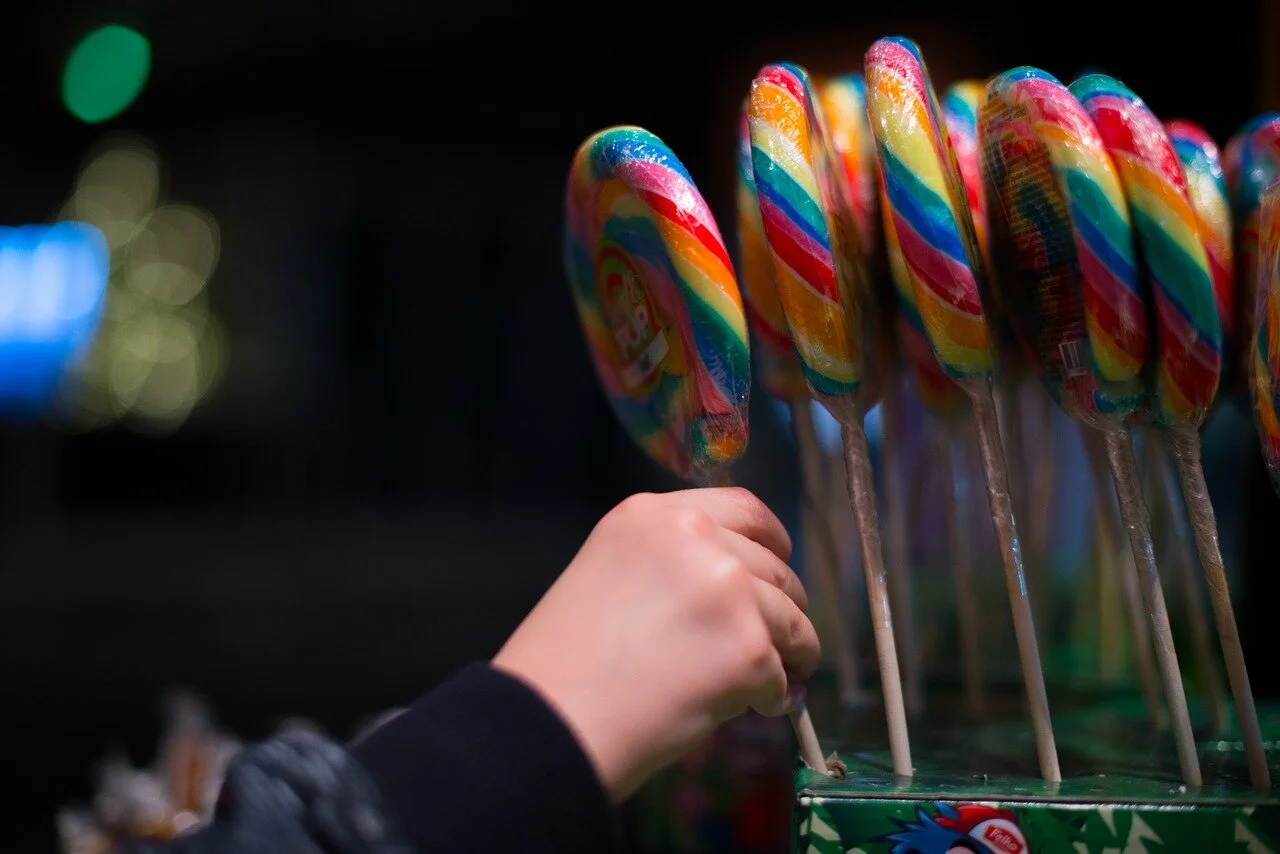
The girl with the colorful sticky sugary treat was now licking it and pressing it to the hem of every dress on the clearance rack, having to peel the fabric off the sucker ever so often so she could put it back in her mouth.
She looked to be about two, maybe rounding the corner to three, but not older. For the sake of telling this story more easily, we’ll assume the adults in her company were her parents and grandparents, judging by who was smiling and who was looking harried carrying the diaper bag. We’ll also assume the infant in the stroller was her little brother.
It’s Saturday and we’re at the weekly indoor winter farmer’s market selling our granola in an upscale shopping mall, where vendors set up their stalls on both sides of the center walkway facing the shops. Most weeks, this creates a sort of ‘safe’ space behind us, where we can leave our hand trucks and extra product stored in bins, and market patrons understand not to wander back there or cut through to get to the other side of the mall. Today, a few of the vendors were missing, creating gaps in the stalls like a first-grader missing her front teeth.
We noticed this young family, as our eyes are usually drawn to marveling at grown-ups navigating a public space with small rambunctious children, and watched them walk just past our booth when they turned sharply into the vendor-less gap to claim a set of backless benches behind us. I felt their relief and could almost see their collective exhale. The toddler was in her element now, freed from the responsible arms that once held her fast, running back and forth from the benches where the menfolk sat and into the fine furs boutique directly across from our stall. She was gleefully licking a rainbow-bright all-day lollipop skewered onto a long wooden stick, waving it about like a wand she didn’t quite know how to use yet, as her mother and grandmother browsed the clearance rack of dresses and coats.
Of course I tended to our customers, but from the best part of my peripheral view, I could see the scene unfolding behind their backs in between sales and chatter. The grandmother had selected a long and flowing blue dress from the rack and was mouthing through the store’s entrance to her husband on the bench that she was going to “try this on, honey, I’ll be right back”. The mother was absorbed with another garment rack of last season’s furs. The girl with the colorful sticky sugary treat was now licking it and pressing it to the hem of every dress on the clearance rack, having to peel the fabric off the sucker ever so often so she could put it back in her mouth. I suspect she and I were the only ones who knew what was going on at that moment (her less than I). Just then, someone had a question about whether our granola was gluten-free, and after several back-and-forth minutes of what is necessarily more than a yes or no answer, I glanced up and noticed that the fur boutique was now empty of customers, as were the benches in the vendor “inner sanctum” area. I looked for but did not see a rainbow-colored sucker stuck to or dangling from any of the dresses on the clearance rack. The sales staff were busy rearranging one of the displays farther back in the shop and my imagination took off in an uncomfortable direction toward the fine gifts shop two stores down.
About thirty minutes later, I watched as a woman reached into a neighboring vendor’s sample bowl of pecans, put them in her mouth, licked her fingers and went back for more. She did this twice more before moving along to the next stall. I couldn’t see from where I was standing, but hoped those were the last pecans in the dish, and the vendors would soon put the bowl away and not refill it. More customers, and so don’t know the ending to that one-act play either.
Remember those assignments in grade school, where you were asked to look at a photo and write the back story that led to that particular snapshot? I reveled in those tasks, feeling like the director of a movie and for as long as it took me to conjure up the details, the One in Control of every character’s fate and destiny. People-watching takes on the import of an Olympic sport sometimes, and a crowded mall on a market Saturday offers up story fodder to keep me at my writing desk until the cobwebs connect my elbow to head, which is how they’ll find me after I’ve passed. I hope. I've always been an observer of life; in the past couple of decades, I've softened the sharp edges of my conclusions about the people I notice, knowing without any doubt that they need my compassion more than my judgment. I’d certainly want the same energy coming at me from across a crowded space. Yes, even the woman who licked pecan dust from her fingertips and went on to touch who knows what door handles, heads of hydroponically-grown lettuce and, please God, the soap dispenser in the ladies’ room. I pray for the strength of her—and everyone’s—immune system, especially now.
As members of various human communities, we’re always walking in on the middle of someone else’s unfolding story, not knowing the near-miss she just experienced or the broken plumbing he’ll find at home after a tiring day at the cash register. Squeezed in between those two possibilities and dozens of others, our encounters with strangers are filled with potential to wreak more havoc or apply the soothing balm of kindness. And, managing our own crises amid moments of smooth sailing, we can often miss the unspoken clues of a neighbor’s distress, a co-worker’s angst, and, still being good people, don’t offer to ease a burden we’d have gladly lifted had we been paying attention. It’s hard, I know.
Replaying those two simple moments of humanity from the market in my mind, I see now that I missed the opportunity to at least let a store owner know that a few of those clearance dresses were probably not going home with anyone, or to pull a decent fellow vendor aside and suggest the use of a spoon in the sample dish next week. It isn’t that I spent unoccupied time wrestling with my conscience. I was tending to my own sphere of influence and the scene changed, as scenes often do, and I wasn’t close enough, in time or distance, to intervene. I simply didn’t follow up. And I could have. Being attentive is an ongoing opportunity as our lives continue to unfold onto and across one another’s.
A breaking news alert: 470 total cases of coronavirus now in the United States, and Italy’s prime minister has just put the north part of his country on lockdown. If you’re looking for opportunities to notice what’s going on around you, and within you, now is the time.
Just remember kindness. This movie ain’t over, not by a mile.