
Finding Things
Lifting the lid on that Rubbermaid tote sure did reveal a lot more than silk ties and manila folders.
I found out this past week that we own far too many dish towels.
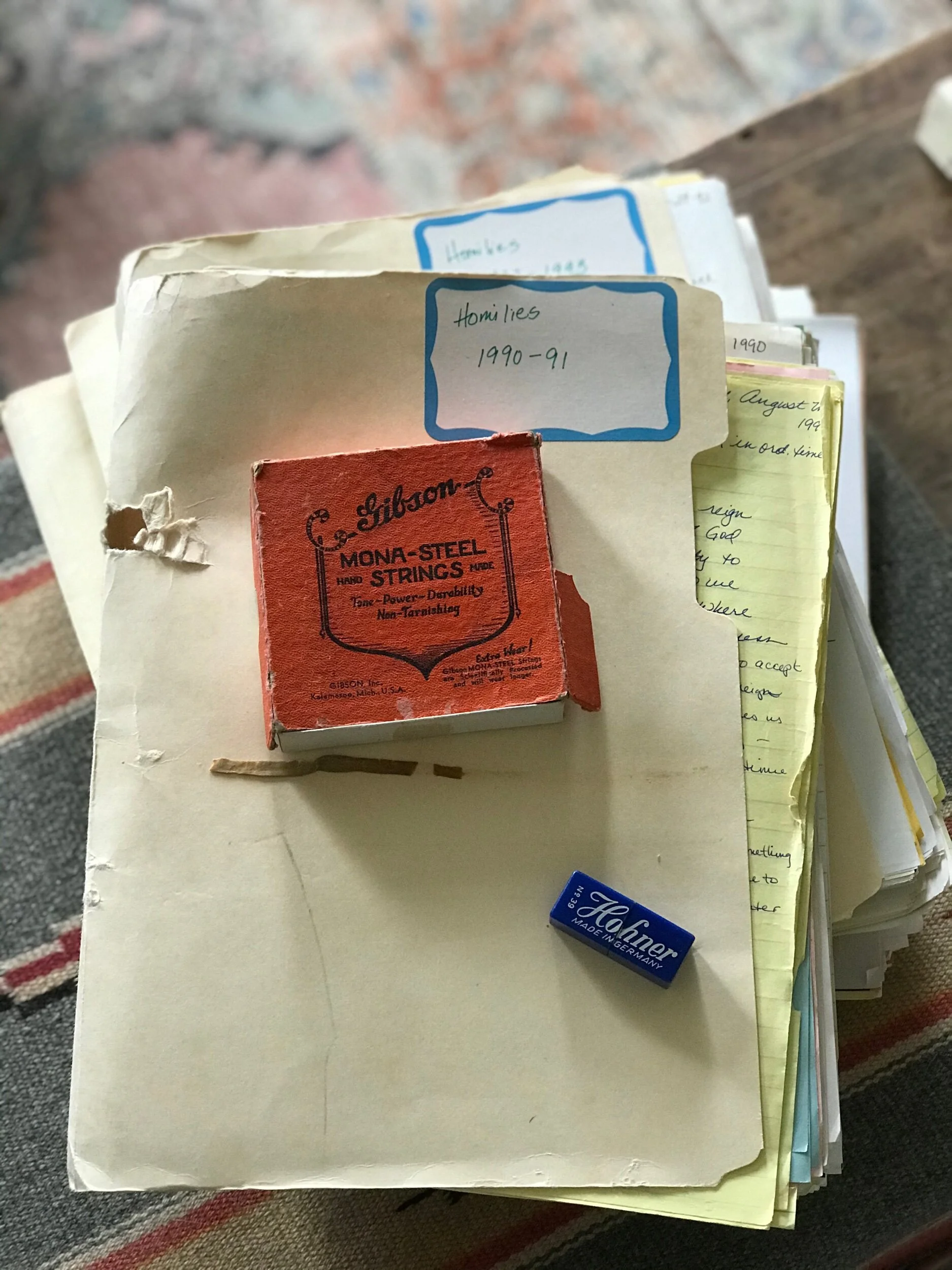
I also found the originals of all the homilies I gave when I was a member of the pastoral staff at The Newman Center back in the early 90’s. Five years’ worth of homilies, and an adult lifetime of dish towels. There’s no correlation, save for the span of time in which each of these discoveries was made. Some may find it interesting, though, that there are far more homilies than towels. The word “priorities” comes to mind…
Living through a modified quarantine (I still go into the hospice office a few days a week), with both of us spending more time at home than we used to, Patrick and I find ourselves smack in the middle of myriad discoveries, and they’re not confined to what lies within the walls of our home (though, on rainy days, the attic is the perfect place to start). Inside or out, we are always stumbling over, unearthing (literally) or finding something new here. The first few days of lockdown, we did what most folks probably did—turned our attention to the dusty stacks of collected detritus from our equally-dusty youth, determined to move it along to a Better Place (i.e. the burn pile down the hill from the house, or Goodwill, or incorporated into our living room décor). But after a few days, that’s work, folks, and so we paged through some treasured cookbooks and started baking breads and making bean soups. More fun, less time, and we could eat the results of our labors. The stuff in the attic had been sitting there undisturbed for ten years; it wouldn’t evaporate if we left it alone another six days.
It’s both humbling and embarrassing to see what two people can accumulate in nearly three shared decades, even after moving seven times before we settled here at the acreage. Most moves push us to jettison what we simply don’t need anymore (or don’t want to pack and unpack), but we’re slow learners in the “touch nothing twice” classroom. At least seven times, we’ve packed and unpacked tools that may come in handy, raw materials for too many future and noble repurposing projects, a few pairs of jeans we hope to downsize into someday, and a collection of kitchen utensils that any Iron Chef winner would be lucky to own. A thin but strong line of sentimentality runs through everything because we affixed our dreams to each item, and it’s hard to peel that romantic veneer away, even though we’ve moved far beyond the initial spark that pulled these things to us.
Pre-pandemic, we had the luxury of jobs that took us away from the prolonged daily visual of all that we’ve tucked in around us, begging for attention. It was easy on our way down the driveway to make note of the pile that used to be the old dairy barn and promise to sift through it the next dry and sunny weekend that presented itself. But after 8+ hours of meetings and driving school children to and from their lessons, the trip back up the driveway to the house was all about respite and unwinding; the old dairy barn pile became blurry around the edges. Now, there’s no avoiding its persistent gaze. So earlier today, we found ourselves standing where the old barn stood, dragging sections of the metal roofing into the clearing near the banks of the creek, promising to sort through the rusty twisted panels and tin-snip smaller pieces into birdhouses. The toe of my boot kicked a small and perfectly clean Tonka truck wheel across a patch of crumbly barn floor soil. I wonder if we’ll find the rest of it beneath the rotted and punky rough-cut beams that once towered over our heads.
Back inside, in the upstairs guestroom, the homilies rested in an 18-gallon blue Rubbermaid tote, along with some old silk ties, my dad’s red plaid flannel bathrobe, pretty much every music and pop culture magazine from the 80’s and 90’s bearing Sting’s photo on the cover, a mini Hohner harmonica on a chain, and all four yearbooks from my college days. Digging them out from beneath all of that, I saw that my leanings toward order and organization had been well-established and well-employed. The homilies were first hand-written, then typed, then paperclipped together with printed copies of the readings for that particular weekend. I do not recall the moment they were relegated to that tote, or what it was like to sort them by year and label the manila folders that held them. I only remember what it was like to stand behind the lectern in the cavernous worship space and speak the words I’d written in front of 1000+ faithful fellow Catholics (terrifying the first couple of years, then merely intimidating, but always humbling). I practiced for hours in the days leading up to my assigned preaching rotation until I had the words, pauses, transitions and flow memorized. Sometimes my parents would be there, trading their more familiar and traditional Sunday Mass for a progressive prayer and songfest that boasted a 30-member choir, trumpets, drums, and applause after the final benediction was offered. They sat close to the front, throwing me encouraging smiles, and hugged me tightly in the after-Mass reception line at the back door to the parking lot.
Lifting the lid on that Rubbermaid tote sure did reveal a lot more than silk ties and manila folders.
Living here, we’ve grown quite accustomed to one or two discoveries in the course of our usual 9 - 5 (roughly) work week. It happens organically on a morning or evening walk, or when we head down to the still-standing old goat barn to fetch the pruners. We’ll notice a new patch of wild raspberry vines just past where my brother’s ‘68 Chevy pick-up is parked, see clear signs of a new resident mole tunneling her way around the front tires. And we’re always on the lookout for the new buckeye saplings on the west side of the driveway. But in the past five weeks, the sheer volume of “new” that happens here, most likely every day right under our unaware noses, leaves us confounded and a bit sheepish—have we really been that distracted by whatever the heck else is taking place to our left and right, above us and below us? Yes. We have. And more startling is the realization that it can manage just fine without an ounce of help from either of us.
What we’re finding in these days of land and home-focused existence is more than our stuff in the attic. We’re rediscovering pieces of ourselves that we’ve carried with us all along but set aside, stories and memories and unexamined values that need a good airing out, dusting off, pruning and reshaping. In its overwhelming and frightening hands, this pandemic is giving us the unexpected gift of concentrated time, introspection and self-discovery the likes of which we’ve not explored, ever. Even with 41 acres of classroom surrounding us. It’s as liberating as it is uncomfortable, and we’re finding that we welcome the creative tension of it all. To move through this time in human and earth history without being profoundly touched and changed by it is not an option anymore. I’m not sure it ever was.
As we continue to pass through the immediate worst of this, and into whatever the next iteration of “normal” is, I look forward to finding you there. Bring your bins and totes with you. We’ve got some catching up to do.
Retirement Practice
Patrick has been home since early March, like so many others whose lives have been interrupted and rearranged by the pandemic, and has not let the spring grass grow beneath his feet.
It’s been a month now since Patrick and I went for a somewhat spontaneous stroll down the path to the sweat lodge before dinner and found the old garden beds, overgrown with multiflora roses and dead burdock stalks. All he wanted was to show me how he had worked to get the compost tumbler unstuck from the mud and working again, and I applauded his efforts enthusiastically, of course. But we lingered just long enough for my curiosity to pull me toward the tangled mess, and soon we were breaking the thick dried-out stalks across our knees and chatting happily about bringing the space back to purpose and life.
They were humble raised beds, clapped together with scrap wood in an instant, or nearly so, four or five years ago, and then wrapped haphazardly but functionally with a length of plastic orange snow fencing propped up with slim rebar posts threaded here and there through the mesh. Protected by this MacGyver-like set-up were six or so tomato cages that held the most delightfully-named varieties: Sunrise Bumblebee, Blue Berries, Berkley Tie-Dyed Green, and Atomic Grape (someday, I want to sit at the table in that room where botanical experts make these decisions, just so they can see me smile broadly at their cleverness). We had also tried a lovely purple variety of cauliflower, which the groundhogs loved, but not enough to finish an entire head of it. As I have still not figured out the actual reason for groundhogs, I shake my fist at the entrance to their underground hovels and curse the hedonistic randomness of their eating habits.
But over the years, we’d turned our attention to a larger meat chicken enterprise, and the garden quickly became a promise we kept making as we walked to and from the sweat lodge, back and forth to the portable chick pens to rotate their pasture grazing area. We’d cast wistful and guilty glances in the direction of the raised beds, now overtaken by the sturdiest weeds the land could offer, and head back to the house where a package of thawed chicken thighs waited patiently in the fridge, marinating. The ghosts of homegrown greens and cabbage and zucchini were long forgotten.
We earned our dinner though, that evening a couple weeks ago, pulling out the rebar stakes, disentangling the snow fence and saving the tomato cages for this year’s crop. It took less than an hour, and our dreams that night were filled with images of the French Breakfast and Watermelon radishes we would tug from the soil to slice and scatter atop the corn mache and baby kale of our future salads. Back in the house, cleaned up and fed, we sifted through the seed packets we’d purchased last year, and set them to sprout in flats and peat pots placed on top of an old wooden crate that sat below one of the bathroom windows.
Patrick has been home since early March, like so many others whose lives have been interrupted and rearranged by the pandemic, and has not let the spring grass grow beneath his feet. He’s been hand-clearing the ridge just to the west of our house, raking the fallen branches and piles of yard waste I’d dumped there last year, filling the two-wheeled garden cart and making multiple trips back and forth to an impromptu burn pile near the now-cleared garden area. The ashes would be added to the compost tumbler to help balance the acidity of the mix and encourage those delightful compost worms so necessary to the whole process. Each day I’d come home from work to a tour and a full account of his ridge-clearing progress, his red-cheeked and smiling face a testament to his determination to keep the garden project on track. He did not disappoint, and I love him even more for his industriousness. If you’ve ever hand-cleared any overgrown patch of land with the intent to grow food there, or pushed back a thicket of stubborn, sinewy grapevines and thorny blackberry stalks that catch at your shirtsleeves and stick to your gloves, you know what he’s accomplished. It’s hard hands-and-knees type work, crawling and stooping and trudging your way to that grand and satisfying view of bare earth where a jungle once existed.
Is it any wonder then, that when I took a break late yesterday afternoon from a day of sewing facemasks to stretch my legs and breathe some of that excellent fresh air that only this place can offer, I found him armed with a propane tank and a blow torch, burning the area around and beneath the hooped trellises I’d installed over twelve years ago using ten-foot cattle panels, t-posts and zip ties? Apparently, the pioneer romance of hand-clearing had evaporated for him and he’d moved onto the “quick results” plan. I joke often that Patrick needs constant surveillance, but he knows his way around the business of fires, having served a long stint on the local volunteer fire department, trained up and everything. I trust him and yet, it’s still a startling to see the flames bursting from the metal torch, roaring and chewing through five years’ worth of dried vegetation. Through the smoke and bits of floating ash, I saw the blackened edges of the raised beds we’d built at the bases of each trellis, intended to help the pole beans and cucumbers climb their way to harvest time. I think we can save the planks for this year. Just need to reposition them a bit and look past the burned spots.
We’re in “make-do” mode, all of us, I think, if Facebook posts are any proof of our human tendency toward creativity in times of adversity. I suspect we approached the initial days of lockdown as some sort of socially responsible spring break, finding projects and crafts and self-sufficiency strategies that would make our ancestors nod approvingly, and give us great stories to share over lunch with our colleagues when we all returned to our regularly-scheduled workplace routines. But that hasn’t happened yet, and I’ve seen strong and heartening evidence that our own romantic gardening efforts are now focused on sharing what we grow with our neighbors, doing porch drop-offs of greens and baseball bat-sized zucchini and Principe Borghese tomatoes, waving and smiling at each other through the windows as we walk away. As staying at home stretches into a third month and who knows how many more beyond that, we come to a deeper appreciation for what it takes to live. And survive. As community.
When Patrick’s late father, Larry, was settled and tucked into a life beyond the 9 - 5, he often remarked “retirement has nothing to do with doing nothing”. I suspect he may have initially imagined a post-workplace life through the lens of idle leisure and anticipated more than a few episodes of boredom. At times, with this lockdown “social” distancing strategy in place to flatten the curve sooner (could we please consider revising that to “physical” distancing? It’s more accurate, and a lot more soothing to my ears), it feels like Patrick and I are in some strange sort of forced retirement practice, figuring out how to be with each other for extended periods of time, tending to what needs our attention outside the comfortable old walls of our living room, and learning what we’re capable of physically as we take on the more neglected areas of the land that lets us be here. So far so good, my friends, I’m happy to say. Inside, the sprouts have officially become plants, and outside, the two-wheeled garden cart awaits its next load of blow-torched ironweed and blackberry stalks.
We’ve all gotta do what we can. Right?
Life Going On
In any project like this—part engineering and part emergency response—even the most solid of relationships can be tested.
There’s nothing like a broken sump pump in the bowels of the muddy crawlspace beneath your house during a torrential downpour at 10:30 p.m. on a Saturday to take your mind off a global pandemic.
Between finishing a late dinner and selecting a season five episode of Downton Abbey (the one where Lady Rose gets married), the red and orange storm we were tracking on our weather apps came down the driveway and parked its rainy self over our acreage for as long as it took to unload at least two inches of turbulent gushing water onto everything beneath the skies. At first, the lightning was a brilliant flash-purple color and I persuaded Patrick to join me in turning off all the lights (yes honey, phones too…) to watch it backlight the just-in-bud sycamores on the western edge of the creek. Our living room windows framed it spectacularly and we ooohed and ahhhed like kids at a fireworks show. But when the rains came, and kept coming, we transformed our awe into responsible homeowner concern, keeping an ear to the hum of the sump pump below the floorboards.
Silence.
Just before the part in Lady Rose’s reception where she confronts her mother about trying to stop the wedding (sorry…should have written “spoiler alert!”), I suggested to Patrick that maybe we ought to check the basement. He pulled one of the rechargeable emergency lights from the outlet by the mudroom door, creaked open the old crawlspace door, and came back into the living room grim-faced. “Uh-oh, Spaghettios”, he said softly, exhibiting an unnatural calm given the circumstances (ten years ago, I’d have heard a string of expletives coming from below the house that would have continued as he emerged from the basement and made his way back through the mudroom, the kitchen and the living room on his way to the bathroom to get the Tylenol. I loved him then and love him still, grateful for the growth that’s brought him to where he is now). There were several inches of water making a slurry of mud and other floating bits of crawlspace debris, creeping dangerously higher toward the furnace that lives and functions atop a small concrete slab, an island of warm protection against our cold winter nights. It is important to add that this is a new furnace, installed by two stalwart and brave service technicians in February who insisted that they’d seen worse locations for such a machine than our humble dirt hole under the joists.
To the right of the unit was our back-up trash pump; Patrick quickly set it down in the swirling brown water and snaked the attached green garden hose up to where I stood at the top of the stairs (not really “stairs” but a couple of precarious concrete ledges that gave you some sort of footing before you dropped into the dank and slippery abyss) so I could drag it out the back door and shove the soon-to-be flowing end of the hose into the catch basin that drained down the hill. It worked like it was supposed to, buoying our spirits for the next step in the repair operation.
In any project like this—part engineering and part emergency response—even the most solid of relationships can be tested. We’ve had our share of nature-meets-house catastrophes over the years, and we’re not still together simply because it’s convenient. We’ve used those experiences to carve new depths into our respect for one another, and expand our reservoirs of forgiveness beyond what we thought they could offer. We’re both strong managers with excellent ideas. And if you’ve ever worked in such a dynamic, you know that there’s often more than one right way to get a job done. When the stakes and tensions are high, though, the luxury of time to discuss and arrive at consensus isn’t anywhere in your toolkit, and you learn quickly, sometimes painfully, to defer to the one holding the hammer (or, in last night’s case, the short-handled shovel used to dig out the sump pump that was stuck in the mud that had collected just above the gravel bed of the sump pit). I stood at the top of the basement concrete ledges, sending words of encouragement down to the shadowed outline of his hunched-over 5’ 9” frame (unless you’re a small child, you can’t stand upright in this space. So far, no child has accepted our invitation to give it a go), and tried not to ask bothersome questions. In my chicken boots, I trudged through the sludge outside the back door to fetch buckets and bricks, reposition the drainpipe poking out from the foundation, and toss dry microfiber towels down to him to wipe off his hands and the electrical cords that we hoped against all hope would deliver the juice needed to keep draining that water away from the base of the furnace. In a crisis, we all have something of value to contribute.
Turns out the pump unit needed a thorough flush in a bucket of clear water to get it working again. A quick reconnection of the drainpipe sections and a plug-in later, we pulled off our muddy wet clothes, hung them on the line outside for an au naturel rinse by Mother Nature herself, put on pajamas and sank into our places on the couch. Below the floorboards, the reliable hum told us we’d done the job right, and we exhaled as one.
For about three hours, we didn’t trade words or worries about the swift and frightening spread of the novel coronavirus, projected estimates of new infections in Ohio or elsewhere across the country, or comment on the heartbreaking stories from that hospital in Brooklyn featured in a New York Times article we’d both read the day before. Instead, we marveled at how quickly we’d moved from a couch-view purple light show to a furnace rescue operation, and didn’t hurl a single frustrated or sharp word in the other’s direction. Not a miracle, but certainly an outcome worth noticing.
Dear ones, our lives are still going on underneath and around and in between the news reports of this horrible viral outbreak. They must if we are to land on the other side of its insidious and relentless pace with a solid grasp of what really matters and how we infuse that into our next iteration of “normal”. I do hope you are taking breaks from whatever your news sources are to hear that wind howling through those just-in-bud branches of the Bradford pear tree by your front deck. Or to notice that the grass has suddenly become new and green again—wasn’t it brown just the other day? Look at your hands resting in your lap and consider all that they have seen and done to be helpful to someone else—family member, stranger or friend. And now they’re going to tear lettuce leaves into smaller pieces and shred carrots and create a meal that will keep you alive for another day. It’s just as important as holding frontline healthcare staff in your hearts, fiercely praying for their safety. I recommend doing both.
Here at Naked Acres, the dirt floor of our crawlspace is a little bit dryer and less slimy. That’s enough for now.
Oh, and the finches have returned. Time to fill the thistle socks hanging from the young mulberry trees off the front deck.

How Are You?
Listening to the robins organizing their days, and the sparrows arguing, it’s easy to imagine a different world than the one we’re currently experiencing.
There’s an old black walnut tree in the wooded part of the meadow that I can’t wrap my arms around.
There’s an international health crisis happening right now that I can’t wrap my head around.
So this morning, after an uncharacteristic sleep-in that saw the sunrise at least two hands above the eastern horizon, I went to visit that tree and offer it our troubles. Surely this seasoned and sturdy relative would have some wisdom, some calming perspective to help right-size an over-anxious heart like mine. On the south side of its massive grooved-bark trunk is an indentation that my back fits into perfectly. I nestled in and, still standing, faced the bend in the creek, wondering what would be different for us all when the sunset was two hands above the tree line to the west.
Listening to the robins organizing their days, and the sparrows arguing, it’s easy to imagine a different world than the one we’re currently experiencing. Out here, everything is fine and moving as it should. I let that feeling settle in, knowing it’s only partly true, and bow my head.
Just two days earlier, the skies let loose with torrential rains, and gave us our first flood of a spring not even twenty-four hours old. The raging waters cut through and collapsed a section of a five-lane road near the office, stranding residents and commuters alike, and several elderly folks were rescued by boat and moved to safety. Pandemic and flood in one day; no one wants to even whisper what’s next? The answer would be more than we could bear.
After brunch (a steaming bowl of comfort—creamy oat bran with walnuts, butter and maple syrup), I hung a load of laundry outside on the line, glad for a brisk wind that would snap the wrinkles from my damp work clothes and leave the fabric cool to the touch. With “normal” up for grabs right now, I’m at least trying for familiar.
But…how are you doing? I mean that. My own social circle isn’t so vast and active that I see everyone I know every day. But knowing that I can’t makes it even more compelling to check in, reach out, offer reassuring words of comfort with some irreverent humor tossed in where it’s appropriate and appreciated.
How are you coping? Isn’t this all just the weirdest thing ever? And tragic, and surreal, and unsettling? Jump in here with your own descriptors. It’s also filled with unexpected gifts that could change forever the way we function in the workplace and the effort we give to our relationships. I don’t know what we’ll be, collectively, when we’ve muscled through to the other side of this, but I know for sure we won’t be the same. In some ways, that will be really good. And in others, there will be losses to grieve. Whatever the task, I hope we can face it together with the best of ourselves intact and ready to work.
I think I can wrap my heart around that.