

What's Wrong With This Picture?
Nimble and responsive we must be, and that leaves precious little time for noticing, much less reflecting on how we’re coping with it all.
On the morning of Monday, September 10, 2001, at our 8:30a.m. weekly huddle, I sat across from a co-worker at the American Red Cross, and from a small but solid certainty in my gut, said “something big is coming. I don’t know what, but something big.” She nodded slowly, a trace of curious concern shadowing her eyes. I didn’t elaborate. Couldn’t, really, because I’d shared all the information I had at the moment.
Twenty-five hours later, our phones in the Volunteer Services department started ringing and didn’t stop for at least three days, jammed with the hearts and worries and panic of 2000+ souls offering help, needing a break from the barrage of media images and replays of towers falling, people running, fatal dust everywhere. We’d clear seventy messages from our voicemail, and another eighty-nine would take their place. I remember one message from a woman, her voice shaky with tears, asking what she could do to help and could someone please please call her back right away? Four hours later, a second message, this time her voice more tense and strained, asking if we’d received her message and could we please call her back? Our phone system crashed just after retrieving that second batch of messages, and I wondered how she dealt with that as she dialed and dialed, over and over again, not connecting to our outgoing message that had only been changed once, asking callers to maintain their resolve as this national crisis continued to unfold.
Phones back up and working again on 9/12/2001, we plucked her third and final message from the voicemail bank, an unmistakable suggestion that still echoes in my memory: “Well, I can see you need someone to answer the phone!” I moved her to the top of the call-back list, and an hour later, she sat in the chair in my office, her tearful apologies filling the space between that chair and my desk. When we needed copies made, or a room prepped for a meeting, she was on her feet in an instant. I can’t remember her name now, but her spirit is with me still.
On Wednesday, March 11, 2020, those memories and more rushed to the surface and came to rest in my heartbeat as I filled the familiar Volunteer Services seat at the emergency response table again, this time with hospice colleagues to my left and right, most of them nurses, all of them with more than a trace of concern on their faces as we stared into the face of COVID-19’s unfolding impact on every aspect of our work. Our collective purpose and operations were about to change, and in ways that, perhaps mercifully, we couldn’t fully comprehend. We did what excellent health care providers do—immediately immersed ourselves into triage thinking, gathering the data we had and moving it forward to inform our planning for the worst, the best, and the ever-changing.
Somewhere amid the CDC reports, nursing home lockdowns and modified distribution of PPE (personal protective equipment: masks, gowns, gloves, face shields), it seemed necessary to remind us all that we must tend to our own feelings and fears, set aside for the common good, yes, but present still below the adrenaline-saturated daily briefings and increasing phone calls from families, field staff and our sturdy band of volunteer team members. In those rare moments of pause between activities, those fears wanted our attention. I offered amnesty for unfiltered expressions of doubt, anxiety, gallows humor and tears, without judgment. Only love. I’ve tried to keep up my end of the bargain by listening and offering what I can in the moment that presents itself. Thing is, the moments and the needs keep changing. This is the fastest moving target I’ve ever known. Whatever I write and post today will be miles away from the decision we need to make in 72 hours. Nimble and responsive we must be, and that leaves precious little time for noticing, much less reflecting on how we’re coping with it all.
Just a week ago today (Sunday, March 15), I could walk into any local grocery or drug store and view a shelf filled with hand sanitizer and canned green beans. A day later, a listing on eBay showed 40 watchers on an 8oz bottle of Purell priced at $76. I know we’re made of better stuff than this, and my eyes hungrily rake the headlines for proof. It soothes my soul to watch videos of Italians singing to each from their balconies, guitars and tambourines fully employed in soothing, heart-healing joy.
Another 9/11 memory rises to the surface: on my way home that night from the office, around 11:30, I spoke with a friend who had just witnessed several fistfights at the gas station where he was trying to fill his tank for his long commute home an hour away. He had thought more highly of his tribe until that moment, and sounded broken for his fellow human beings. I invited him to come to my office in the days ahead and listen to the compassion coming through the phone lines, the relentless offers of help, creative ideas for managing a line of blood donor hopefuls that stretched around the block. He couldn't come, of course, but hung up knowing that for every altercation over a gallon of gas, there were at least two, maybe ten more stories of people not having to dig down that deep to find and offer the love we all needed during those fear-darkened days.
I don’t know (again, mercifully) what June will be like. Or Tuesday this week. That $76 bottle of Purell has disappeared from the seller’s page, dozens of others taking its place. I’ll be at work tomorrow, attending our daily briefing with a pen in one hand and my heart in the other. If I anticipate too far into the future, with despair behind the wheel, I’ll arrive at a dark and bleak destination. I don’t want that. So I won’t choose it.
Instead, I’ll choose videos of Italians. And Spaniards. And Israelis. And Americans. Singing to one another the songs that will push us through to whatever is on the other side of this Test to end all Tests of humankind’s ability to be just that: kind.
And kindness doesn’t cost no $76 for 8oz, I can tell you that.
Paying Attention
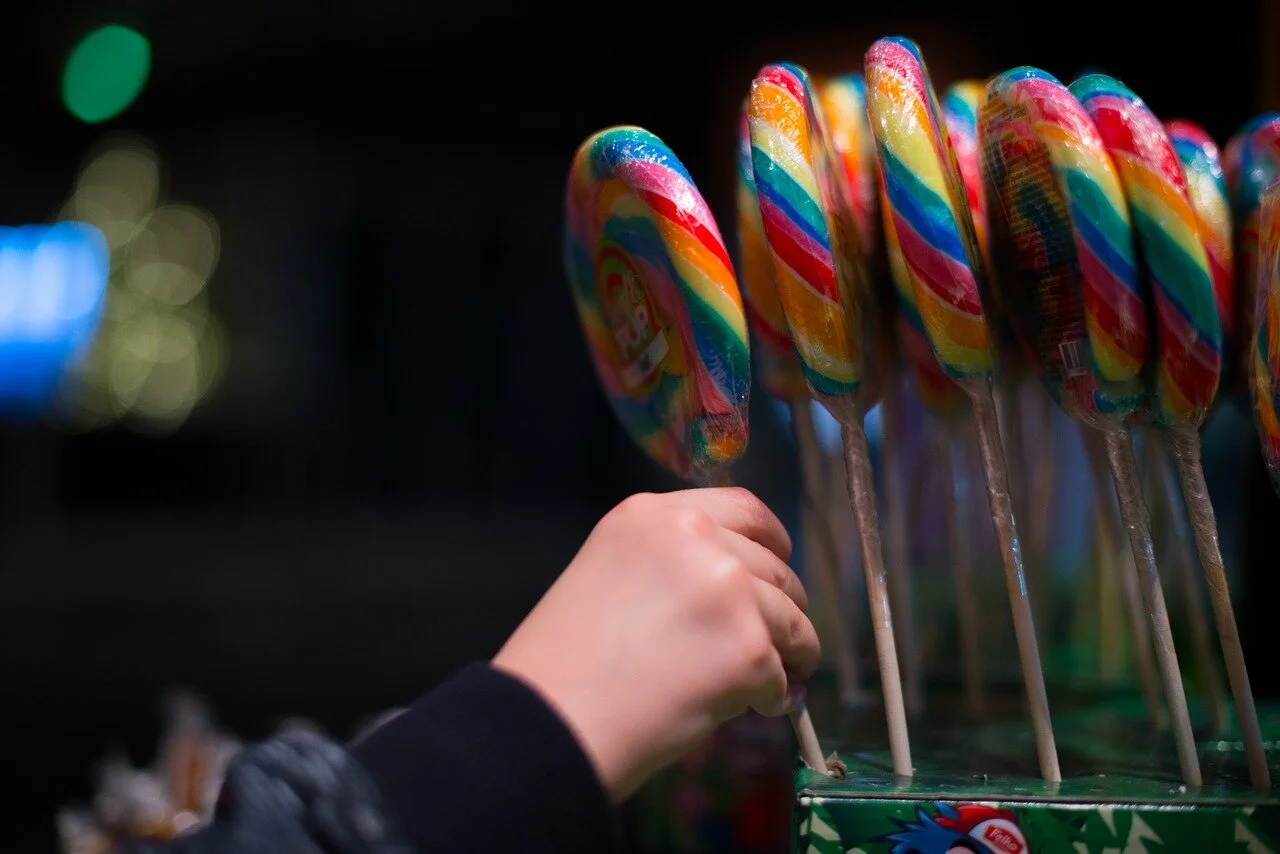
The girl with the colorful sticky sugary treat was now licking it and pressing it to the hem of every dress on the clearance rack, having to peel the fabric off the sucker ever so often so she could put it back in her mouth.
She looked to be about two, maybe rounding the corner to three, but not older. For the sake of telling this story more easily, we’ll assume the adults in her company were her parents and grandparents, judging by who was smiling and who was looking harried carrying the diaper bag. We’ll also assume the infant in the stroller was her little brother.
It’s Saturday and we’re at the weekly indoor winter farmer’s market selling our granola in an upscale shopping mall, where vendors set up their stalls on both sides of the center walkway facing the shops. Most weeks, this creates a sort of ‘safe’ space behind us, where we can leave our hand trucks and extra product stored in bins, and market patrons understand not to wander back there or cut through to get to the other side of the mall. Today, a few of the vendors were missing, creating gaps in the stalls like a first-grader missing her front teeth.
We noticed this young family, as our eyes are usually drawn to marveling at grown-ups navigating a public space with small rambunctious children, and watched them walk just past our booth when they turned sharply into the vendor-less gap to claim a set of backless benches behind us. I felt their relief and could almost see their collective exhale. The toddler was in her element now, freed from the responsible arms that once held her fast, running back and forth from the benches where the menfolk sat and into the fine furs boutique directly across from our stall. She was gleefully licking a rainbow-bright all-day lollipop skewered onto a long wooden stick, waving it about like a wand she didn’t quite know how to use yet, as her mother and grandmother browsed the clearance rack of dresses and coats.
Of course I tended to our customers, but from the best part of my peripheral view, I could see the scene unfolding behind their backs in between sales and chatter. The grandmother had selected a long and flowing blue dress from the rack and was mouthing through the store’s entrance to her husband on the bench that she was going to “try this on, honey, I’ll be right back”. The mother was absorbed with another garment rack of last season’s furs. The girl with the colorful sticky sugary treat was now licking it and pressing it to the hem of every dress on the clearance rack, having to peel the fabric off the sucker ever so often so she could put it back in her mouth. I suspect she and I were the only ones who knew what was going on at that moment (her less than I). Just then, someone had a question about whether our granola was gluten-free, and after several back-and-forth minutes of what is necessarily more than a yes or no answer, I glanced up and noticed that the fur boutique was now empty of customers, as were the benches in the vendor “inner sanctum” area. I looked for but did not see a rainbow-colored sucker stuck to or dangling from any of the dresses on the clearance rack. The sales staff were busy rearranging one of the displays farther back in the shop and my imagination took off in an uncomfortable direction toward the fine gifts shop two stores down.
About thirty minutes later, I watched as a woman reached into a neighboring vendor’s sample bowl of pecans, put them in her mouth, licked her fingers and went back for more. She did this twice more before moving along to the next stall. I couldn’t see from where I was standing, but hoped those were the last pecans in the dish, and the vendors would soon put the bowl away and not refill it. More customers, and so don’t know the ending to that one-act play either.
Remember those assignments in grade school, where you were asked to look at a photo and write the back story that led to that particular snapshot? I reveled in those tasks, feeling like the director of a movie and for as long as it took me to conjure up the details, the One in Control of every character’s fate and destiny. People-watching takes on the import of an Olympic sport sometimes, and a crowded mall on a market Saturday offers up story fodder to keep me at my writing desk until the cobwebs connect my elbow to head, which is how they’ll find me after I’ve passed. I hope. I've always been an observer of life; in the past couple of decades, I've softened the sharp edges of my conclusions about the people I notice, knowing without any doubt that they need my compassion more than my judgment. I’d certainly want the same energy coming at me from across a crowded space. Yes, even the woman who licked pecan dust from her fingertips and went on to touch who knows what door handles, heads of hydroponically-grown lettuce and, please God, the soap dispenser in the ladies’ room. I pray for the strength of her—and everyone’s—immune system, especially now.
As members of various human communities, we’re always walking in on the middle of someone else’s unfolding story, not knowing the near-miss she just experienced or the broken plumbing he’ll find at home after a tiring day at the cash register. Squeezed in between those two possibilities and dozens of others, our encounters with strangers are filled with potential to wreak more havoc or apply the soothing balm of kindness. And, managing our own crises amid moments of smooth sailing, we can often miss the unspoken clues of a neighbor’s distress, a co-worker’s angst, and, still being good people, don’t offer to ease a burden we’d have gladly lifted had we been paying attention. It’s hard, I know.
Replaying those two simple moments of humanity from the market in my mind, I see now that I missed the opportunity to at least let a store owner know that a few of those clearance dresses were probably not going home with anyone, or to pull a decent fellow vendor aside and suggest the use of a spoon in the sample dish next week. It isn’t that I spent unoccupied time wrestling with my conscience. I was tending to my own sphere of influence and the scene changed, as scenes often do, and I wasn’t close enough, in time or distance, to intervene. I simply didn’t follow up. And I could have. Being attentive is an ongoing opportunity as our lives continue to unfold onto and across one another’s.
A breaking news alert: 470 total cases of coronavirus now in the United States, and Italy’s prime minister has just put the north part of his country on lockdown. If you’re looking for opportunities to notice what’s going on around you, and within you, now is the time.
Just remember kindness. This movie ain’t over, not by a mile.

Service
I was lifting it ever so carefully past her salt-and-pepper hair when it happened.
When I was thirteen years old, I spilled coleslaw on a nun.
(Imagine for a moment the collection of variables and precise circumstances required to make such an incident even possible, much less a memory).
I needed to fulfill some now-blurry community service requirement as part of my freshman year on-boarding, no doubt designed to infuse some additional character into my awkward teenage presentation. There was no sidestepping the mandate; at a late summer meeting for incoming ninth-graders and our parents, we were handed our marching orders and a modest list of service opportunities. I selected the one that read “Religious Education Conference, luncheon help”. It sounded the closest to my wheelhouse at the time—clearing tables and doing dishes.
The gathering took place at the high school on a Saturday, with myriad breakout sessions held in different classrooms and our better-than-average cafeteria preparing and serving the food. In the late 70’s, most Catholic women who belonged to a religious order and were teachers had transitioned away from the full habit, leaving behind the black tunics, coifs and veils and adopting a mostly monochromatic and conservative business suit look. Pantyhose and soft-soled shoes completed the outfit, and unless you knew she was your fifth-grade social studies teacher, it was hard to tell who had taken vows and who were among the laity (single, engaged, or married). Since I was only expected to clear dirty dishes from the tables, the distinction didn’t register as important to me.
Until, with a plastic dish bin resting on my hip, I reached between her and her seatmate to retrieve her nearly-empty plate (one of those cafeteria standards: tan with three sections, two small and one large), with just enough coleslaw swimming in one of the smaller sections to be dangerous if I lost my grip in between the table and the dish bin. I was lifting it ever so carefully past her salt-and-pepper hair when it happened. A stray strand of bright green cabbage broke free from the edge of the plate, dripping slaw dressing in slow motion, and plopped quietly onto her left shoulder, just above the shiny gold cross tack pin on her lapel. I doubt she felt the impact of something so small, but the bright green against her absolutely spotless navy blue suit jacket was impossible to miss, an unfortunate epaulet as evidence of my entry-level table-busing skills.
I wasn’t, by any developmental stretch of the imagination, an assertive thirteen year old dutifully busing tables in a cafeteria that would soon become the battleground of my adolescent coming-of-age moments. I was well-schooled in doing the right thing by wonderfully decent parents who modeled this behavior for us consistently and successfully. But positioned out of sight behind this unaware nun, standing for a smidge more than a split second on the edge of choice, I choked and took easy way out. As far as I could tell, she hadn’t noticed anything amiss; I said nothing to her, hurried back to kitchen area behind the serving line, and started getting my affairs in order. I was going to spend eternity someplace really, really warm.
Like so many unseen transgressions that tap incessantly on even the youngest of consciences, I punished myself far worse than any adult could have. I confessed this event to no one, and tucked it safely away into the box marked Thank Goodness Thirteen Only Lasts A Year.
With such a shame-ridden introduction to the world of volunteerism, it’s ironic, or perhaps redemptive, that I celebrate 38 years in the volunteer management profession this year. For just shy of four decades, I’ve been the one creating those lists of service opportunities for high school students, faith community youth groups, corporate leadership training programs and other good community souls who want to do something for someone else and not get a paycheck. That premise alone borders on lunacy for just a moment, but quickly turns meaningful when, at the required orientation and training (yes, those are two different things), a seasoned unpaid staff member tells the story of how she was able to resuscitate that fan at the stadium on the day of the Big Game as part of the all-volunteer first aid team, or helped a young family move into their new home, built with donated materials and their own sweat equity, closing the door once and for all on a homeless past.
Working with the selfless and the altruistic for this long has fortified what my wonderfully decent parents showed me in my tender youth: that people are generally good and we’re continuously invited to keep that goodness unfolding as we all walk along together. It’s not easy work, this putting others’ needs ahead of our own. It gets complicated when funders want measurable impact data at the end of a grant cycle, or well-meaning applicants don’t respond to follow-up voicemails and text messages. They sounded so sincere on the phone; I hope they’re ok. And we long to clone the ones whose humility is the hallmark of their personal creed, who accumulate stories first, not hours, and give us suggestions for improving the next volunteer appreciation dinner without a trace of entitlement in their voices. When the lights are turned off at the end of a fundraising event, they’re the ones walking us to our cars and thanking us for a lovely evening, their ID badges dangling from a logo’d lanyard we gave them when they accepted their first assignment.
In my work, I get to combine a true love for systems administration (employing my anal-retentive tendencies) with the quiet privilege of listening to someone explain why she needs to honor her late father by putting her own shoulder to the cause he championed until he died two years ago just a week shy of his eightieth birthday. With tears filling her eyes, she asks if she’ll be given a chance. With tears in my own eyes, I tell her she’s registered for the next training, and to arrive promptly at 6:00p.m. My job, in that moment, and every similar moment, is to frame and ground the relationship she’s about to step into with our organization, and then get out of her way.
What good folks do for no compensation and precious little recognition lands on a broad spectrum that blurs here and there. It includes court-ordered community service dictated by a magistrate, unpaid internships, one-day company give-back projects and the steady, weekly visits to animal shelters and post-op waiting rooms where pre-med students in khakis and hospital-issued uniform vests offer hot chocolate and snacks to nervous families waiting for a physician’s report. I wouldn’t dare weigh one against another on the “more noble” scale. The benefits go in at least two directions, often six or more by the time the board of directors gets wind of them. Service is service. Let’s start there and refine, if we must, after the last wheelbarrow load of mulch is spread out beneath the new swing set at the neighborhood community center playground.
In a world where the bleakest news lands regularly above the fold, even an awkward thirteen year old trying her best to help and navigate the slippery ropes course of maturity-in-process can make a difference.
Sister wherever-you-are, thanks for forgiving my failing in that cafeteria classroom we shared. I’m still trying to pay the lesson forward.

Food Rules
Food and I have a complicated relationship, and I’m certain that it’s my fault.
This morning, I learned you can put too much kale in a smoothie.
It was that sturdy dinosaur kale too (Lacinato, an Italian variety), with its pebbly dark green leaves, that, in a salad, chew up rich and fibrous and make you feel all healthy as you’re swallowing it down alongside the carrot shreds, tricolor quinoa, market-bought pea shoots and toasted organic sliced almonds for crunch.
But in a smoothie, with only half a frozen banana, a handful of wild blueberries and some past-expiration date pomegranate kefir, the kale will dominate, and I’m just not feeling it this morning, to reassemble the Nutri-bullet, pour the now blue-green frozen sludge back into the blender cup, and add a tablespoon of maple syrup to take the edge off. I’ll muscle through the intensely grassy, grazing-the-back-forty flavor and get on with the rest of my morning. Tomorrow’s smoothie will be differently ambitious, and a smidge less virtuous.
Food and I have a complicated relationship, and I’m certain that it’s my fault.
I’d say overall I eat well, following some generally accepted guidelines that vegetables should take up most of my plate, and there should be some protein in sight. I live happily without soda, hamburgers and steaks and veal, have a soft spot for scallops and red shrimp in my stir fry, and keep raw almonds in the bottom right-hand drawer of my desk at work next to the 70% dark chocolate (fair trade). I love apples (see “Edible Jewels of Autumn”, November 10, 2019), cucumbers and hummus, and eat peanut butter right from the jar, but not more than a tablespoon at a time. At each meal, there’s a healthy fistful of vitamins and other supplements that I swear by (turmeric with black pepper, psyllium husk capsules, Maitake mushroom, milk thistle, B-complex with C, garlic pearls, red yeast rice and Vitamin D), and I’m pretty darn hydrated with water and green tea throughout the day. I try, really hard, to stay on track with all this.
But a 12-hour workday that has me driving across three counties at night to get home before ten o’clock will be interrupted by a quick stop at Taco Bell’s drive-thru and I wake up regretting the side order of nachos I added to my bean burrito (I know there’s lard in the tortillas, and don’t want to know what’s in the cheese sauce). I hastily pack a salad for lunch, add a can of tuna and an apple, and forgive myself. I want so much to purge the pantry of anything processed and in a box, grow and dry my own beans and roll my own oats, but haven’t made it there yet. White cheddar popcorn and Veggie Straws make my greens and tuna lunch taste better somehow, and our friend Jen makes the best brownie drop cookies after we’ve stuffed ourselves with her homemade pizza. Today’s over-kaled smoothie was supposed to balance all that out, but I think I may have gone too far.
There are several folks in our circle whose eating lifestyles go the route of low-carb, Mediterranean, vegetarian and vegan, and it’s pleasure to eat what they make for us. We arrive early enough to help put our meal together, never leave hungry, and incorporate some of their creative inspirations into our own cooking for days after our gatherings. Our friend Nina makes the best red lentil, onion, and coconut milk soup, so now we have all those ingredients on hand should such a soup emergency arise. We’ve added low-carb wraps to our bread box and embraced meatless bowl food dinners. Even with these focused food frameworks, though, I think we all fall off our respective dietary commitment wagons now and then. When we spy a confection from the local patisserie on someone’s counter, we do not judge. We savor each bite of tiramisu on our plates, grateful that they remembered how much we love the mingling of marsala-soaked lady fingers and cocoa on our tongues. You know how I like to employ magical thinking at times—food shared with friends and cherished family members can’t hurt us. Love wipes out a multitude of dietary transgressions.
When I’ve wiped my mouth with one of our faded cloth napkins and washed the last dish, what it really comes down to is keeping food right-sized in our minds. That whole “live to eat, or eat to live?” is the question thrumming in our conscience, and what we allow ourselves to swallow is simply the period on the end of a long sentence that articulates how we feel about food. For about nine or so years, before I met Patrick, I was a dedicated and annoyingly zealous vegetarian. If you dined with me, you’d also get a whopping and detailed side of what that burger was going to do to your colon (I said “detailed”, and meant it), and how much of the earth’s water was sacrificed in order to bring that portion of a dead cow to your plate. It all may have been true, but I missed the point. A friend just wanted to share a meal, not be lectured and bullied into why my spinach and whole grain pasta was the more noble food choice. I’d forgotten that food was forever enmeshed with culture and history and relationships, and that the main dish wasn’t necessarily the main reason for getting together in the first place. Thanks to a couple of brave friends who weren’t put off by confrontations, I learned to tone down my fervor and remember that sharing food was, most times, a sacred encounter of souls, not the debate stage during an election year.
I’m not a vegetarian now, but come to the food on my plate with a more informed and respectful approach to its origins, the many, many hands that have touched it on its journey to our kitchen, and the way it will nurture me at a cellular level. That takes some considerable slowing down and suspending of judgment, and gallons of humility. I am lucky to not live in a food desert, to have a place to grow and harvest my salads, and to educate myself about the organizations that bring farmers’ markets to the city where older adults with vouchers can take home a tomato in season and shake hands with the woman who plucked it from the vine that morning. I realize not everyone has what I have. What I do with that awareness will continue to shape what goes in the skillet and down the gullet.
The lesson for today was a simple one focused on quantity in relation to other ingredients and desired outcome. Like any good recipe, there will be variations.
A little kale goes a long way.