
The Choices of an Approaching Spring
I’ll offer up a few sore muscles in exchange for a dinner salad I bent over to pick after changing out of my work clothes on a Wednesday in June.
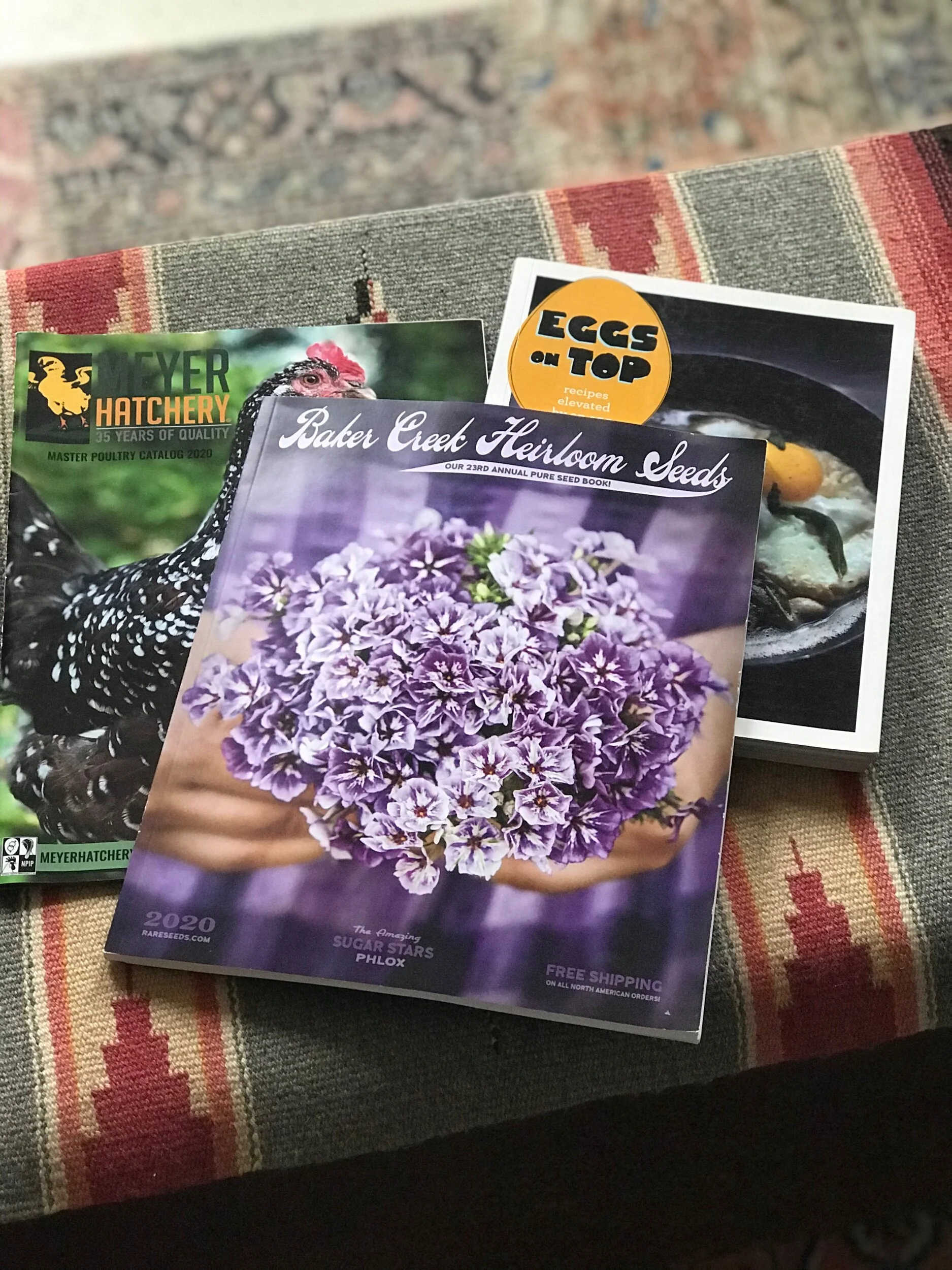
The garden and poultry catalogs have started to arrive, and we’re almost buried by them. But I don’t mind. It’s my favorite time of the year, second only to spring, when I actually get to start planting all those seeds that I’m going to buy, and skim through the cookbook shelves in the kitchen, looking for lost egg recipes. Right now the landscape is still nearly monochromatic with its tawny browns and dirty greens, dusted here and there with the white of last week’s snowfall, and I love the peacefulness of that look, truly. But as February moves to wrap up and we hurry it toward the door (has anyone ever wanted February to go on longer? I ask you…), my mind’s eye is awash with visions of the color riot coming our way. I also walk the land looking for the right fallen branch to herd chickens gently to the coop at all those July sunsets. Add “imagination” to the list of gifts these acres give without restraint.
Our home, the actual physical structure, does not present itself as a candidate for Country Living photo shoots, and I keep a few apologies in my pocket when new guests come to visit, though that’s not really necessary. The sheer expanse of land and birdsong that welcomes these folks is such a contrast to the concrete and horn-honking of their daily lives, they overlook the pile of unfinished project pieces on the front porch and the two dead blue spruce trees on the ridge that still need to come down, and drink in the unspoiled no-billboard-in-sight view of the meadow that beckons and stretches out at their boot-clad feet. We did have the house re-sided several years ago, in a charming buttercream color, and it looks sweet, so I don’t want to paint too “Green Acres” a picture in your mind, but if you spend more than an hour here, and look a bit more closely, the flaws we see as loveable become more distinct around the edges, and we’d understand completely if you had questions.
On my normal commute to and from the main office where I spend some of my daylight hours, I do a quick drive-by evaluation of houses and gardens that give me ideas, and sometimes envy. Most homes around here make good use of the space provided to them, and the requisite boxwood hedges are neatly trimmed and shaped. Add some red or yellow maples in the space between the stepping stones to the front door and the two-lane road, and now we’re talking country curb appeal. It’s on the branches of these trees that residents will hang the colored plastic Easter eggs, string two or three strands of blinking Christmas lights, and dangle a squirrel-proof bird feeder at just the right level to be visible from the front windows. We set the stage carefully for our natural entertainment out here, and make no apologies for its random look. Daffodils and tulips start out in neat rows on either side of the walkway up to the house, until those disgruntled squirrels apply their efforts in another direction, digging up and relocating bulbs while we sleep or knit in the living room. Then, come the first warm days of April and May, we scratch our heads a bit at the sight of a singular long-necked Apricot Parrot bloom, surrounded by a sea of fresh green spring grass, like an unintentional artistic tulip statement on the lawn. It’s minimalist and funny all at once.
A couple of neighbors good-naturedly cope with front yard flooding during the rainy seasons, creating temporary lakes that, if the water sits long enough, will sport a fringe of cattail sprouts and collect a flock of migrating Canada geese with a few mallards tossed in for diversity. When the gravel driveway is submerged, we wonder if we ought to float a skiff of provisions across to keep them going until the water recedes. So far, they’ve been ok, and wave from their SUV on their way to work. We look out for each other here, notice things and try to be noninvasively creative with our offers of help. Does that make sense? It’s not creepy, I promise.
One house, though, just seven minutes or so south of the main road, captures my attention every day in both directions on my commute. It’s a small white clapboard house with green shutters and a white barn out back. One tree stands about fifty yards from the front door, and that’s it for its botanical footprint. Not a bush or shrub, no raised garden beds out back, window boxes or half-cut wooden barrels with coral impatiens spilling out of them. Surrounding the foundation two feet out in every direction is pea gravel meticulously raked to pebbly perfection. No cement goose, naked or clothed, on the concrete slab front porch, and no shepherd hooks with feeders swaying in the breeze. The home’s face is clean and bright as it faces the west, and a peace settles deep within me as I drive by, slowing down to take it all in. I wonder how old the occupants are; such a simple presentation gives way to the plausible conclusion that the residents are past the hard yard work age, or at least have a doting grandchild willing to keep the place looking neat as a pin.
And now I’m torn, seed catalogue in my lap, with too many pages dog-eared in the herbs and perennials section. I know well enough the work it takes, planning and planting and tending to the offspring of my mid-February gardening ambitions. I’ve had my share of sawgrass blade cuts, stinging nettle rashes, and magnesium salt baths to coax my muscles through planting season. And I’ve left many a project unfinished, only to find it tangled up beneath a pelt of wild ivy and burdock. I make all sorts of solemn pledges to not let such a thing happen again, just please give me one more chance at a sensible spring gardening plan, please! But then those darn catalogues arrive in stacks and after I’ve shoveled off the front porch twice, I’m wrapped in an old quilt on the sofa, dreaming of basil and Aracaunas. Couldn’t I just be content with the wildflowers that have sprinkled and established themselves in the meadow and the field-turned-burgeoning forest and have done with it? The spring beauties with their delicate purple streaks, the tall mullein stalks sporting tiny yellow flowers, or the tightly-packed heads of white yarrow along the creek banks and the pungent scent of garlic chives crushed underfoot no matter how carefully I try to spare them my weight as I walk? I could get used to salads made of dandelion greens, creeping Charlie, red clover and sheep sorrel, I think. They’ve kindly done all this growing and blooming and reseeding and going seasonally dormant for years without my help at all.
We’ve tried all manner of floral décor on the outside of our dwelling, celebrating a couple of brilliantly-colorful seasons when Patrick worked as a driver for a local nursery. He’d bring home the discards of pink pansies and flame-red and orange cockscomb (a variety I've never tried from seed) by the flat, and I’d spend a happy Saturday afternoon tucking them into pinch pots and ceramic containers scored from the Goodwill, arranging them on top of old picnic table benches and wooden end tables on the porch, leaving some room for a wicker chair or two. It cheered us to walk across the remaining space on the front porch among the blooms, reaching out to run our fingers through the petals.
After all that, the simplicity of a more monastic-looking landscape does indeed have some appeal for us as we continue to accumulate our days on this gorgeous piece of paradise. I think I’d find it easier to rake a few feet of pea gravel back into place than inch my way around the house on my hands and knees, yanking out the purslane, pigweed and buckhorn plantain by the fistfuls. The gray and white of gravel could be pretty, couldn’t it, and I’d spare my lower back a bit? I could just buy eggs at the farmers market in May instead of raising mail-order chicks through the precarious awakening weeks of spring, changing out the newspaper bedding and refilling their waterers daily before showering for work, praying the raccoons don’t find a way into the pen after we’ve gone to bed?
But what sends our hearts soaring and lifts our spirits here or anywhere has often been the result of some significant effort on our part, and I respect that. For all the reasons I’ve written about in previous posts and more, I’ll offer up a few sore muscles in exchange for a dinner salad I bent over to pick after changing out of my work clothes on a Wednesday in June. I’ll happily scrub the potting soil stains from beneath my fingernails if I can look at the full pink and white head of a Peppermint hydrangea bobbing in the breeze in front of the living room windows, or touch the feathery leaves of a chocolate Cosmos on my way out the door for a Sunday morning walk at sunrise. And when Patrick is working late, the chickens and I have a grand time talking about what matters most, and I gently herd them back to their coop for the night, thanking them out loud for the pale sage green and brown speckled eggs they’ve given us for breakfasts that week.
As long as I can stand, and walk, and inch my way around these acres, I’ll do what I can to bring the color and the love. Whether minimalist or extravagant, to each her own peace, right?

Chicken. On Ice.
The view from the top is rurally remarkable—all rolling pastures and horses grazing and the sun gilding it all like God’s front yard.
We’ve got one chicken left.
She’s a speckled Sussex with no claws at the end of her toes. We have no idea how that happened but here she is, the last survivor of a once-thriving flock of twenty-eight egg layers, meandering the expanse of our acreage and wondering where everyone is.
She’s a patient soul too. I had an early morning work meeting Friday and left the house well before dawn, so didn’t let her out. At that hour, there’s all manner of poultry predators looking for an opportunity to seize the moment of a human’s poor judgment. I just couldn’t take the chance, so left her safely tucked and locked inside her “coop”. It’s an old rabbit hutch, made of two large dog cages set in a sturdy plywood frame with a slanted roof to shed the rain. The whole unit stands on legs that place it a good four feet off the ground, and the cage doors have dual sliding-lock mechanisms. The front is wrapped in hardware cloth. Last summer, when we transitioned the last two girls out of the traditional brick-and-clapboard chicken coops that sit near the creek (another midnight raid that wiped out six of the remaining eight in the flock, most likely due to a marauding band of weasels or fishers), it took a while for them to learn how to fly up and into the opening to roost for the night. For a time, they’d end up settling onto the work table on the front porch at dusk, and Patrick or I would carry them to the hutch. Most nights, that involved gloved hands and a sneak-up-from-behind approach that often resulted in lots of squawking (I’ll let you figure out who) and running about, chasing them through the grove of mulberry saplings and around to the back of the house. We’d catch them eventually, of course, and tolerate dinner being late or interrupted. For all the entertainment value they’ve brought us over the years, it seemed a fair trade-off.
But on Friday, Patrick wasn’t home in the middle of the day to let her out like he usually does, and so this brave little hen with no claws on her toes didn’t get to greet the dark morning’s delivery of snow on top of a thin sheet of ice that covered every surface and every thin tree branch and froze the truck doors shut.
I got to do that.
The ice had arrived two days earlier, and stayed, which was unusual and strange. Strange to drive on dry roads and see the trees crystalline and unmoving. For two days, we walked through a fine and frozen mist from our cars to the entrances of grocery stores, schools, banks, offices and finally the doors of our homes, telling tales of near-misses and face plants when the soles of our boots lost purchase in the dark. Wednesday morning, I took a spectacular and slow-motion tumble off the slanted steps of the front deck, missing the bottom step completely. But I stuck the landing, got out a shaky “ta-da!” to no one in particular, and gingerly picked my way to the truck, grateful I hadn’t been carrying the crock-pot I needed for a dinner event that evening.
Weather-guessers predicted a wintry mix of sleet and ice followed by two inches of snow, and darn it, this time they weren’t too far off the mark. By the time I ventured out Friday morning, area schools were either closed or on a two-hour delay, and I needed to meet my boss at the office by 6:45. That meant leaving in the dark and hoping fiercely that at least one of the many townships I’d be traveling through had a stalwart salt truck driver with a compassionate work ethic. And that I’d timed my departure to end up a few car lengths behind him. Or her.
Didn’t work out that way, and at the last minute, I lost my courage and decided on an alternate route that would bypass the dreaded and steep Dry Creek hill I happily traverse in warmer, more civilized weather. The view from the top is rurally remarkable—all rolling pastures and horses grazing and the sun gilding it all like God’s front yard. The northern approach goes past a cemetery (mildly unsettling in any weather) and drops down quickly with a slight curve at the bottom, then flat for a brief stretch across the creek and back up at a steep pitch. If you’re behind a truck of any size or build, try not to follow too closely. But it’s gorgeous anyway. As the mid-way point between home and work, it gives a welcome boost at the start of the day, and a contented exhale on the way back.
I turned onto the presumably safer road feeling a bit more emboldened and rather strategic, until I remembered the hairpin curve at the bottom of a slightly less steep but still intimidating hill that swept past a Texas Longhorn steer farm. I could only hope they were safe and asleep in one of the barns, as I’d hate to land among them in the pasture when the truck went airborne despite my best efforts to stay between the yellow lines. That lovely thought helped me white-knuckle my way slowly down the hill at almost 25mph, gently pumping the breaks and bracing for the sharp turn ahead. Meanwhile, the snow continued to fluff its way down and I tried hard to see its beauty in the reassuring glow of my headlights. Whoever was driving behind me was patient and thankfully not aggressive. This breakfast meeting better have mimosas. Another helpful thought. I made it to the office with only a few more adrenaline moments and maneuvers.
I’ve been fortunate to have only driving-through-snow-and-ice success stories since we moved here. It’s part skill, part excellent vehicle choices (trucks with 4-wheel drive are essential for my peace of mind) and considerable amounts of luck and timing. But there’s an uneasiness that roils just below the surface of our romantic appreciation for a winter landscape, and it keeps us both sharp and humble. Sometimes, it’s a triumph just to make it safely across the porch and into the truck.
What any of that has to do with only having one chicken left is a connection I’ll let you make on your own. But I sure did envy her temporary captivity Friday morning.
Spring, are you listening?

Improvements
If you need a nap, try to do it within earshot of a warbler or a mockingbird.
I can’t remember if I read it somewhere or if someone told me, but eating salad with chopsticks is much better than using a fork. No matter how big or small the greens are, or the add-ins, it’s a more consistent and satisfying means of delivering the goods to your mouth. I hope you’ll try it.
My afternoons at work are better since I’ve added a mug of green tea topped with a stroopwafel to the agenda. Anything that happens after that feels more elegant and purposeful. I can’t explain it, but then, no one has asked me to.
Water and going outside will fix just about any condition or annoyance. And these two options are so customizable. You can stick your head out the car window at a red light like a dog, step onto your front porch with your morning beverage and greet the day. Or…drinking water, dipping your toes or your entire self in water, listening to water cascade softly off the hard concrete of a mossy fountain, standing on the sand as the waves come at you so rhythmically. Those last two put them both together almost effortlessly (see what I did there?). But if only one is available, really make it work for you. Bend your head back and get that last drop, drink that tumbler dry, take off your socks and feel that cool grass or hard soil right there on your skin. Let the wind rearrange your hair despite the gel or mousse you applied in your morning ablutions. Spreading your arms out as wide as you can adds drama. You’ll feel better.
Putting out cloth napkins at an informal gathering of good people is part eco-consciousness and part sociological study, which, when combined, add an element of rarefied sophistication to a party where folks are willing to learn more about each other. Some of our guests are hesitant to use them, afraid they’ll get them dirty with rich red tomato-y pasta sauce or hummus that strayed ever so slightly from the target, and will ask for a paper towel. We cheerfully reassure them that the chintz pattern on one or the dancing bees on another are sturdy enough to mop up faces and survive an extra spin cycle in the washer. Judging by their surprised smiles, you would think we’d given them a strip of scratch-off lottery tickets. Delightful.
If you need a nap, try to do it within earshot of a warbler or a mockingbird.
That feeling of resentment toward someone that sits all heavy and muddy in your gut? That you just can’t shake or transform or dissolve? See above suggestion to go outside or do something that involves water. For at least those few moments, your senses will be taken up with the coolness of liquid on the back of your throat or the expanse of sky miles above your head (gray and cloudy or blue and endless makes no difference) and you won’t have spent another second snagged on the razor wire of contempt. Then, come back, notice the heaviness of resentment unreleased, and forgive yourself for being in the middle of your own movie. Self-compassion clears the way for compassion towards others. Toward anyone. Oh, and it’s a practice, not a one-and-done event. Let that sink in a bit.
Carry-out pizza on a Tuesday night, when your workday was pleasant and manageable and without drama, gives a rise to the week even before hump day shows it’s hump. Carry-out pizza on a Tuesday and a Friday in the same week is pure decadence, after which you may need a cigarette and some time in the confessional. Make it worth it—get extra cheese.
We almost always do better when we talk to people instead of about them. Especially those folks we see every day, need to get along with in the workplace, or sit next to at Thanksgiving.
In the middle of an argument or an intense discussion with someone you love deeply, reach for her hand and make contact. Though I don’t know the nature of your loving relationships, it’s unlikely such a move will lead to violence. In fact, the evidence shows the opposite—it’ll calm things down, provide a gentle and tactile reminder that you’re both on each other’s side, underneath all that present-moment contrariness.
At least once in your life, be responsible for another living creature that doesn’t speak your language, move about the way you do, or have a paying job.
Even one houseplant, nothing fussy or high maintenance, can make the most cluttered or sparse room feel less so. If it’s still alive after seven weeks, get a second one.
When faced with overwhelming, confusing, expensive, inconvenient, troublesome, and even urgent choices, remember: doing nothing is still an option.
There. Isn’t that better?

Little Things
We never know who our roommates are in this old and crevice-filled abode.
A wasp has joined me at my perch on the couch this morning, its onion-skin wings folded tightly and in perfect alignment with the rest of its sharp and angular little 1” body. It meanders across the brown arm of the sofa, changing direction, doubling back, nearing the edge and retreating. Almost the same color as the pretend leather fabric, I wouldn’t know it was there save for catching its jerky walk on its spindly legs in my peripheral vision. The kittens are fixed in fascination from their spot below on the carpet, their yellow eyes following its every slow and painstaking move to some unknown destination.
I’m paying close attention as well, having administered in the past my share of baking soda poultices to soothe stings that neither of us had planned (looking back, I’m sure it was my fault and not the wasp’s). I’m not going to kill it. I just want to keep it in sight. They’re less aggressive in the winter, and when they do make an appearance in some room of the house, they resemble a hungover party guest trying to figure our where he put his socks and his car keys. We’ve all been there, so we don’t make a scene; we just work our daily comings and goings around them, and keep a careful eye on where they wander off to next. As I look past this one through the living room windows and into the snowy landscape on the ridge, I don’t begrudge him his decision to tuck in somewhere warm. I return my eyes to the arm of the sofa, and he’s gone. Well. Ok. Shake out the lap throws and turn over the pillows. And walk carefully across the multi-colored boho patchwork area rug that’s a perfect hideout for anything brown with legs.
We never know who our roommates are in this old and crevice-filled abode. Mostly, they remain unseen and silent, especially the insects. We have a rather unsettling fondness for our spiders; they keep the fly and no-see-um population in perfect check, so it seems unwise to evict or execute them simply because their many legs and small size put others off a bit. They work hard for a living and teach us daily that patience is essential for survival. But to put a houseguest at ease, we will employ the cup-and-index-card evacuation tactic so that the rest of the visit can unfold in peace. We don’t judge, just accommodate.
But these little lives that intersect with ours are precious to us, even when the sight of them in swarms or many-legged gangs make our skin crawl. We’re awed at their organized communities. We watch as they gather food, survive the sub-zero winters, care for their offspring, perform the tiniest of mating dances and sometimes simply buzz about our heads for no apparent reason. I remember one afternoon in May when Patrick and I were outside on the grass, stripping cedar branches of their needles to dry and use in ceremony, when a flock of dragonflies (“swarm” just isn’t the right word here, though it is probably the more entomologically correct one. Allow me a bit of poetic license here) zigged and zagged inches from our ball-capped heads. We could hear them, there were that many that close by. Draw whatever conclusions you wish on the spiritual meaning of this encounter. We were charmed and delighted right down to our skivvies and now look for them each spring, with or without the scent of fresh cedar on our fingertips.
I get why most folks cringe or look for the nearest shoe to use as a weapon when dealing with all manner of creeping and crawling things. They’re small, they can get into places we’d rather not have them (the classic “they’ll find their way up my trouser leg” fear), and once they’re in there, bite things we’d rather they didn’t bite. Plus, when they reproduce they do so with seeming teeming reckless abandon. Clearly no one in insect circles teaches abstinence or any form of birth control. Have you ever seen those moving columns of gnats or mosquitoes just suspended in mid-air when you’re out for your morning walk? We’re outnumbered and always have been. Entomophobia seems a healthy fear to allow, if not actually nurture, in our two-legged nuclear family species.
But one five-minute segment of the evening news is all I need to put spiders in perspective. If I’m gonna work up the energy to fly off the couch in a panic, it will be about the Big Scary Things, too large to go unnoticed, too big to crawl up a trouser leg and catch me unawares, too heavy to scoop up in a glass and relocate in the hydrangeas outside. And I’ve lived through Big Scary Things, so I’m not romanticizing the contrast here. Tiny living things demand our attention in a different way, inviting our observant eye to notice how they manage in a world so much bigger than they are. They take their place on a vast food chain beyond their control, hunker down and get about their buggy business without complaint. And in large numbers, they command our respect, sometimes from a safe distance, lest we think we were here first. We’re bigger, sure, but not always better. It’s good to remember that every now and again.
If humility I must learn, give me a wasp on the arm of a sofa any day.