

Finding Our Feet
I am lucky to be able to pause and regather my strength.
I read somewhere that wearing socks to bed can help you sleep better, so I tried it last night.
It worked, as far as I could tell. I fell asleep and stayed there in that glorious REM spot for most of the night, and my dreams were neither vivid nor absent. Now, I’m not a credentialed scientist but I can at least employ some entry-level research methodologies by wearing socks to bed again tonight, and maybe for the next several nights to compare the results, test for consistency, even throw in a few new variables and plot the outcomes (add a footbath and some coconut lotion, nestle in with the kitten, more pillows, less pillows…we’ll see).
Bottom line here is I need a good night’s sleep. Several million of us do after last week’s election outcomes. I know…socks seem a thin comfort in the face of our shock and anger and deep apprehensions. But we start with what we can manage. I can manage socks for now. And a long overdue break from social media is also in order, not scrolling through the headlines looking for any sign of hope. I’m more likely to find her in the grocery store parking lot, stopping a cart from rolling into a fellow shopper’s passenger side door. That fleeting connection is real and simple and ends in two people exchanging smiles and it’s enough. It has to be or all is lost. I feel that in the marrow of my campaign-weary bones. The mandate to love hasn’t changed. It’s only become more urgent. Kindness—the deep kind, not just pretending to be nice—is still the coin of the realm I want to live in. I must remember this when the angry desire to throw rocks and burn effigies snarls to the surface and threatens to lay waste to all the hard work I’ve done trying to re-set my heart.
Last Wednesday morning, the land knew. She was eerily and respectfully quiet, a mourner with her head bowed in reverence to the tidal wave of grief washing over her. In the middle of our drought, she gave us the rain we so desperately needed when we woke up that day, and it began the slow soothe of our frayed, raw nerves. I had an early morning work commitment and couldn’t disappear into our fields and woods like I wanted, so I slipped into the mid-week traffic, driving next to strangers and searching their faces for clues, anything that would offer a narrow path to connection. We took normal care of each other as we usually do in our metal rolling cages, sharing the road, using our turn signals (mostly) and letting folks in front of us who clearly have to be on time for something and are cutting it close. I arrived at my destination with precious little memory of how I got there. I tucked the experience away to unfold on Thursday morning’s walk.
Today’s rains are steady and gentle, and I made it to the small clearing in the woods where I usually pause to sit on the hard wood of a massive black walnut trunk and Figure Things Out. The scent of woodsmoke from nearby houses’ fire pits stirred memories of our first years here with a wood burning stove of our own. We’d shovel out the previous day’s ashes and set split oak and cherry chunks onto the cold bricks, light the kindling and swing the door shut to watch the gathering flames wrap themselves around the wood. Many’s the night we sat together, Patrick and I, in front of that cast-iron stove, our legs outstretched with the soles of our feet warming deliciously inside our socks (again with the socks…). After a time, we’d check the clock and reluctantly close the damper before heading responsibly to bed until it was time to go to work. I don’t recall if our sleep was better for it, but my memories sure are. And in them I find another source of comfort and reassurance in these encroaching dark times.
I have no grand or exact predictions about what’s to come. For me, it’s still early days and I’m trying to catch my breath. Others in my orbit are telling me the same and we’re giving ourselves room to react on our way to response. I think of so many fellow humans in the world who don’t have that luxury, whose lives have been wrenched from their hands and turned upside down and they are pulled forward in a stumbling dead run just to get out of harm’s way. Too many haven’t made it to any sort of safe place. I am lucky to be able to pause and regather my strength. It’s what I must do; I know no other option.
So, dear friends, I will not let a necessary and temporary foray into inertia paralyze me. My feet have been places, seen a lot, collected stories and purpose and soon we’ll be summoned to new places, along with the rest of our very selves—shoulders to bear the weight, arms and hands to carry the weary, voices to speak what matters most.
We’ll all need a good night’s sleep before we head out. Best put on your socks.

Of Dew and Gravity
What does a falling tree sound like when it hits the ground here?
A furious and gusty wind stripped the trees near the house bare last Thursday. Cottonwoods, sycamores, black walnuts, the 100-year-old silver maple out back—all caught naked before the sun had gone down. For the better part of summer and early fall, we had set up one of our market canopies (the first one we ever owned, a little 10’-square humble contraption with a red nylon “roof” and splayed retractable legs) just at the western edge of the mulberry grove off the front porch and spent many an afternoon gathered with dear family and friends, working out the world’s ills and scraping salad bowls and casserole dishes clean while the kittens gamboled about between our stretched-out legs. Pulling up to the house after work last week, the whole affair was caught helplessly on two of our shepherd’s hooks, the red nylon canopy ripped and ragged, metal frame bent and tangled. I guess that’s it, then. Summer is officially over.
Friday morning’s walk was a scouting expedition filled with curiosity at every bend in the path—what did the wind knock over and lay down that would require chainsaw skills and heavy lifting to clear? I can still spot a new fallen tree in the woods, even though last year’s soldiers lay peaceful and spent on the forest floor, now horizonal food and shelter for the four-legged and winged creatures who take up residence there. Some of the smaller trunks get caught on their way down and hang suspended between the branches of their siblings. It’s a physics lesson and moment of wonder all in one, and my secret desire to be at least near the woods when these mighty relatives fall rises to the surface. What does a falling tree sound like when it hits the ground here? I’ve only heard that one time during the derecho of 2012 (when I also had the frightened privilege of seeing a bolt of lightning strike the sinewy arm of an osage orange on the ridge) and it was from within the safety of our home’s walls (swaying ever so slightly on the foundation). I’d beat it to the bathtub to crouch with a towel double-folded across my head and neck, doubting the protection that was supposed to give my arteries and spinal cord. Bottom line: big trees fall hard and loud and the ground shudders on impact. I can only assume it happens similarly in the woods.
Wind and gravity are a potent combination and in mid-autumn, creating a spectacle worth pulling up a chair for. As I sat on my favorite fallen tree in the woods early yesterday morning, I watched as a red maple and its neighboring blue beech unhinged leaves from their uppermost branches. Somehow, Thursday’s gusts had spared or missed these gentle giants and it was the sheer definition of serene to bear witness to gravity’s softer touch. Leaves make letting go look effortless. I’ve seen spinners, spiralers, floats and short drops and upon inspection, the landing looked quiet and nonviolent. How does something go from attachment to sweet release with no broken bones? Sure wish all the headers I’ve taken in my short lifetime were as graceful and poetic.
We need softer landings these days, my dear friends. As the Ohio drought trudges on, I’m betting on a cooling autumn’s last drops of morning dew to sink into the soil around our cherry and oak trees and one particularly thirsty curly willow. Some mornings the grass is juicy and my walking wellies collect stray maple and shagbark leaves, little itinerant travelers plastered securely to the toes of my boots until a thick patch of crabgrass combs them off into a new adventure. It’s not enough of a drink to reverse the damage of the past several weeks, but the land sips it in anyway. Mild and episodic frosts will soon give way to winter’s white and frozen coat of snow and we’ll need to tuck in closer to one another just to keep warm.
I think that’s the key to survival. Letting go and settling in together. We can do this. It’s just how we are.
In the In Between
As I walk, I want to thank each and every leaf on the ground for the shade they gave us in July.
It’s almost time to plant the garlic (a waning moon is on the way and that’s what the old gardeners recommend) and I’ll try later today to get in one last round on the mower before the tired grass finally lays itself down for her winter nap. It’s strange, though, to sit in the woods and still see so much green. I feel hoodwinked into thinking that summer isn’t really over.
But…it’s autumn and we’ve hauled out some of the blankets that’ll carry us warmly through our many chilly nights from now until late April. April…that sounds impossibly far away. Best to embrace what’s in front of us, within arm’s reach instead of looking wistfully over our shoulders for the remnants of the rough summer we’ve had, or too far ahead into a future that gives many of us nightmares so close to the election. Too cold to go swimming but warm enough for a drizzly rainfall. The ombre of greens around us look tired and spent but a full and complete leaf-drop is still weeks away. Seventeen acres of goldenrod have gone from a glowing saffron to a muted and dusty ochre, dotted here and there by the pure white seeds of neighboring milkweed pods, burst open and flinging themselves through the air to catch on what’s left of the ironweed stalks. It’s been a good year for milkweed; I’m hopeful for next year’s monarch season.
Until then, we live in the in-between, the not-yet, the still-unfolding as fall takes her time and summer’s memories still whisper their ghosts across the land. On the walk this morning, a tiny, singular bloom of Queen Ann’s Lace stood stark and determined to cheer me, impossible to miss in a sea of fading emerald crabgrass. Tiny white and lavender asters give an oil-painted look to what’s left of August’s wingstems along the walking path, helping us all transition into the darker days ahead with their encouraging pop of colors. As I walk, I want to thank each and every leaf on the ground for the shade they gave us in July, the breezes they caught in their green palms as they waved to us from way above our heads. Autumn’s winds make the sycamores look like they’re shivering, their remaining leaves trembling in a long and anxious farewell. What they teach us about letting go could fill a library.
And so we step, perhaps a bit reluctantly, into the season of release and reflection, distract ourselves with flavorful soups and a bit more toast than we’d have eaten three months ago, buttered all the way to the edges. I am anxious about who we’ll be as a nation in the weeks ahead; love and respect seem thin on the ground for our kind, and I long for kindness, hope, transformation anchored in the deepest regard we can carve out for one another. No matter the outcome on November 5, we are still called to make this human community thing work, to be inclusive and nonjudgmental, to fill sandbags before the floods come and pluck our neighbors off the roofs of their floating houses. We are made for better times and we must choose it over all that competes for our attention right now—convenience, fear of scarcity, dehumanizing the family next door who doesn’t look like us, loud voices insisting on violence, unhealed biases that put more distance between us.
In the midst of so much ruminating, I can hear my late mother-in-law giving voice to one of her favorite truisms: “Yesterday is history. Tomorrow is a mystery. Today is a gift, that’s why it’s called ‘the present’”.
Well, then. There’s the task before us as we live in the in-between.
Receive the gift. And be sure to thank autumn for making it so beautiful.
Drenched
Mercifully, I didn’t know—no one did—what was to come.
Ninety steps into the morning walk last Monday and it started sprinkling. The drops hitting the dry leaves underfoot made it sound more like a downpour and for the first time in too long, I knew my socks would be damp when I got back to the mud room an hour later (hole in my right boot, I’m in no hurry to repair it). No jacket, my distressed Badlands South Dakota ball cap securely in place, I continued north along the path that would lead me, like it always does, into wooded solitude and sanctuary.
(Just over 1,300 miles south, Potential Tropical Cyclone Nine is gathering itself into what residents in six southeastern US states will forever remember as Hurricane Helene).
I didn’t register any wind; the rain fell in straight and gentle sheets over random stretches of the walking paths. I’d move through thin curtains of it and then pass untouched for fifty yards or so before hearing the next approaching wave of refreshment. In that moment, I can’t remember how the city-raised version of me felt all fussed getting rained on in the dash from the front stoop to the car. I have no plans to dig any deeper for that image. I have clean, dry clothes in the dresser at the top of the upstairs landing, including more than a dozen pairs of socks, and that makes me filthy rich by global economic standards. There is nothing to complain about here.
(A red knob of rotating power churns menacingly across the weather app radar, swallowing all of Florida and surging northward through Georgia, Tennessee, Virginia and the Carolinas. Helene grows to a Category 4 storm and images of empty grocery store shelves, plywood sheets over windows and stacks of tightly-packed sandbags fill our screens).
It will take more than a morning’s worth of intermittent and widespread sprinkling to quench the land’s bone-dry thirst, and she knows it. Yet, she received those drops, each and every one, with grace and gratitude. Mercifully, I didn’t know—no one did—what was to come. I walked three more mornings in the humid air, still no jacket, and encountered only one mosquito. On Thursday I dropped down into the creek to walk the damp and rocky bed, noticing once-submerged tree roots along the banks searching for deeper wells of water. Tink, one of our kittens, joined me and we both stopped to admire a most handsome frog—dark green, almost-black—who hopped away and out of sight beneath a tangle of grape vines that hung slack and bunched up just along the western bank. I thought he was brave to be living there, no guarantee that the water he loved and needed would return as he’d known it.
(Thursday night, September 26th, Helene makes landfall in northwestern Florida with horrific storm surges and 140mph winds, unloading incomprehensible amounts of rain as she pushed northward into Georgia and South Carolina. Mudslides and flash floods devour homes and livelihoods. Roads become new rivers and higher ground is quickly becoming scarce).
Thursday was my birthday and I woke up missing my parents in an unexpected and melancholy way. As a child, I was terrified of even the mildest thunderstorms and was the first one to descend into our basement, gathering and sorting the pantry’s food rations for us all in case we needed to live there until rescued. Dad kept his eyes on the tv weather forecasts and Mom would pray, glancing out the window with each flash of lightning. Sometimes our street would flood and the basement along with it; many’s the time we bagged up soggy boardgame boxes and soaked stuffed animals, hauling them to the curb, fingers crossed that maybe Christmas would bring new ones to take their place. Five decades later, I’m grateful that our sump pump in the crawl space keeps sucking up and spitting water out of the drainpipe that sticks out of the above-ground row of cinderblocks on which our 1914 farmhouse rests. Mom and Dad would be proud of how self-reliant and resilient we’ve become (living in the middle of somewhere will do that to you). That doesn’t mean I don’t long for their reassurance now and again when the skies grow dark.
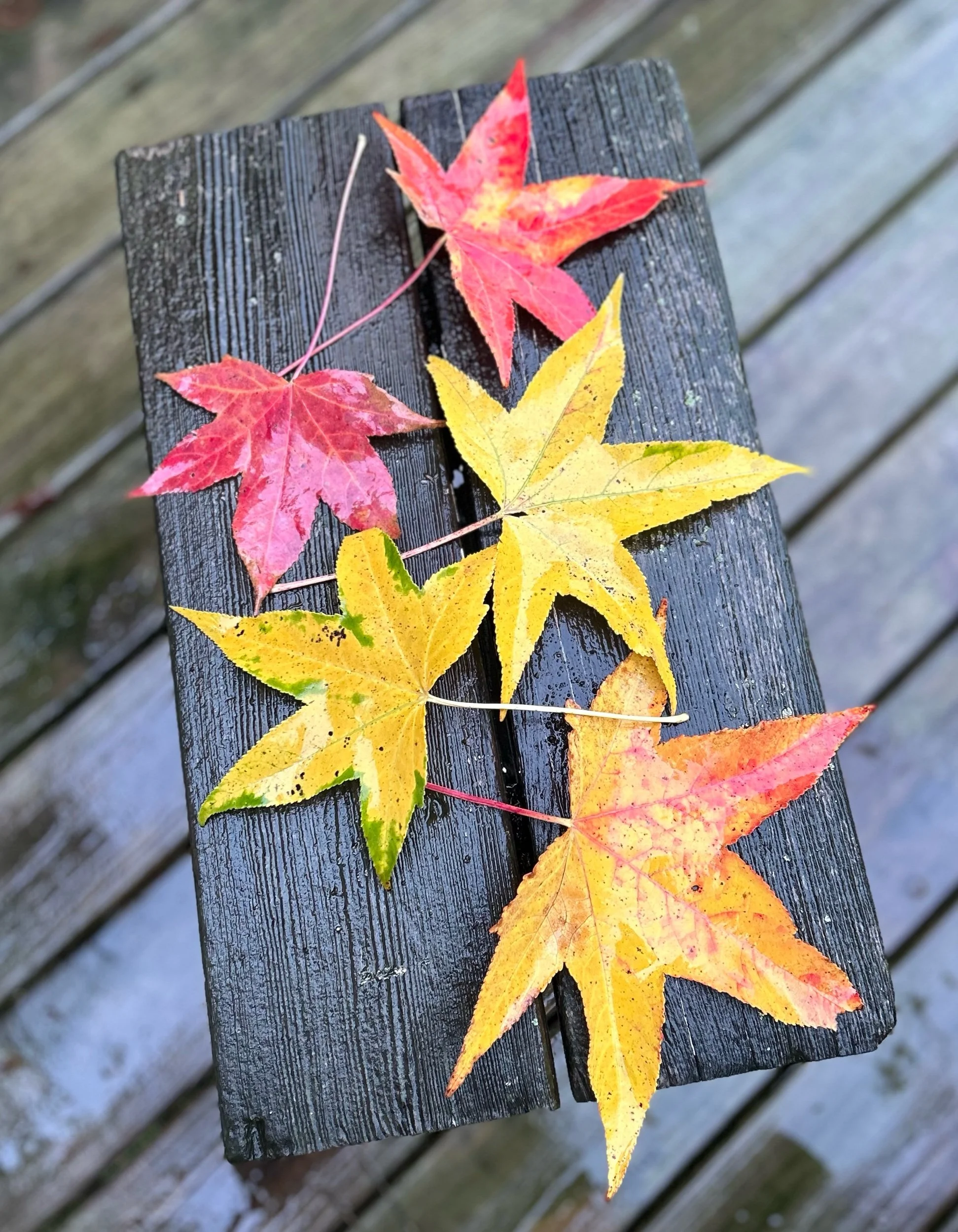
Friday morning, another walk around the acreage, stopping in the woods for a few words with some trees I’ve come to know, and a final loop past the stand of sweet gum trees that were fragile saplings just seven years ago (parting gifts from friends Mike and Deb before they headed west for the next chapter of their lives). Their calico red-and-yellow leaves gather in a ragged circle around their ankles, the last colorful postcards from a summer’s worth of memories soon to decompose, shelter and feed an entire micro-neighborhood beneath our feet over the winter. Carefully, I peel a few of them from their plastered place on the grass and let awe wash over and through me. Here in this tiny speck of Ohio’s farmland, drought relief is weeks and miles away, but these leaves are doing their part, holding in moisture for the earth’s skin just on the other side of their delicate veins and something will grow there.
(Some 1,300 miles away, mud obscures family photos and buries the detritus knocked down and blown to bits by the hurricane’s winds. Staggering statistics stop us in our scrolling tracks: 90 dead as of this writing, more than 1,000 missing persons reports in North Carolina alone, seven water plants closed, 2.4 million without power. More rain to come over the next 48 hours).
Just a week ago, it wasn’t worth firing up the mower to cut what patches of grass were a bit shaggy. The dust I’d have stirred up would have been more plentiful that any clippings I’d have created. Waking up this morning to another round of spitting rain, remnants of Helene’s fury, I stepped into the grayish dawn, heart pointed south and east to brothers and sisters unable to comprehend what just happened, their path forward as clear as the mud their neighborhood streets have become. I send my gratitude and a fierce, desperate hope across the towns and fields between us, wrapping it all in the reassurance that they’ll get through this. We’ll get through this.
Tonight, I’ll cling to the beauty of a handful of fallen leaves and, if the sun comes up tomorrow, walk the land for those whose load is too much to carry right now. Instead of rain, I’ll try to drench them in love.