
Drenched
Mercifully, I didn’t know—no one did—what was to come.
Ninety steps into the morning walk last Monday and it started sprinkling. The drops hitting the dry leaves underfoot made it sound more like a downpour and for the first time in too long, I knew my socks would be damp when I got back to the mud room an hour later (hole in my right boot, I’m in no hurry to repair it). No jacket, my distressed Badlands South Dakota ball cap securely in place, I continued north along the path that would lead me, like it always does, into wooded solitude and sanctuary.
(Just over 1,300 miles south, Potential Tropical Cyclone Nine is gathering itself into what residents in six southeastern US states will forever remember as Hurricane Helene).
I didn’t register any wind; the rain fell in straight and gentle sheets over random stretches of the walking paths. I’d move through thin curtains of it and then pass untouched for fifty yards or so before hearing the next approaching wave of refreshment. In that moment, I can’t remember how the city-raised version of me felt all fussed getting rained on in the dash from the front stoop to the car. I have no plans to dig any deeper for that image. I have clean, dry clothes in the dresser at the top of the upstairs landing, including more than a dozen pairs of socks, and that makes me filthy rich by global economic standards. There is nothing to complain about here.
(A red knob of rotating power churns menacingly across the weather app radar, swallowing all of Florida and surging northward through Georgia, Tennessee, Virginia and the Carolinas. Helene grows to a Category 4 storm and images of empty grocery store shelves, plywood sheets over windows and stacks of tightly-packed sandbags fill our screens).
It will take more than a morning’s worth of intermittent and widespread sprinkling to quench the land’s bone-dry thirst, and she knows it. Yet, she received those drops, each and every one, with grace and gratitude. Mercifully, I didn’t know—no one did—what was to come. I walked three more mornings in the humid air, still no jacket, and encountered only one mosquito. On Thursday I dropped down into the creek to walk the damp and rocky bed, noticing once-submerged tree roots along the banks searching for deeper wells of water. Tink, one of our kittens, joined me and we both stopped to admire a most handsome frog—dark green, almost-black—who hopped away and out of sight beneath a tangle of grape vines that hung slack and bunched up just along the western bank. I thought he was brave to be living there, no guarantee that the water he loved and needed would return as he’d known it.
(Thursday night, September 26th, Helene makes landfall in northwestern Florida with horrific storm surges and 140mph winds, unloading incomprehensible amounts of rain as she pushed northward into Georgia and South Carolina. Mudslides and flash floods devour homes and livelihoods. Roads become new rivers and higher ground is quickly becoming scarce).
Thursday was my birthday and I woke up missing my parents in an unexpected and melancholy way. As a child, I was terrified of even the mildest thunderstorms and was the first one to descend into our basement, gathering and sorting the pantry’s food rations for us all in case we needed to live there until rescued. Dad kept his eyes on the tv weather forecasts and Mom would pray, glancing out the window with each flash of lightning. Sometimes our street would flood and the basement along with it; many’s the time we bagged up soggy boardgame boxes and soaked stuffed animals, hauling them to the curb, fingers crossed that maybe Christmas would bring new ones to take their place. Five decades later, I’m grateful that our sump pump in the crawl space keeps sucking up and spitting water out of the drainpipe that sticks out of the above-ground row of cinderblocks on which our 1914 farmhouse rests. Mom and Dad would be proud of how self-reliant and resilient we’ve become (living in the middle of somewhere will do that to you). That doesn’t mean I don’t long for their reassurance now and again when the skies grow dark.
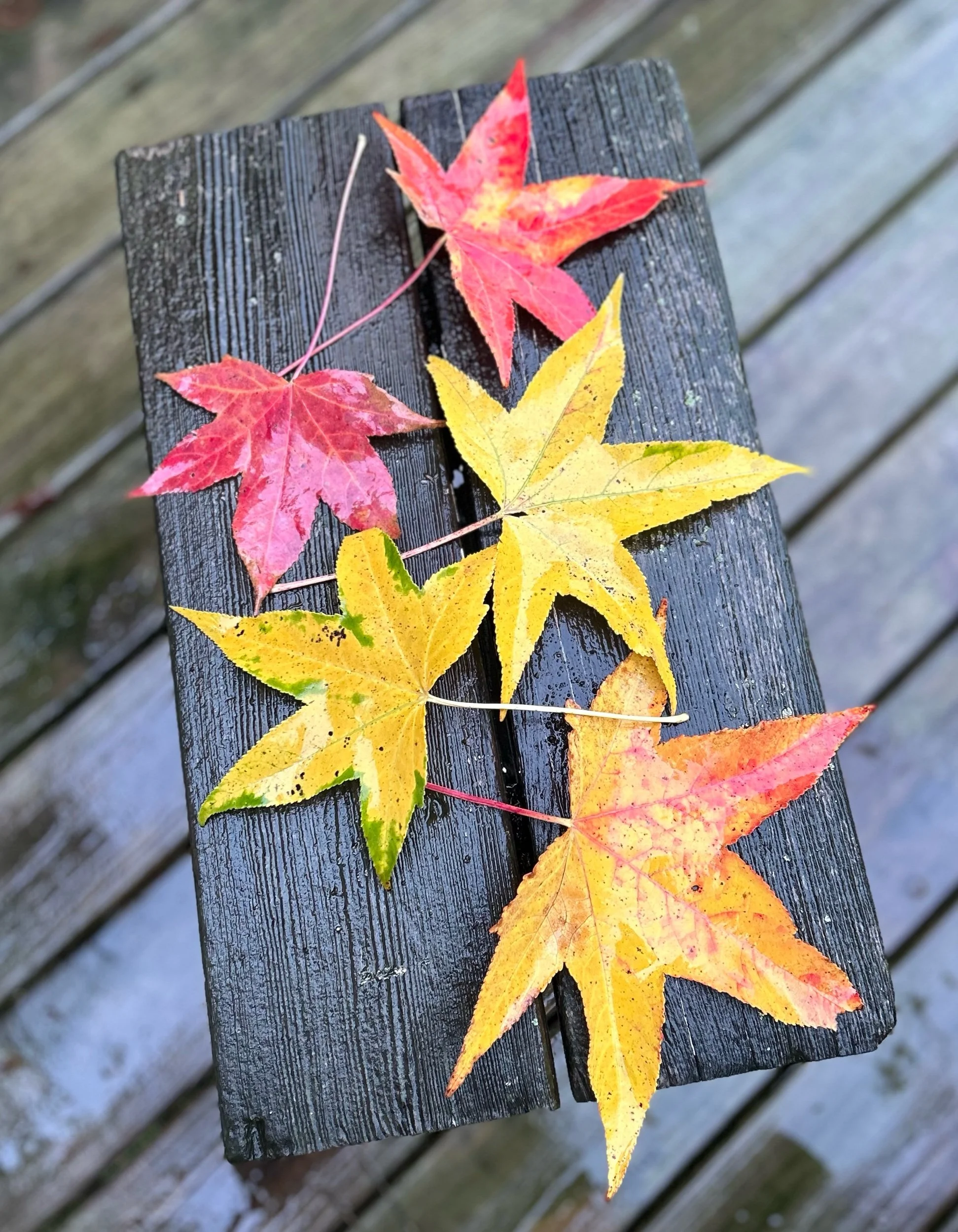
Friday morning, another walk around the acreage, stopping in the woods for a few words with some trees I’ve come to know, and a final loop past the stand of sweet gum trees that were fragile saplings just seven years ago (parting gifts from friends Mike and Deb before they headed west for the next chapter of their lives). Their calico red-and-yellow leaves gather in a ragged circle around their ankles, the last colorful postcards from a summer’s worth of memories soon to decompose, shelter and feed an entire micro-neighborhood beneath our feet over the winter. Carefully, I peel a few of them from their plastered place on the grass and let awe wash over and through me. Here in this tiny speck of Ohio’s farmland, drought relief is weeks and miles away, but these leaves are doing their part, holding in moisture for the earth’s skin just on the other side of their delicate veins and something will grow there.
(Some 1,300 miles away, mud obscures family photos and buries the detritus knocked down and blown to bits by the hurricane’s winds. Staggering statistics stop us in our scrolling tracks: 90 dead as of this writing, more than 1,000 missing persons reports in North Carolina alone, seven water plants closed, 2.4 million without power. More rain to come over the next 48 hours).
Just a week ago, it wasn’t worth firing up the mower to cut what patches of grass were a bit shaggy. The dust I’d have stirred up would have been more plentiful that any clippings I’d have created. Waking up this morning to another round of spitting rain, remnants of Helene’s fury, I stepped into the grayish dawn, heart pointed south and east to brothers and sisters unable to comprehend what just happened, their path forward as clear as the mud their neighborhood streets have become. I send my gratitude and a fierce, desperate hope across the towns and fields between us, wrapping it all in the reassurance that they’ll get through this. We’ll get through this.
Tonight, I’ll cling to the beauty of a handful of fallen leaves and, if the sun comes up tomorrow, walk the land for those whose load is too much to carry right now. Instead of rain, I’ll try to drench them in love.
Parched
All we can do is wait and hope that it’s enough.
I sheepishly admit we’ve recently grown rather fond of a vegan snack made from chickpeas (among other ingredients). It unfortunately ticks all the boxes of an ultra-processed food and is also unfortunately a cheap addition to our pantry (it doesn’t help that Costco carries it in the Extreme Party size). We’re trying to curb our crunch lust and only buy one bag every few weeks, salving our collective conscience with the nutritional information label that boasts four grams of fiber and six grams of protein per serving. Let’s call it a “transition” food choice as we rearrange our diet away from unnecessary items.
But the other day, as I munched away on a small bowlful next to my tuna salad sandwich (with Kewpie mayo, rough-chopped banana peppers and a generous teaspoon of horseradish), I noticed their saltiness and drank twice as much water as I usually do after lunch. Now I think of it, I’m drinking more water in general, even with a responsible measure of these cheese puff snacks in my diet on a semi-daily basis.
Two acres away, our farming neighbor is harvesting his soybean crop three weeks earlier than last year, filling the air with a brown dust that just hangs there, nowhere else to go.
At 8:43 this morning, summer dragged its tired, thirsty limbs across the final stretch of a dried-out finish line, limping from dehydration and passing the baton to a cautiously hopeful autumn. Chilly nights and warm days make for a dewy morning walk but there are far too many leaves on the ground beneath the sycamores, box elders and cherry trees that line the paths and precious little color beyond the sickly yellows and browns that hang inconsolably from criss-crossing and brittle branches overhead. 97% of Ohio is in dry or drought conditions, with 28 counties on the primary disaster list and another 17 literally warming up in the bullpen. We are joining an unenviable global club impacted by water scarcity—40% of the world’s population—and like them, we beg the heavens for relief. It might come (might) this Tuesday if the weather-guessers are right. All we can do is wait and hope that it’s enough.
Last week our kitchen faucet was on the fritz and washing dishes became a Rube Goldberg arrangement of makeshift brilliance involving water from the bathtub faucet heated on the stove in the largest soup kettle we have, followed by a thorough rinse with the detachable shower head, sudsy dishes spread out on the shelves of a sturdy plant rack set up in the tub (remember, I said “thorough”. Nobody likes a salad that tastes like soap). Earlier this year, we went for one of those touchless faucet contraptions and our well water system rejected it outright, sending minuscule bits of sediment through the quarter-inch lines to collect in the spout’s filter. Intermittently throughout the spring and summer, we had no water, then only cold water, then only hot water. Three plumbers’ visits later, we went back to rocking it old school with a faucet that must be turned on and off manually. By global standards, it’s still an insane luxury we don’t take for granted as the daily headlines offer up graphic images of children with saucepans and plastic jugs crowded around an aid truck to collect water for an extremely scaled back daily supply. I shudder at the choices forced upon them in such conditions.
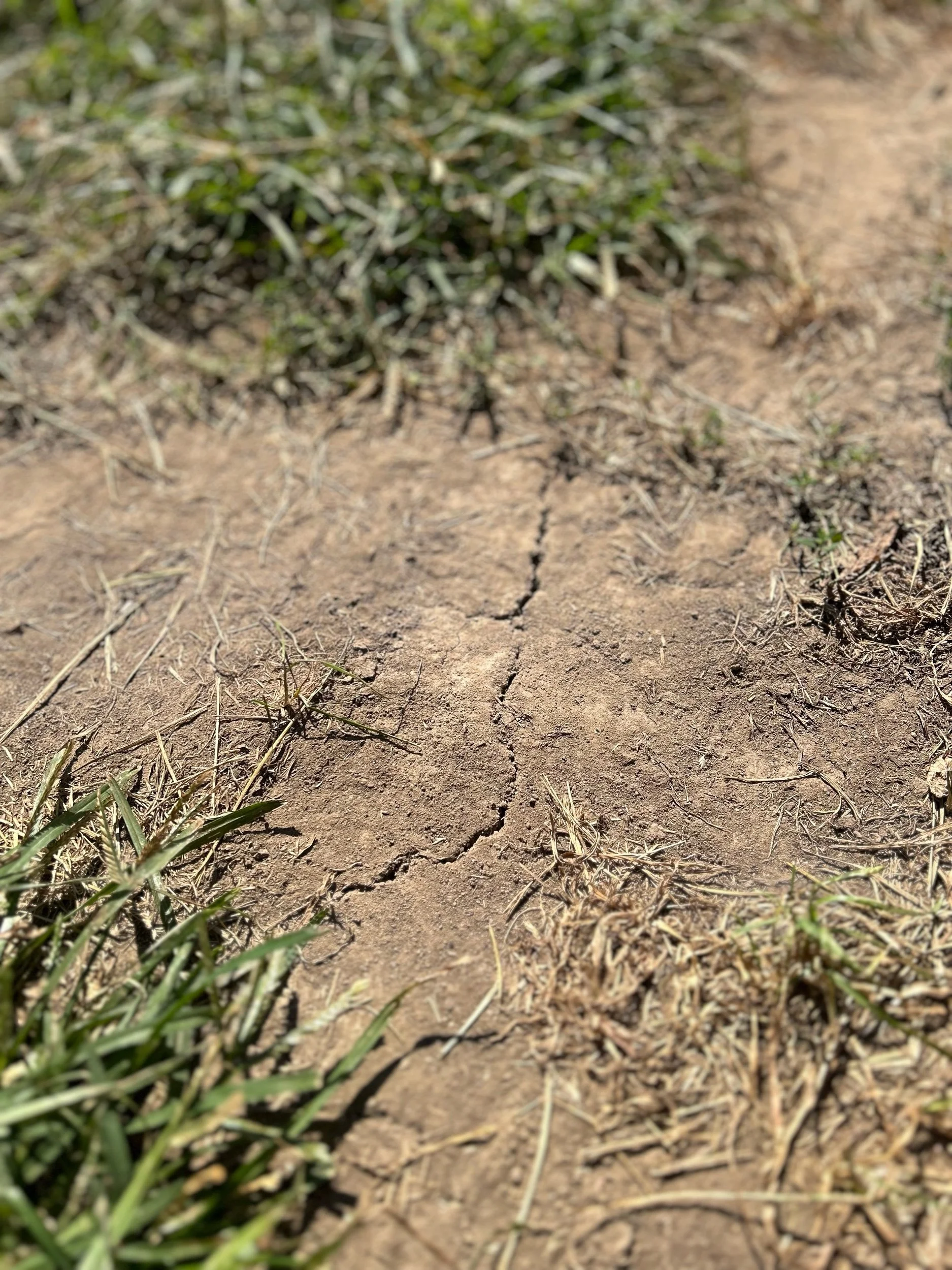
There’s a deep and helpless ache in the face of it all and, in a moment of pause, I realize that a future we feared is already upon us. I’m standing on its cracked and parched soil beneath a sun that has little choice but to shine down on us all from a mostly cloudless sky. What I notice most days are the tough drought-resistant plants that refuse to be discouraged, including the aptly named ironweed and acre upon acre of goldenrod. Though we finally took down the sprawling patch of pampas grass along the north side of the driveway, felling its stalks with the sickle bar attachment of the weed trimmer and finishing it off with mower, tufts of new growth have sprouted up defiantly, looking like a rebellious adolescent’s intentionally bad haircut. I find it both annoying and reassuring. Something within that grass’ dense and fibrous thirteen-foot root system is a will to live that I can’t help but admire (what’s in my root system? Now I’ll be contemplating that for the rest of the afternoon)…
Eating salty snacks during a drought makes little sense but we do it anyway. Being without running water in one room of the house didn’t do anything more than inconvenience us for a week, push our creativity to new levels and recalibrate our humility. But the earth is still thirsty and I try to keep my footsteps light and respectful as she and I and all of us move through this scary time together. I pat my hand gently on the bare cracked patches of her skin between the dying quack grass and curled-up plantain, making tender note of the wild asters smiling up at me from their shady spot beneath the mulberry trees off the front porch. Some of the falling leaves are a bright golden yellow and shimmer as they cascade past the old wooden bench that overlooks the meadow. Beauty is resilient too and I mustn’t forget that. Even in the midst of my human tribe’s suffering and thirst for a way out of the current madness that sours our regard for one another, there are those among us carrying the water of kindness and justice cupped in their hopeful hands; it would be good for us to drink deeply whenever it’s offered.
If the rains don’t come this Tuesday, we must still take care of each other. Please, friends…keep searching for water.

Two Saturdays
Without the bustle of all things market-related, what was I to do?
A day off from the market is a rare occurrence, taken only when the roads are too icy in the 5:30am darkness to make the trip into town safely, or when one is terribly and contagiously ill and must stay in bed with the door shut, tissues and tea on the nightstand.
Two consecutive weekends off from the market is unheard of, unprecedented and unfamiliar territory. Nevertheless, at the tail end of August, I ventured forward into this strange luxury, bringing back stories and treasures and a state of relaxation unparalleled by any meditation I’ve sunk into thus far in my little life (while we’re on the subject of rarities, two weeks ago I wore a dress to work).
Week before last, Patrick enlisted the help of our niece and nephew, Andrew and Rebecca, to work the market in our hometown, giving me respite and a slight conundrum—how to redirect my restless market set up/sell/tear down energy to more leisurely pursuits? I’m cut from the “I’ll sleep when I’m dead” cloth and while not fidgety exactly, I do enjoy that hit of dopamine when I can stand back and look at a project or task completed before diving into the next one. Without the bustle of all things market-related, what was I to do, drive aimlessly around the backroads of central Ohio and stop when the mood struck me? Have lunch at a small-town diner and forget that I’d be well outside the gluten-free restaurant belt? Head toward a lake or dam and watch the life that gathers on the sandy and reedy shores? Well…yeah, that’s kinda the idea and almost what happened.
I ended up at an artisan’s co-op about an hour from our place, looking for new earrings from a vendor we met at a pop-up market two years ago. She was set up next to us and our granola at a family farm-turned small craft brewery and her colorful display kept catching my eye (we all know how well granola pairs with beer, right? We scratched our heads at the invitation to attend and stopped scratching when we sold out in three hours). That day, I added half a dozen pairs of her fine clay crafted jewelry to my collection, giving some away to folks who said they liked them. Two weeks ago, I arrived at the small eclectic shop in Marysville where she consigns her wares and found what I was looking for and more. In this well-curated and cleverly laid out space, I reminded myself to look up and not just eye level at the products within arm’s reach. Dangling from the ceiling were exquisitely detailed twisted grapevine wreaths adorned with tiny hand-crafted clay mushrooms and fungi, paired with patches of moss and stems of artificial greenery that looked like the real thing. Enchanted, I stretched to unhook a crescent moon-shaped one and carried it gingerly to the checkout counter. Against the backdrop of our pistachio-green front door, this vertical fairy garden would welcome family and friends and Amazon delivery drivers well into the autumn season.
A Saturday off? I could get used to this.
Yesterday, we weren’t scheduled for either of the two markets we work. By previous arrangement, I’d been invited to attend a local authors event, sponsored by an indie bookstore just east of Columbus, where I joined 39 fellow writers at long tables set up in the lower-level auditorium of the nearby library. For two glorious hours, I was in the company of creatives, wordsmiths and dreamers who weren’t leaning too hard on our shared writing craft to pay the bills. A steady stream of readers filled the space, stopped to chat and ask us about our work and we happily engaged them as time became irrelevant and blurry on the edges of our conversations. I sold and signed copies for folks who took them up to the checkout table and marveled at my luck—I get to write and sell my words to someone who wants to take them home, nestle into a comfy place and read what I wrote. Seriously—that’s a grand outcome on the other end of a long, long chain of events that began with a simple idea for a story. I’ve just carved out a new and deeper pocket in the well of my humility. To celebrate, Patrick and I stopped for carryout from a fantastic vegan and gluten-free cafe on the way home. Eating green bean curry over rice and a tofu gyro in full view of the meadow will never get old.
Last night, I took more than a few moments to consider just how long it’s been since I’ve had a break like that. To unfold a Saturday slowly before me, not lugging a 120-lb canopy out of the car, wrestling it into place and hauling out the 20-lb tables, 50-lb totes packed with bags of twelve different granola flavors that sell like hotcakes on the hot asphalt of the parking lot where we’re set up…such a pause in that kind of action is pure gift, matched only by the generosity of our customers who rush to the table, thank us for being there and stuff their reusable bags with food they’ll eat for the next several days. For two weekends in a row, I got to see what the woods look like on a Saturday morning (versus say, a Tuesday, on a work remotely day), find out if the blue jays are more chatty than usual now that it’s the weekend (news flash: they aren’t the least bit encumbered by the human invention of the work week) and imagine the gaping hole in the row of stalls set up an hour away, good souls unpacking loaves of sourdough bread and round cardboard containers of cinnamon sugared donut holes, telling folks we’ll be back in a couple weeks. It’s luxury, every bit of it—a side hustle that helps us whittle down some debt and makes the house smell good at the same time, working fulltime jobs that bring meaning and purpose into our lives, getting to step away from either or both for a day, feeling deep gratitude all the way through to our muscles and bones and joints. In all directions, lucky us.
Stillness? Yes, it remains on my list of experiences to master. Retirement? A tiny speck on our married horizon but not rushing at us in a panic. When that decision arrives, I’m confident we’ll know what to do in and around the strangeness of joining the unsalaried class. Until then, I’ll eyeball some future Saturday and fill it with many things or no things, chasing whimsy and writing about it later.
What are you going to do with your next day off? Asking for a friend…
Two Trees
Their branches reach across the walking paths to shake hands and hold on, creating long stretches of much-welcomed shade on steamy afternoon strolls.
The eastern cottonwood, populus deltoides, is a native hardwood in our area and grows at a rate of four to five feet per year. Its soft-edged triangular leaves flutter in the lightest breeze, filling the air with a cascading and rustling whisper (imagine if the word “shimmer” had a sound…). In early summer, much to the irritation of we allergy sufferers, the trees’ canopies shake loose thousands of seeds that drift lazily through the skies, a cottony snow that falls and collects in fluffy patches on the bright green grass. I gather handfuls here and there, wondering if I can needle-felt it like wool into whimsical tiny rabbit and mushroom shapes. On average, cottonwoods can live anywhere 70 to 100 years but in supportive growing environments, that can extend to 400. Dozens of them line our creek banks and throw their offspring into the rich soil on the edges of the walking paths. We stopped counting the new saplings years ago.
As if competing for the title of Most Prolific Propagator, our sycamores (platanus occidentalis) began filling in the once-plowed and cultivated L-shaped cornfield some twenty-four years ago and now we walk through a burgeoning forest instead of open acreage. Their branches reach across the walking paths to shake hands and hold on, creating long stretches of much-welcomed shade on steamy afternoon strolls. They’re the last to green up in the spring and the first to drop their caramel-colored leaves in late summer, adding crunch and covering to the soft soil below (one autumn, in a burst of artistic inspiration, I made a book out of several of the largest leaves, some bigger than my face, and adorned it with tiny pinecones). Several stand alongside the cottonwoods on the creek banks, a towering wall of reassurance when the winds come in strong from the west. Well, most days…
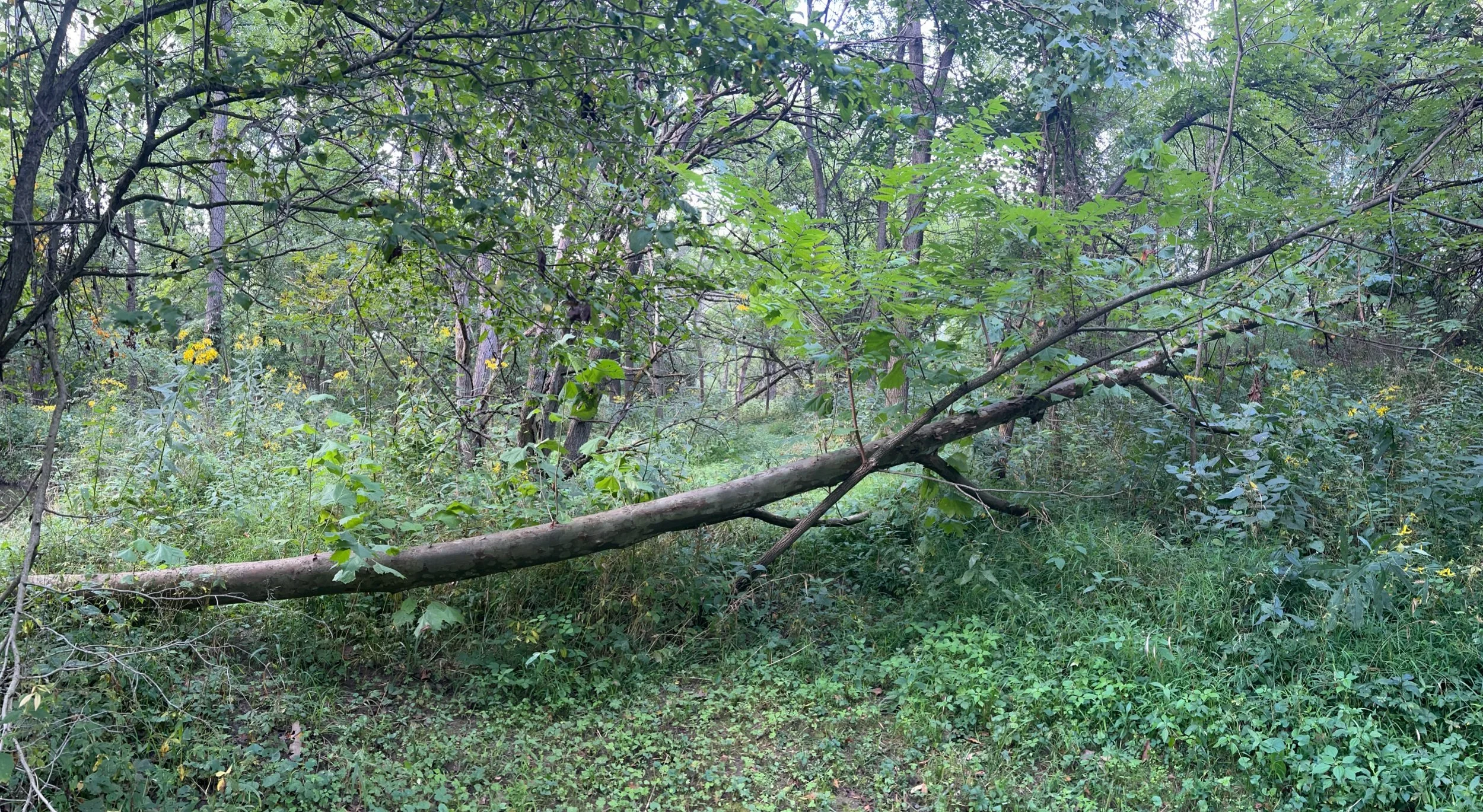
Late last June, as my brother Mike was finishing up the bathroom remodel, an afternoon of heavy nonstop rains loosened the soil around the roots of exactly one cottonwood and one sycamore on the east side of the creek and a stiff westerly wind finished the job, laying them down as the waters rose and rushed over their massive trunks. Nearby black walnuts and willows tried valiantly to catch these older sisters as they fell, only to be bowed by their weight. Undeterred, these younger saplings now reach for the sun in a sideways stretch, looking brave and determined in their smallness. As summer stepped aside for autumn and an unusually warm winter, I waited and watched for these two sentries to give up their spirits and become future firewood in a slow and sorrowful goodbye.
I’m still waiting.
Spring brought more soaking rains and summer has so far balanced the effect with enough dry days to keep the meadow, front yard and walking paths mowed (around ten acres total, more or less). In the mornings, I climb gently over the fallen sycamore, stopping to touch the green leaves sprouting from her trunk and marveling at the taproot still drawing strength and sustenance from below the creek’s rocky bed. Twenty yards further down the path, I put my small hand around one of the uppermost branches of the horizontal cottonwood, thanking her for being a kind and generous teacher as a light breeze sets her leaves to trembling. It occurs to me that both trees’ magnificent canopies, once an over-my-head mystery, are now within my grasp. For the first time in both of our lives, I can touch the lofty perches of crows and song sparrows. As if I needed one more reason to go silent in the presence of these sentient beings…
It’s a safe bet that future spring and autumn rains will continue to carve out and widen the creek’s banks and winter’s unrelenting winds will selectively topple more of the trees now anchored in the packed but fragile earth that guides the rushing waters to the eventual river downstream. I can do nothing to stop that and must accept the hard truth of impermanence once more, humbled by the unknown and inevitable event that will bring my own pulse and breaths to a close.
I can’t say for certain, but I think these two may outlive me.