Choosing Small, Appreciating Humble
Sometimes silence is the most appropriate response, perhaps accompanied by a gentle squeeze of the hand.
We’re about a month out now and I still can’t find adequate words to describe the total solar eclipse that happened in the skies above our slice of the world.
My brother, Mike, traveled from Hawaii for it (and to work on a kitchen remodel job with a dear friend of his) so I took the day off and we drove just forty minutes west from our place to a family farm-turned brewery hosting a watch party in their open-sky surroundings. We arrived early and the field where we parked was already half full. In less an hour, they were turning people away. By mutual agreement, we decided to tailgate the event in the parking lot far from the good-natured crowds with their blankets spread out on the grass and folding chairs unfolded. Official Eclipse Glasses? Check. Water? Check. Ok—bring on the show.
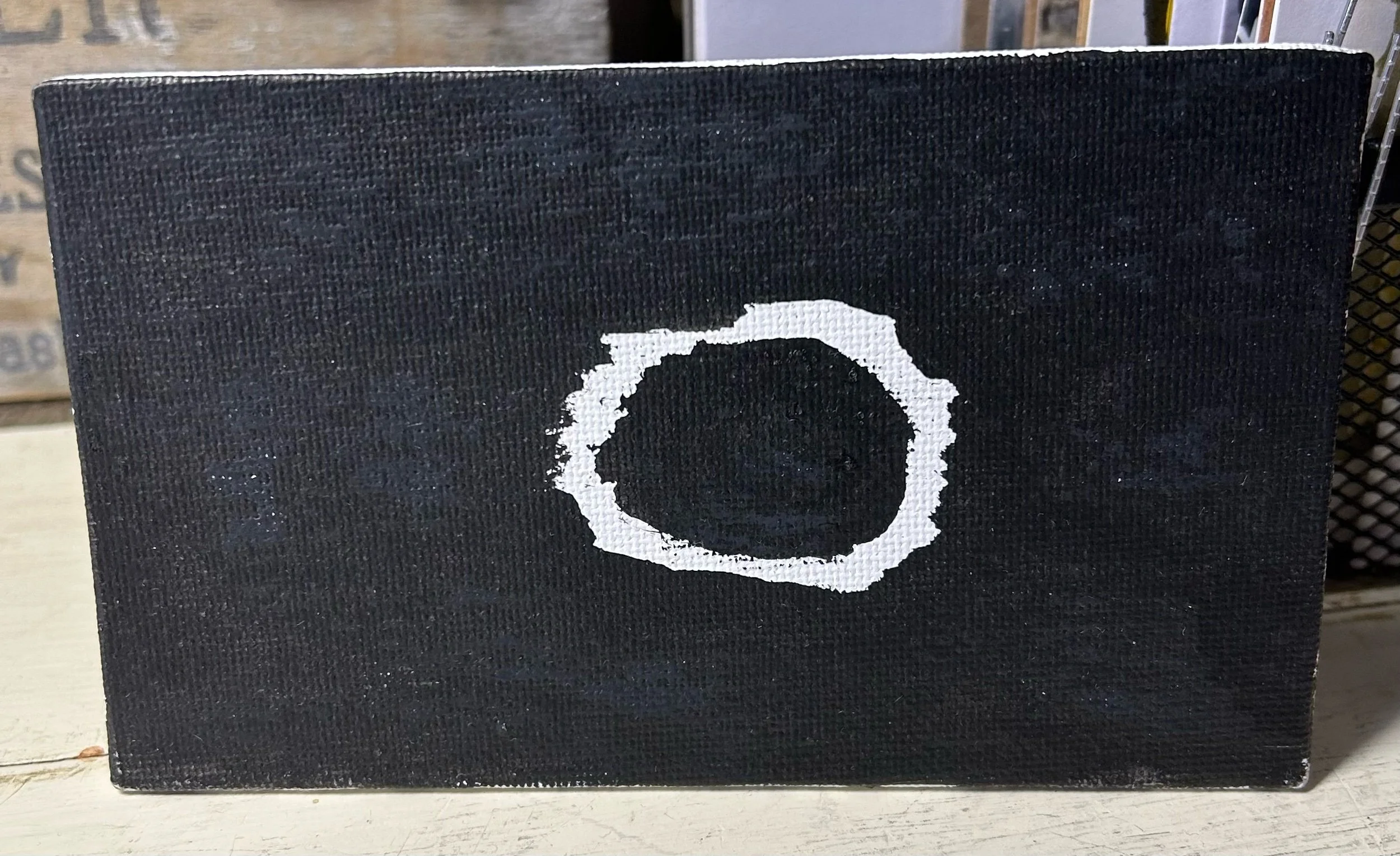
Two days later, I got out my watercolor crayons and a small 3x5” mini canvas and painted my experience of that moment when I looked up safely without Official Eclipse Glasses at a spectacle that has yet to be contained in a sentence or paragraph of the fanciest descriptors (painting is a relief for this writer whose initial go-to is an ever-expanding vocabulary). Georgia O’Keefe I’m not, but I signed the back of it anyway and mailed it to my brother the day before he headed back to the islands. I was so surprised by that simple act of creative gear-shifting that I painted a second one, signed it and now it sits on my studio table reminding me of the day Mike and I turned our gaze upward for the better part of a sunny afternoon in April. The carnitas street tacos we ordered from one of the food trucks there were excellent—we waited over an hour in line for them.
In the days and weeks that have rolled out since then, I’ve asked coworkers and friends about their solar eclipse experience and found that I’m not the only one to go silent, searching for the right words to describe the impact of what we saw. It’s not just me who’s weary of “amazing” and “jaw-dropping” (something our bodies do naturally when we bend our heads back) and all the other overused adjectives our superlative-addicted culture offers relentlessly (see also “stunning”, “awesome” and “incredible”). My brother and I agreed to get back to each other should some appropriate arrangement of words come to mind. Until then, we leave it to “that was great being with you for the eclipse”. and “I’m glad we shared that moment”. Sometimes silence is the most appropriate response, perhaps accompanied by a gentle squeeze of the hand.
Our current situation frequently offers up the chance to reflect on the continuum of grandiose to simple in our lives. I often consider our experience of the two farmers’ markets where we sell our humble kitchen-made granola. One is akin to a bustling street fair in the old downtown section of a suburb north of downtown Columbus. In the summer, we, alongside our nearly 100 fellow vendors, average 4000 - 6000 visitors on a Saturday (as high as 7000 on a peak weekend) and the rain doesn’t deter these stalwart patrons of all things fresh and local. They outfit their dogs and small children in raincoats and hats (I once saw a mixed breed pooch wearing the sweetest paw-fitting rainboots), bring all manner of colorful totes and wagons to carry their purchases, and shun umbrellas as something beneath their dignity. In between downpours, they buy our Blueberry Almond and Vanilla Chai flavors, we swap stories under the shelter of our green 10-foot canopy and reassure each other that we won’t melt. It’s a kind and gentle exchange that boosts us for the restocking granola-baking that the coming week with bring. We are always grateful.
In contrast, the local market just fifteen minutes from our home is a more intimate affair—a good weekend will see maybe 300 pairs of feet walk past the twenty or so vendors who, by market stipulations, must make or grow their table’s bounty no more than 25 miles from the town square. Our customers are neighbors we haven’t met yet and friendly visitors looking for the charm of a slower pace. The local college brings in parents for family weekend activities and they nearly always leave with a bag or two tucked into their student’s backpacks for snacking on in between classes (Mocha and Lemon Blueberry Tahini are favorites). Much to our delight and surprise, this smaller market consistently outsells the larger one and leaves us smiling and scratching our heads a little for their generous support of our small and crunchy venture, now in its eighth year. We’re always grateful here too, and it feels that much sweeter because we’re closer to home. I could see us making this our retirement gig when the time comes.
In between eclipses and farmers’ markets are sunrises that stop me in my ambitious morning-walk tracks to look up and about instead of just down at my feet, middle-of-the-night thunderstorms that mean I’ll be nodding off on the bus ride into work because I chose wonder instead of sleep, and sheer hand-clapping joy at the antics of a skunk family whose little ones tumble playfully down the ridge to the meadow, only to climb back up and do it all over again. How did I get so lucky? I don’t hear music in the background or see angels doing cartwheels across the setting sun (though I’m sure they do most every night). It all just comes and goes in a breath and if I’m paying attention I get to see it, commit it to memory and then walk back up to the house with the day’s eggs in a small-handled bag from the local nursery. Simple stuff, this, gathered and noticed and appreciated.
Until those other words come along, I’m fine with “beautiful”, “breathtaking” and “wow”. That last one will always be enough.
Glue
What divine epoxy adheres to the jagged brokenness of our life’s pieces and sticks them back together?
The mower is in the shop for its spring tune up and the grass knows it.
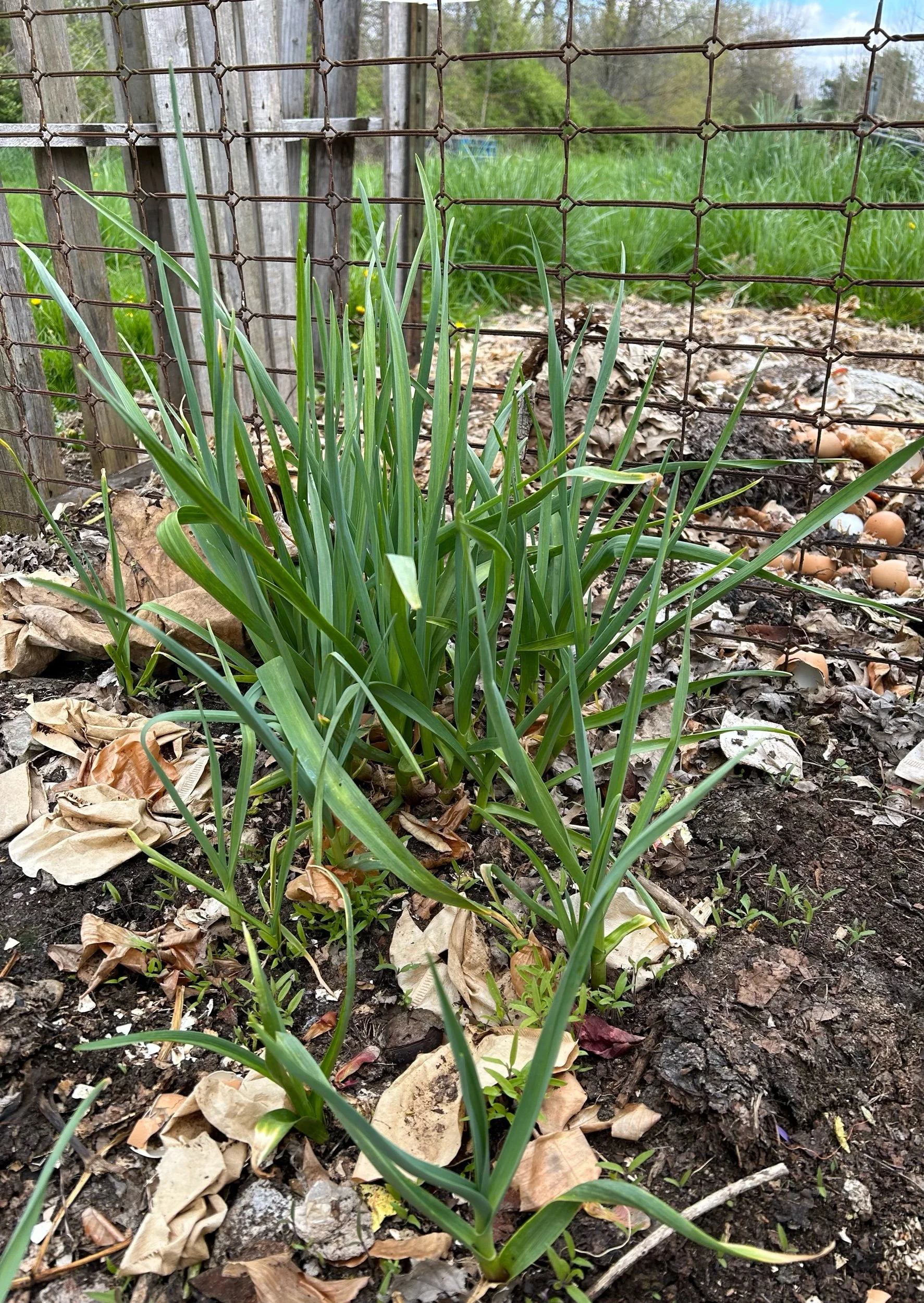
Dressed in her finest 70’s shag carpet vibe, the slopes surrounding the house and the walking paths through the fields are an uneven and cheerfully rebellious carpet of quackgrass, dandelion (in puffball stage now), lamb’s-quarters, knotweed, wild violets and plantain, with flat patches of creeping Charlie and white clover sprinkled in to distract us from the botanical chaos beneath our feet. I was hoping we’d get another bumper crop of wild garlic mustard this year for making pesto but it’s literally thin on the ground. No matter—the plantain and purslane are edible and we’ve got plenty of nettles to keep us in soups and lasagnas well into the summer. We’ve even got green onions sprouting up in the compost pile. Barbara Kingsolver calls weeds “the gardener’s job security.” We also call them dinner when it’s safe to do so. And we know this: there’s no stopping spring.
It’s impossible not to notice the reassuring effect this land-home has on us when new life is bursting forth in every direction. Our place is landlocked and pretty much hidden from the ribbons of traffic that zoom by on the two-lane road a mile and a half west of our driveway. Were it not for our phones and internet (and the need to slide into that traffic a few days a week for work) and a shared curiosity about what the rest of the human tribe is up to, we’d live an ignorantly insulated life, unaware of the headlines that bring the rest of the world to its knees. But…we are aware, we do read and scroll and feel the sharp edges of a global momentum that seems bent on self-destruction. In the midst of all that, it begs the question—why are we still here, all of us? I can only speculate and wonder, with an undercurrent of fierce hope, the kind that makes you clench your face up tightly, press your clasped and intertwined fingers against your lips and send everything you are outward to an unseen force that must be, must be, watching, listening, standing alongside us.
What is holding us together? What divine epoxy adheres to the jagged brokenness of our life’s pieces and sticks them back together? In my 20’s, I traveled with three male friends to a monastery just outside of Atlanta and stayed overnight (disguised as a man since women were not permitted accommodations. Another story for another time). I wondered about their spartan lifestyle, heard their chants at regular intervals throughout the day. I didn’t see a television in the areas we visited, though I didn’t look for one. In the short slice of time that I observed and participated in the rhythm of their routines, I thought of a life so focused, so contained and driven inward, sunrise to sunset to sunrise again. How could there not be some ripple effect on others in spiraling concentric circles that reached beyond Georgia’s state lines into Florida and eventually into Cuba and Puerto Rico? How many more communities of full-time pray-ers are there in the world? And…how could all of that not be helping, in some way?
Then there are the other less formal and less communal acts of intention and compassion that weave and whisper themselves through our days: doors held open as we juggle sacks of groceries, artists who paint messages on flat stones and leave them on beaches for searchers and fellow travelers to find at just the opportune moment, farmers’ market vendors who give away whatever product is left at the end of the day to local food pantries or a customer who’s short on cash, simple eye contact with someone next to us at the bus stop, held for longer than a flash, a reminder that we’re in this together. Whenever we dig into our recycling to find a piece of something that will keep us from having to run into Lowe’s and buy brand new, we’re helping. Any and all inner work that lovingly tries to tame the ever-churning “figure it out” thought cycle we get pulled into at the expense of our peace…that helps too. And bending down to feed the cats, the dogs, the ferrets, or sprinkle flakes of fish meal and spirulina into the aquarium by the front door. More glue, more adhesive to strengthen the bond between us all as together we rise and push back against despair and insist on love. Shifting one’s view away from the headlines like this is not just a good idea, it’s good medicine, water for parched throats. We mustn’t minimize it or dismiss it as soft, ineffective, Pollyanna folly.
I’m counting on these simple acts of continuance and connection. Just as sure as spring means a shaggy lawn and unbridled growth, I believe in the power of glue.
Join me.

A Day’s Work
Hundreds of thousands of people with whom we share this planet work much harder than I do, no matter what my aching knees say.
From the looks of things, it’s going to be the Year of Apples and Mulberries. I lost count at fifty mulberry trees last year (the rabbits of the arboreal world) and have already cleared a patch in the freezer for the jam and barbeque sauce we’ll make in a few months. The trees that give us apples are a mystery in variety and origin, remnants of a working orchard that rimmed the meadow where the former residents’ dairy cattle grazed their afternoons away. The fruit is an impressionistic red streaked with lime-ish green and face-puckering sour. We have yet to turn them into anything beyond a quick trail snack, tossing the cores onto the walking path for the deer if they want them. Everywhere we look is food in raw form and if we didn’t have day jobs, we could easily make a life of gathering, preparing and storing the land’s bounty to get us through the seasons. It’s time to get out the “Edible Wild Plants” book and dog ear the “Spring” section. For as long as we live, there will always be work to do.
If one of life’s prominent themes is motion, another must be contrast. We wouldn’t appreciate warmth so much if we didn’t know what cold fingers and toes felt like toward the end of a winter walk. Silence is that much more blessedly soothing when it follows the cacophony of the neighbors’ 4-wheeler slicing through the air on a summer Sunday morning. Sweet plays with salty in a dark chocolate almond bar where flakes of sea salt land on the tip of the tongue in that first bite. I’m not thirty anymore (or forty, or fifty…shall I keep going?) and I know it, as evidenced by how much less weeding I can do in an afternoon without noticing any aches in my fingers or knees. Tending to the land spreads out over several days now. When did gathering fallen branches become a full day’s work instead of the warm-up for the after lunch gardening marathons of my youth? Hundreds of thousands of people with whom we share this planet work much harder than I do, no matter what my aching knees say. It’s all relative and I get it, but it’s good for the soul to consider another’s life work, the rhythm and rocks that a fellow human must move in order to survive, to solve a problem, to eat.
For the past thirteen days, first responders, engineers, tugboat and barge captains, transportation officials in Maryland and workers at the Royal Farms convenience store near the entrance of the Francis Scott Key bridge have put their shoulders and hearts to the work each of them must do in the aftermath of a disaster that left empty chairs at six families’ tables. How do they awaken each morning since March 26, knowing—or not knowing—what will be asked of them in the day’s waking hours, and how do they put it aside, if such a thing were even possible, when they finally reach their own driveways and dinner tables? In the days following the September 11 attacks, it was someone’s job to figure out where to transport the debris from the Twin Towers so that it could be sifted, examined, sorted and piled up, one truckload after another, day after day, week upon week. Who bore that burden and finally decided, in a moment of karmic irony, that the Fresh Kills site on Staten Island, the world’s largest open-air dump, would be the most suitable place for such a heavy and unfathomable purpose? Twenty-three years and 600,000 tons of debris later, there are still fragments of lives amid the dust, no closure within reach. No matter what I was tasked with during my time at the American Red Cross in the days and months following that horrific event—receiving volunteer interest phone calls by the dozens, directing a steady stream of blood donors at our doors and guiding community businesses wanting to feed us as we worked ‘round the clock—none of it came close to the weight on the shoulders of that one person who directed the truck traffic at that Staten Island dump-turned-graveyard and crime scene.
Getting up at 4:30a.m. twice a week to catch a bus downtown and support those who advocate for nursing home residents isn’t easy but it’s manageable compared to the hard labor required to harvest sugarcane in India, coffee beans in the mountains of Central America, or direct air traffic in a tower high above the runways of the world’s airports. I have little to nothing to complain about given my circumstance and privilege and I’m aware of that, deeply, for the majority of my waking hours. We all do our part, with a grounded commitment to the outcome, and that mustn’t be minimized or overlooked. It’s just hard not to compare my day’s efforts to someone else’s, a someone whose home has a dirt floor and sheets for windows. Looking globally to my left and right, I humbly acknowledge that I work on easy street and pretty much always have, every day of my employed life.
Let the mulberries fall in showers from the trees. I am up for the job of sorting and washing them, picking off the stems and crushing them into their next life as sauce and jam and who knows what else so that we can enjoy them in the chilly days of winter.
In Baltimore, there are three more bodies to find beneath the wreckage and a bridge to rebuild.
First Things
Prioritizing one’s life is a complex load to carry and it doesn’t help that the baggage keeps shifting around.
It starts before I even open my eyes. A cascade of tasks tumbling out in no rank order, rolling over the edges of my just barely awake mind, jockeying for top spot on the to-do list while I try to remember where I put my socks. Laundry, fresh batches of granola to be made, finishing up last night’s dishes left with good intentions in the wash basin by the kitchen sink and don’t forget to pay the gas card bill online. Kitties will be hangry and batting their claws-out paws at each other, what’s clean and presentable to wear to work? Speaking of work, did I send that project update email or just imagine I did and is there enough card stock to print a round of motivational meme cards for an upcoming meeting? Right about now, it’s clear that if I don’t tend to my morning ablutions and soon, I’ll have something else to add to the list.
Does anyone else start their days like this?
A life of continuous motion awaits us on the other side of the womb and doesn’t show any signs of letting up until we transition over to the Big Stillness where finally, I’ll get some rest. It’s not the richness of activity that unsettles me at times as much as the need to figure out which tasks are urgent, important or both. Prioritizing one’s life is a complex load to carry and it doesn’t help that the baggage keeps shifting around. As young-uns, much of this work was done for us by taller and more responsible folks (parents, teachers, elder siblings on power trips while mom and dad were out grocery shopping on Friday nights) but they eventually stepped aside as we demonstrated a budding ability to mange things on our own. When we screwed up, they would helpfully rearrange the chaos and hand it back to us for another go. But there’s no playbook for getting it Right All The Time and so…we unspool a life of trial and error and here we are to tell the tale.
Somewhere beneath the surface of all this internal activity imposed on external circumstances is a persistent nudge of what matters most in any given moment or situation. Let me ask you, dear reader and fellow traveler, at what point do you remember developing those core nonnegotiable values that helped you find your true north and apply it to some of your more nettlesome brain benders over the years? When did you learn that people are more important than things (we actually had a family friend create a lovely banner in classic 70’s burlap and felt style with that quote on it. It hung by the front door for years, guiding our out-the-door thoughts at the beginning of the day and offering both reassurance and admonishment when we returned. I think I claimed it when it came time for the family goods to be distributed), that being honest might not always feel good in the moment but, when practiced again and again, knitted together the strong threads of your own integrity? How did you learn gratitude for the smallest of pleasures and wonder and awe for the incomprehensible ones? Who taught you to love and presume good intention in front of all evidence to the contrary?
I still have wise people (some still taller than I am) in my life to help guide some of my stuck moments (I keep my personal board of directors on their toes) but it’s these hard-won and indelible conscience-framers that filter the choices I face daily. Easing Patrick into a hectic workday by having his coffee and lunch ready will always be more important than getting two trays of raspberry birthday cake granola baked and cooling before my morning walk. All living things not human who rely on us for food will be fed before I sit down to my own bowl of oats and in a stretch to make coming home from work just a smidge calmer, I’ll make the bed and be sure most of the kitchen floor is swept. It’s not a grand affair to tend to such details but I’m of the mindset that anything I can do to make future Liz and Patrick less stressed is worth the effort up front. Before I put my bare feet on the cool floor, I try to say thank you for even having a bed and floor in the first place.
I know life doesn’t move in a linear no-circling-back sort of motion, where what was first today will always and forever be first from that moment forward. I expect a shifting sands existence where what anchors me is what matters most. In those fresh waking minutes of a new day where tasks, like energetic toddlers, tug at my sleeves for all my attention, I’ll try to receive them with kindness and a thankful heart rather than a nerve-straining pressure to get everything right.
In a world of first things first, I choose to lead with gratitude.