
What Spring Does to a Person
If you’re gonna eat local, dream big and put up with a little discomfort. It’s worth it.
Every tree is the color of matcha right now, an undulating sea of lattes on the commute home that will last but another week before they move onto the next shade of green in their collective unfolding. The freshly-tilled fields are a rolling ombre tribute to cocoa, from light milk to the deepest dark; if I were a young child in the back seat on a long road trip, I’d insist my parents tell me without hesitation that this is where chocolate comes from—one soil scoop at a time. Tired as I am from the day’s work, I’m in no hurry to get home. Can’t I just dawdle along in this arboreal cafe for a few more hours?
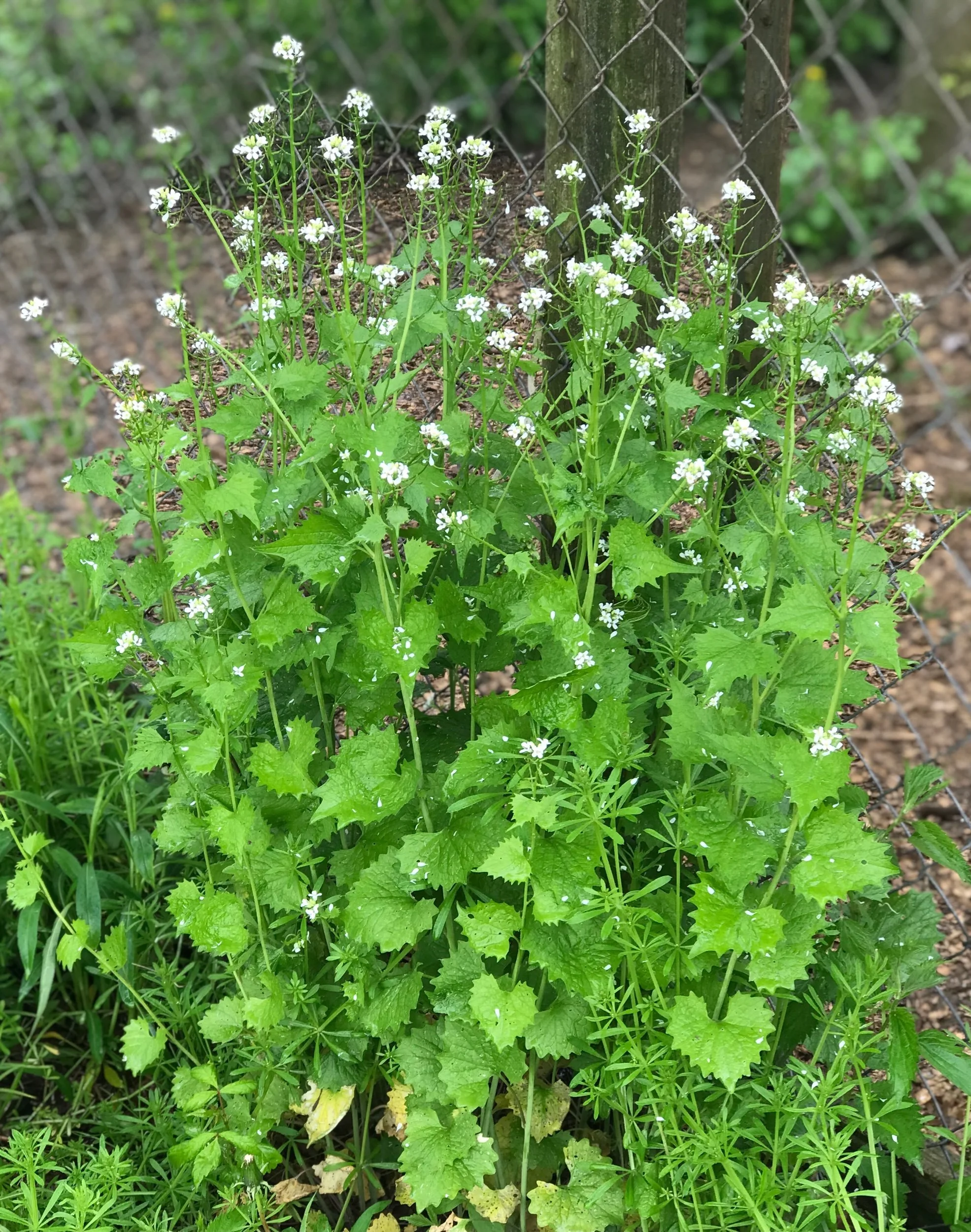
I made a glorious mess in the kitchen last weekend, following through on my dream to harvest armfuls of wild garlic mustard and turn it into pesto. If you’ve ever done this, you know it can be an oily affair, bits of basil or whatever green you’re using sticking to your fingers and the inside of the food processor’s bowl and your spatula and the counter… It’s pointless to clean as you go and a much better use of your time to dream of that first bowl of pasta adorned with the fruits of your labor. Patrick and I have been intermittent foragers over the years. He’s the hesitant skeptic, what with his paramedic training and experience tending to those who ingested something they thought was safe, and I’m all “honey, you really can eat stinging nettles—just plunge them in boiling water first for about 45 seconds” (which is why I’m not allowed in the kitchen without a permission slip). We did acquire a copy of “Edible Wild Plants”, a field guide and companion in lean times when green leaf lettuce soars past the $2.99/lb mark, and it helpfully lists poisonous lookalikes (with color photographs) so you don’t go munching on leaves or berries that will make your lips swell to three times their normal size. I learned that the roots of spring beauties, a sweet little wildflower that takes over lawns in between the last really hard frost and a few subsequent milder ones, can be harvested and cooked like tiny potatoes, but I just can’t bring myself to dig them up. They’re too pretty at my feet and I’d miss them on the morning walks (besides, once you dig up those little tubers, that’s it for them. The book cautions not to wipe out an entire patch at a time. Leave enough for next year). On the other hand, I can’t keep up with this season’s garlic mustard crop. With a quart of that pesto in the fridge and several more pints resting in the freezer, there’s still enough growing out there in between the buckeye saplings that line the driveway and up through the chicken run fence to keep us going well into next spring. I tucked a few tablespoons into a couple loaves of no-knead artisan bread, which our guests last Sunday cut into thick slices and slathered with more pesto. Sometimes, you leave our place not only full but fragrant (remind me to put a bowl of mints by the door).
Meanwhile, the raised beds have yet to coddle a single seed, potato cut or onion bulb in their compost-fluffed soil because we can’t seem to catch a day when the weather would permit it or we’re not working. Today’s a bit on the drizzly side but the air is warm and my tired old gardening jeans hang patiently on their hook in the bathroom waiting to be more gainfully employed. We’ll be late getting the tomato seedlings in, and the cucumbers and peppers. Those need a strong root system to thrive and we’re not going to rush it. In the mudroom are bags of red, yellow and white onion sets and three varieties of potatoes begging to get on with it ‘neath a comfy layer of dirt. It’ll be messy, but what’s a little dampness in the face of a future roasted Kennebec looking up at us from its place on our plate, nudged in next to the Lacinato kale salad dotted with yellow pear heirloom tomatoes sliced on the diagonal? If you’re gonna eat local, dream big and put up with a little discomfort. It’s worth it.
I have a friend who often says “do something today that will make your future self happy”. Such wisdom is the essence of any effort to grow one’s own meals and a near-cure for the tendency to procrastinate or give up on a diet. It pulls us out of our stupored complacency just enough to change our current view from the couch and step into the bigness of a world noisy with bird reunions at the feeders and eye-stinging fresh colors dressing every branch and every acre.
If you need me, I’ll be out back getting our dinner ready.
Once in a Lifetime. So Far.
We’re neither thrill-seekers nor shrinking violets; we just receive what’s put down in front of us and give our creativity a thorough workout.
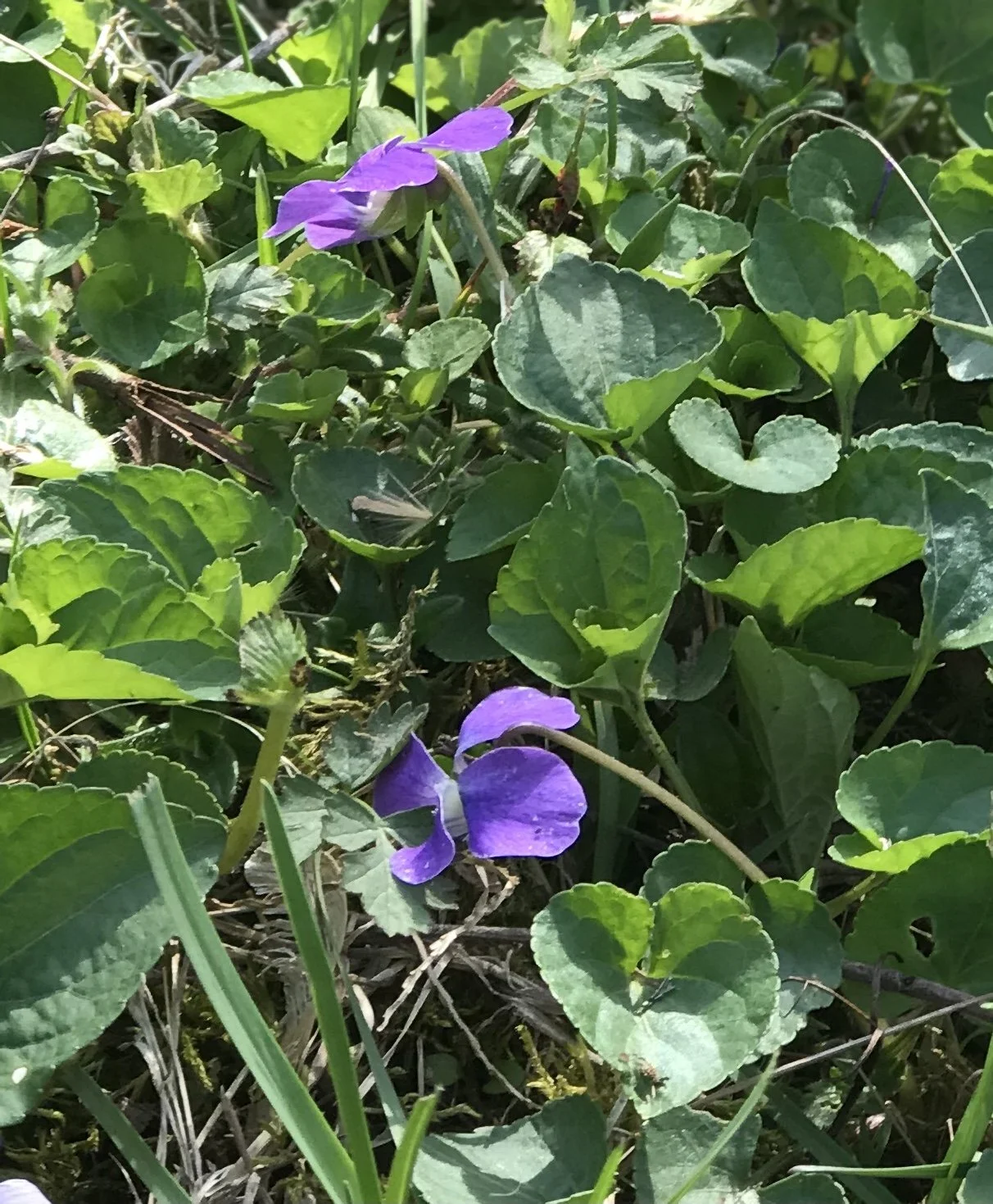
When you see a violet shivering at your feet in a low and sharp early spring wind, it’s all you can do not to kneel down and shelter it with your hands, gather it up into your warmth. But there are hundreds of them trembling in the cold, and how does one hug a meadow full of wildflowers?
There are patches of them everywhere, white and pale lavender to deep purple and the frost is so unforgiving, but these tiny harbingers of new life hang tough among the chilled blades of grass, trusting in the inevitable late morning sun’s thaw long after I’ve landed at work. I gingerly toe-step around them on the after-work walk and now they’re laughing in a kinder breeze.
As April wraps up and spring still figures out which side of the freezing mark she’s gonna land on, we’re already behind on our outdoor projects and that’s right on track for us. Someone (not to be named here, but you know her) signed us up for a second farmers’ market this summer and now begins the work of logistics duplication, from inventory to staffing to supplies. The good news is I get to buy another hand truck for the second market and it makes me happy. There are few tools on the “can’t imagine our lives without them” list, and a reliable working dolly is in a three-way tie for first place, alongside the two-wheeled garden cart and a freshly sharpened set of kitchen knives that allows us to close our own humble farm-to-table loop well beyond canning season.
When the office for your second (and bigger) job is framed by new grass and open skies, the mind tends to meander into areas encompassing the sublime and the ridiculous because there’s no one around to stop you. Raking through the compost in each of the raised garden beds, memories of singular events and experiences we’ve had on the land rose to the surface. I’ve only ever seen one single salamander in our twenty-three years as caretakers here, its sides painted with neon aqua stripes and matching dots down its back. And only once have I had the unique privilege to witness a pair of snapping turtles mating in the creek as a gentle flow of busy water washed over them (I don’t want to be indelicate here, but suffice to say, their hard shells and short legs didn’t impede them on the way to turtle bliss. Of course I gave them some privacy). On the day we visited the land as potential buyers all those years ago, we saw a pair of redtail hawks lock talons and spiral down in a vertical tunnel of love and species propagation the likes of which has not been repeated in our view. We’ve only ever lugged sleeping bags out to the sweat lodge one time to catch a glimpse of the Leonids in November (a spectacle that conveniently shows up around the time of our wedding anniversary and isn’t that romantic). I saw more meteors that night than Patrick did, no matter how many times he changed viewing position on the frozen ground at the base of a half-circle of young white pine saplings. I stopped saying “oooh—there’s another one” about six meteors in just because that was the kinder thing to do.
I finished the day’s garden prep work and mind-wandering with a “to be continued” ellipsis at the end of my thoughts and have since used my waiting time in line at the bank and the grocery store wisely, adding these to the list of one-hit land wonders I suspect will expand in perpetuity, long after I’ve made my Walk:
A spectacular post-storm vista over the eastern field that included a 3/4 rainbow with a rising full moon perfectly centered beneath its arc.
Watching a turkey vulture snatch up a young rabbit from this same field and soar upward with our first kitten, Scout, hanging onto the poor critter’s other end until it dawned on him that letting go was the better choice.
Walking through the flooded paths back to the woods, wearing my new Quality Farm & Fleet wellies right after a torrential downpour only to lose my right foot into the inky depths of a hidden gopher hole, filling my boot with rainwater right up to the rim (the schlooping sucking sound it made as I pulled my booted foot out was loud and juicy over my hysterical laughter).
The storm that layered four thick inches of ice on the barn roof, collapsing the trusses over six pregnant Boer goats who went into hard labor for the next 47 hours after Patrick and I frantically chipped away at the ice that froze our Guinea hens’ little feet to their outdoor roost (epilogue to that one: everyone survived their respective ordeals and the barn roof looked like a swayback mare until my talented brother, Mike, hitched up his toolbelt and set those trusses right again. We’ve long since given up the goat farming but that barn is ready for the next adventure as soon as we figure out what that is).
None of these events (see also: incidents, episodes, character-building growth experiences) has been matched or repeated, in part due to chaos theory and other right time/right place variables. The rest leaned heavily on honing our city kids-turned-country dwellers’ better judgment, where we learned to begin each trouble-shooting discussion with the phrase “remember the last time…?” and carefully considered our options from there. We’re neither thrill-seekers nor shrinking violets; we just receive what’s put down in front of us and give our creativity a thorough workout. Since it’s likely we’ll not raise goats again, I doubt we’ll see another collapsed barn roof kidding season in our future but who’s to say that Tink, our newest kitten in the clan, might not want to play tug-of-war with some bird of prey later this year over the furry field catch of the day? I’ll be torn between capturing it on the iPhone I didn’t have when Scout was dangling yards above the clover or reaching up to grab Tink’s back legs, adding my weight to the weirdest food chain in flight few have ever seen on a summer afternoon.
If you like variety, with no promise of reruns, this is the place.

Spring: The Season of Perspective
My hunger is never satisfied but I don’t feel greedy. Maybe someday I’ll figure out how that works.
While we were busy with Other Things, the young silver maple saplings in the far northeast field stretched themselves upward oh, say, another three feet or so and if we get to live here another twenty-three years, the humble and bumpy walking path Patrick carved out with a rented walk-behind brush hog mower will become a shrouded forest path where future fallen leaves will soften our footsteps. Parents reading this, please tell me you understand. Without children of our own, I can only imagine what it’s like to tuck your toddler into bed one night and find her filling out the paperwork for her temporary driver’s license the next morning, asking for your signature in the “parent/guardian” section and hoping you’ll cover her first six months’ insurance payments. Caring for any living thing from the beginning is a never-ending double take and don’t blink existence.
I try to live in the present moment, truly I do, and I fancy myself a fairly decent noticer of my surroundings, but each morning’s walk sends me right back to “Paying Attention" preschool. Whenever time allows, I dawdle and mosey about the paths, stepping off of them now and again to inspect new treefalls and one particularly curious patch of freshly turned and crumbled earth—two holes separated by about seven inches of undisturbed grass. Not sure what the digger was looking for; they appeared to have lost interest and moved on, leaving behind a nice ankle-turner for someone (me) on the day everything is covered in snow and the edges of the walking path are anyone’s guess. Maybe writing it down here will help me remember and save us all a trip to the ER.
If Thoreau went to the woods to live deliberately, I walk the land to reset my spiritual password, to freshen up my outlook and scrub off another layer of complacency’s thick skin. Let’s call it mindfulness exfoliation and, guess what? It works, every time. To have a wellness strategy so unflinchingly reliable is both responsibility and pure gift, and it shares the company of only a few others (Patrick, water, breathing). They are mine to employ or ignore, with risks on both sides. But I never regret the decision to suit up and step out, covering the better part of seventeen acres in just less than an hour. If not for a day job that keeps our creditors happy and the fridge full of options, who knows if I’d ever come back to the house? There’s just so much to see out there, to notice and register and revel in, a perpetual party with a buffet that keeps refilling itself to feed each and every one of my senses. My hunger is never satisfied but I don’t feel greedy. Maybe someday I’ll figure out how that works.
Until then, I come to a place on the field path (and in my thoughts) where I realize the impermanence of it all. At some unknown hour, my feet will no longer make contact with this generous and forgiving soil. The box elders by the chicken coop, that we didn’t plant or have anything to do with except leave them alone, will lay down and be finished in their growth, and a different flock of sparrows than the one we currently know will take to flitting from one dead branch to another, their chirps heard by someone else (human or not). The trees I lean against and whisper my thanks to will give shade and shelter to other visitors or be moved once and for all to a different interpretation of who they currently are. I don’t linger in this mind space but for a few moments, long enough to appreciate that what I’m standing on, surrounded by and tending to in This Moment is all there is, and all that matters. Then it’s onward through the meadow to make a note that it might be helpful for me to learn how to use the smaller chainsaw and finish a fallen old mulberry’s dramatic exit, stacking the chunks of its trunk and limbs for a future sweat fire or one of Patrick’s masterful wood-turned works of art. To-do lists have a way of keeping the existential and melancholic at bay.
At last count, 56 of the tulips I planted last fall have zoomed past the soil line, taking in the warmer days with great joy and purpose. The deer have found a handful planted beneath a perfectly shaped mulberry sapling in the garden and after rooting up the bulbs, decided to leave the remaining ones alone. September’s fallen buckeyes and horse chestnuts on both sides of the gravely driveway have pushed themselves up through the scattered leaf mulch, determined to reforest the area that our local electric company slashed and poisoned beneath the power lines strung above the creek. We’ll gently relocate as many of these young ones as we can in the eastern field, along with more volunteer maple and sycamore saplings until we’ve got a going arboreal concern.
Impermanent? Yes, every bit of it.
Still worth the effort?
You bet.
The Calm After the Storm
The roaring wind pushed through us all without apology.
I clear the path of fallen branches because it’s Sunday and I have more time for such industrious dawdling on the morning walk.
Weekday excursions are a more focused affair, with poetic encounters and soul-cleansing gratitude, to be sure, but always an eye on the inner clock that gets me to work more or less on time. But Sunday walks…ahhh…they are the blank page opened before my willing feet, a time to stroll more leisurely among the coming season’s project list and on occasion, take the trimmers with me, listening to the laughter of a blackberry vine’s thorns echo in my ears long after I return to the house.
A second straight weekend of straight-line winds with 55mph gusts drove some of the arms and fingers of our walnuts and maples into the ground, like nails into soft wood. They poke out randomly along the path at rakish angles and I leave them be, an art installation to surprise our next round of house guests. Large deer hoofprints wend their way among the sticks, crisscrossed with raccoon and coyote pawprints and a leaving or two of their scat, which I’m rather impressed I can identify by now. We are never alone here, and it’s most reassuring to step among the proof of that. The tiniest of twigs carpet the ground and I resist the temptation to build little fairy houses out of them, knowing that a day’s worth of granola baking awaits me in the warmth of our clean kitchen. A project for a warmer, less scheduled day, and in the presence of imaginative children who are dear to us.
There are certain trees that I visit on the walk, one of them a young sycamore sapling I found a couple of years ago, bent double to the ground after an early summer windfest, broken save for a strap of her sinewy bark holding both halves precariously together. I ran back to the house and scrambled frantically among my cotton sheeting scraps like a wartime Red Cross volunteer looking for bandages and found just enough to wrap the wound and set her upright again. I tethered her young trunk gently to a rusty t-post I grabbed from the potting shed on my way back to where she lay patiently wondering what could be done to save her. She took her medicine well and has survived half a dozen such storms since, determined to heal and grow into the unfolding seasons in perpetuity (fingers crossed, touch wood). We have that in common, so I stop and greet her each time I walk, wrapping my hand around the coolness of her slender branches one at a time. I press my cheek against a lower limb that stretches toward the west and tell her how proud I am of her tenacity. I’ll pass by her again on my double loop through the field, so we agree to save our farewells until then.
About twenty feet off the main path, I step into a mixed grove of blue beech, towering black walnuts and assorted ash trees, well-established and clearly the gatekeepers of this diverse vertical community, leaning my forehead against their rough bark one at a time as I exhale a whispered good morning and thank you to start our respective days. The reasoning of the wind is beyond my simple comprehension, so I’ve stopped asking why these sentinels are still standing while others lay at their feet, spent and taken too soon. Since it’s still Sunday, I settle myself onto the huge trunk of a fallen black walnut stripped of its bark and wait for the overture to begin.
It opens with the single staccato tapping of a woodpecker I can’t see, boring a hole into both tree and silence with regular pauses, the timing of which I can’t sequence. He solos for several minutes this way until another one takes up the sound on its own perch several yards to the south. Having made their point, the woods go quiet until a trio of Canada geese honk their way overhead, the leader’s wingspan missing two of its feathers on the right as their song fades into the distance. Next comes the deer snorting section of the orchestra and now we’re in a full on symphony that blurs the line between rehearsal and performance. I realize it would be a tad improper to leap up and burst into applause, so I re-set my wonder and gratitude to an inward place where I will store this scene for all eternity. No intermission in this Concert of All Living Things, and it never, ever ends.
Can it be that it was just yesterday at this exact time the wind was playing the trees’ canopies like so many stringed instruments, plucking at and rubbing their woody fingers together, relentlessly coaxing out mournful melodies for hour upon hour? How can it be, this contrast of motion and near-silence that envelopes us all, as if nothing even happened on the back side of last night’s sunset? We all found our own ways to work around the previous day’s drama—the market managers wisely moved us back inside to the winter season location (we were to relocate outside for April until they saw the forecast), cardinals still scritched out their cheerful calls and white-throated sparrows chased each other in the mulberry branches, while specks of high-flying redtail hawks caught the thermals and coasted across the cloud-scuttled sky. The roaring wind pushed through us all without apology. I left the front deck’s yellow wooden bench on the lawn where it landed, promising to put it back once things had settled down a bit. Patrick and I stooped to gather branches that were everywhere on the grass around the house, snapping them over our knees so they’d fit better in the garden cart that we’d later wheel back to the sweat lodge and add to the kindling pile. I called up the morning’s image of that forest symphony and smiled inwardly at our bend toward activity even while cherishing those moments of stillness.
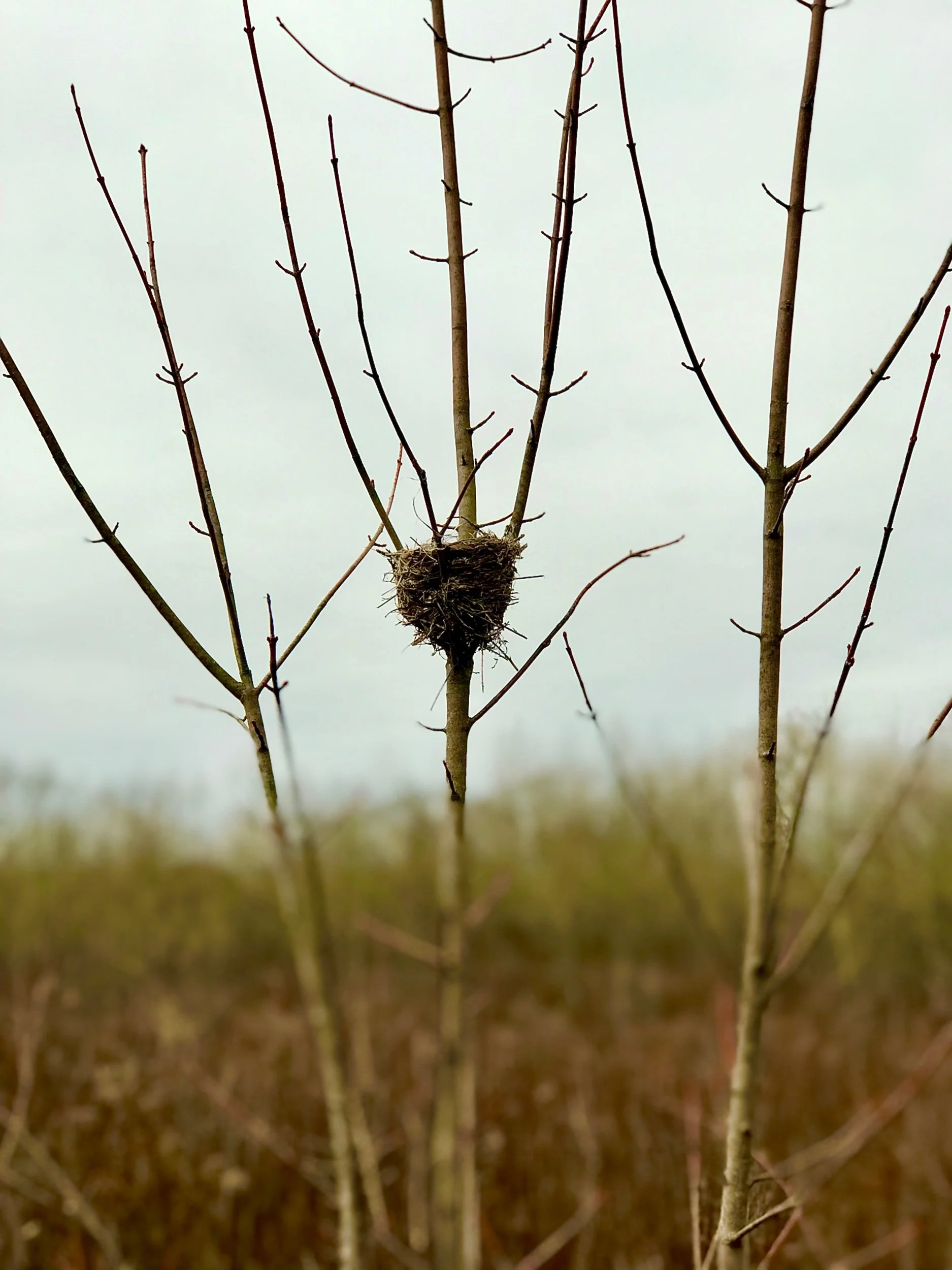
Out among the hundreds of hopeful silver and red maple saplings in the field just south of the woods, a small nest (architect yet unidentified) sits in the crotch of one of them, securely anchored and unassuming in its durability. I’ve watched it for the past year, unmoved by the storms of the last three seasons, perfectly shaped, intact and going nowhere. Brambles climb toward it now but it seems not to notice at all, just content to be its strong and quietly confident self, having served its purpose last spring as dwelling and incubator for its long-gone temporary residents. I doubt new renters will move in this spring but who knows? Real estate this sturdy won’t stay vacant for very long. Like those select trees I’ve come to know and understand even a little, I pause on the walk and consider what this nest is teaching me, setting aside my own misguided hubris to listen carefully. Whatever storms may come as the next few months unfold, I hope we’ll both endure, with quiet confidence and grace.