
Seeking Shelter
I still stand beneath them all and wonder where summer went.
A pale autumn sun sipped at the night’s last stars and while my back was turned, swallowed the moon’s sideways smile in one soundless gulp as I made my way back to the woods. On the other side of a marathon market weekend (three events in two days—a lot for us), I welcome the softer start to my morning and the chance to get reacquainted with something other than parchment-lined baking pans and the aroma of cinnamon. No matter how bone-tired I am, or how challenging the elements, I never regret the decision to walk the land.
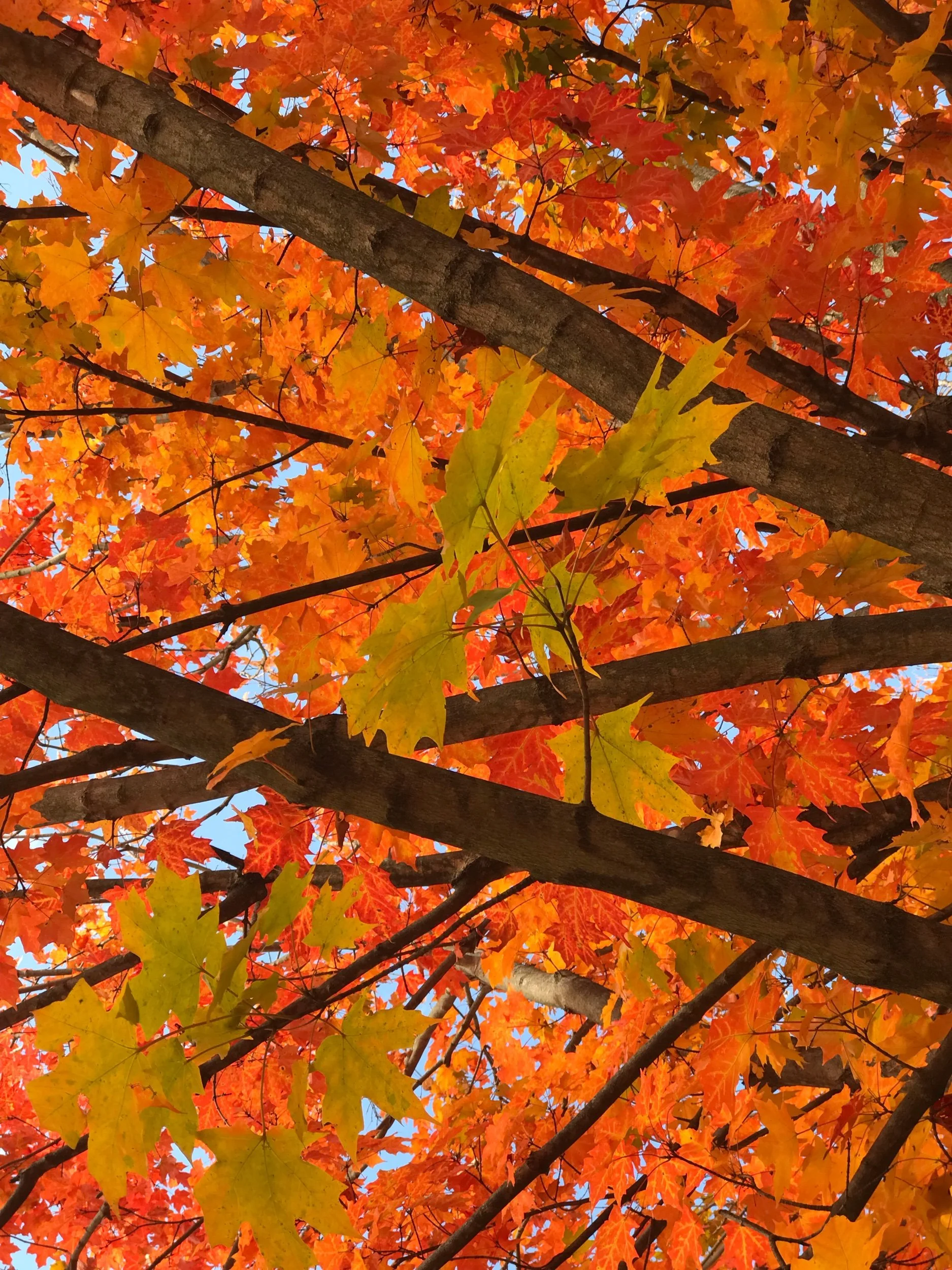
It’s a color carnival out there this year and I’m not the only one who’s noticed. Each tree is vivid and unstoppable. Everyone’s talking about it at work, posting views from their front windows and driveway aprons on every social media site within hand’s reach, displaying an ombre of oranges and reds, deep rich mustards and translucent saffrons from the silver maple out back, edged in a crimson bleed. Somebody get Crayola on the phone—they might wanna update their deluxe box of sixty-fours, or at least dedicate a collection to the season.
I like how nature seems to have arranged for the trees to shed their leaves on some sort of rotation schedule—the sycamores first, all crispy brown caramel and milk chocolate, then silver and red maples taking their time dropping a leaf here, five there. The black walnuts shimmer their golden dresses down to the ground the minute a good breeze comes through, and I watch the kittens jump to catch them in the driveway, unable to resist all that twisting movement and sideways fluttering. And the sweet gums with their calicoed tunics, one tree sporting a deep beet-red collar at the top of its canopy while the rest of its leaves move from orange to yellow to pale celery. If rainbows were trees…(much gratitude to friends Deb and Mike for sharing about 50 young saplings from their place one day after Thanksgiving, getting them all tucked into our waiting landscape. The butternut squash soup and homemade bread we shared wasn’t nearly enough of a thank you).
What a shock it would be for the leaves to all drop at once without warning, no gradual easing into the cold exposed months of winter. This slow and measured transition feels kind and motherly and we receive it as gift for spirits already raw from the abruptness of life’s other harsh about-face moments. But I still stand beneath them all and wonder where summer went. Just six weeks ago, they gave us respite from a stronger and more determined sun as we plucked errant bindweed and thistles from the garden’s raised beds. Now their bare arms and fingers reach for a cooler sky about to go brittle in the span of another six weeks. Good thing I’m romantic about the views that surround me. I’ll try to remember that when I’m schlooping my way through the slush and ice on my way to the coop to see if the girls even want to leave their cozy pine shavings-fluffed bed and peck at the grain scattered in the morning’s snow.
Friends, life has been even heavier lately. In a staffing restructuring at work, I lost my admin and am working with my other teammate to take on the duties left behind, most of which we haven’t touched for four years. She took another position in the company, so we’ll still get to see her, thank goodness, but the gap in our team is a sinking feeling in the pit of my stomach that I haven’t been able to shake yet. I’ve taken to fretting again about how Patrick and I will age (it’s an episodic theme that surfaces this time of year as our bodies slow down and we walk reluctantly into the shrinking light of the next two months). The headlines continue to test the elasticity of one’s heart with the brutality of Russia’s war against Ukraine, cholera plaguing the good souls of flood-ravaged Nigeria and just last night, a crowd surge at a Halloween event in Seoul that left over 150 young adults trampled to their deaths. I know I should stop scrolling, and I do, but there are still too many unnecessary empty chairs at tables these days whether I’m reading about them or not.
So I suit up and head outside, walking sticks in hand and beg the trees for just another day of their comforting shelter, understanding that we’ll need to face the bare days of winter together, looking for grace and beauty wherever we can find it. When I wonder if I’m up to the task, Patrick greets me at the end of a workday with a pot of vegetable soup simmering and steaming up the kitchen windows. He smiles and pulls me in for a “how was your day” embrace and I reshape my definitions of shelter and protection, instantly and deeply aware of what I have, resolved not to take it for granted. It’s within my grasp and influence, this posture of humility and also my moral duty. I’ll keep asking “what else can I do?” and quiet my worried heart to hear the answer. Meanwhile, there’s a mulberry in the meadow, still shaking her green branches at us and I wonder what she knows that her ash and cottonwood neighbors don’t. She guards the creek as squirrels run up and down her trunk and across the grass at her feet, saying “not yet, not yet. When I’m ready.” Teachers are everywhere here.
So I’ll keep taking my tires bones out to the woods. I’ll remember the colors across the fields, throwing all my trust into a spring that so far keeps coming back to dress our trees in reassuring garments of hope and growth.
That’s what “what else?” looks like from here.

Alphas, Omegas, and the Stuff in Between
These days, I find myself comfortably going to those mind-attic places, unpacking the dusty boxes and trunks of my life lived so far, and holding the contents to my chest in reverence, gratitude and love.
A few weeks ago on a Friday, I met a young man who irons his paper money without explanation or apology. The next morning, I watched a cobweb spinner slowly descend from the kitchen cabinet on a single silken strand and come to rest near a splash of water on the counter, fold its long legs inward like the metal frame of a market canopy and take a drink.
Two unrelated firsts at my age (having just rounded the corner on a milestone birthday easily divisible by ten) giving further evidence that simply waking up is a worthy endeavor and, as my hospice work has taught me, a privilege denied to many. With wonders like these waiting for me in the dawn’s early light, I don’t even use an alarm clock anymore.
I also don’t intentionally pursue such moments; they just cut across my path and I notice them deeply for as long as it takes to gather the data and process it through filters that include humor, curiosity and precious little judgment. I’ll be the first to tell anyone that I’m late to most parties (ask me when I started using Facebook or tapping my feet to One Direction’s music…well past their launch dates, I assure you) and tend toward wonder that masquerades too often as ignorance, but I know the difference and will argue for it when given the chance. A long-winded description of simply being open, but there it is.
So fast forward to last Sunday, when a dear friend from my early adolescence paid us a visit all the way from South Carolina—my first boyfriend at the tender age of thirteen, and we’ve stayed in touch all these decades—and here he is, sitting in an antique chair across from Patrick, my current and last boyfriend, sharing stories about being restaurant managers. It was a relaxed and easy exchange, as if they’d grown up together on the same street and played kickball after school. Without effort, their conversation never wandered into the arena of what else they both had in common (and I was sitting right there, hard to miss) except for a few quick playful comments when Patrick offered a cup of coffee and my friend responded wryly, “should I drink it?” In the two or so hours that followed, I both participated and observed, finding a place to perch in my memories that covered the ground between thirteen and sixty. Playing guitar at all-school masses in the gymnasium, heading off to college and registering a slight twinge of homesickness as my parents’ station wagon disappeared around the corner of the dormitory where they’d dropped me off, navigating other relationships with a good heart and a good dose of naivete, riding my bike to my job at the health food store across town, becoming a preacher, teacher and bookbinder, learning to make scones, raise goats and drive a zero-turn mower. It all fit neatly in between the alpha and omega of these two cherished men in my living room, with so much more waiting to be called up and remembered. Whuff…the richness of one life touched by two more. I can barely wrap my head around it.
I suppose that’s one of the tasks of growing older, remembering where we’ve been, how far we’ve come and how far we still have to go before we get to What’s Next. I’m up for it, truly, and understand the risk of putting too soft an edge on those times that brought me to my knees. But if I fell down seven, I got up eight and fist-pumped my way to the next lesson a bit smarter (I hope—all evidence to the good, so far). These days, I find myself comfortably going to those mind-attic places, unpacking the dusty boxes and trunks of my life lived so far, and holding the contents to my chest in reverence, gratitude and love. I’m still here. I still get to collect such treasures. I am so, so lucky. It’s the refrain of my days, a soundtrack that never gets old (even as I do). And I’m not ready to start tracking “lasts” yet. Of course, anything I do as the earth rotates could be the last of its kind but I don’t want to sit in that swamp of thoughts just now. It’s rarely helpful and puts rather a damper on the party.
Here’s to the firsts still to come, to the lasts that lie safe in our hearts and all the unheralded moments in between that feed us. What a banquet, my friends. What a feast.
The Reminder
Wedged snugly in the line of trees that caught it, this gentle giant wasn’t going anywhere.
I walk past it most days, though I wasn’t there when it happened.
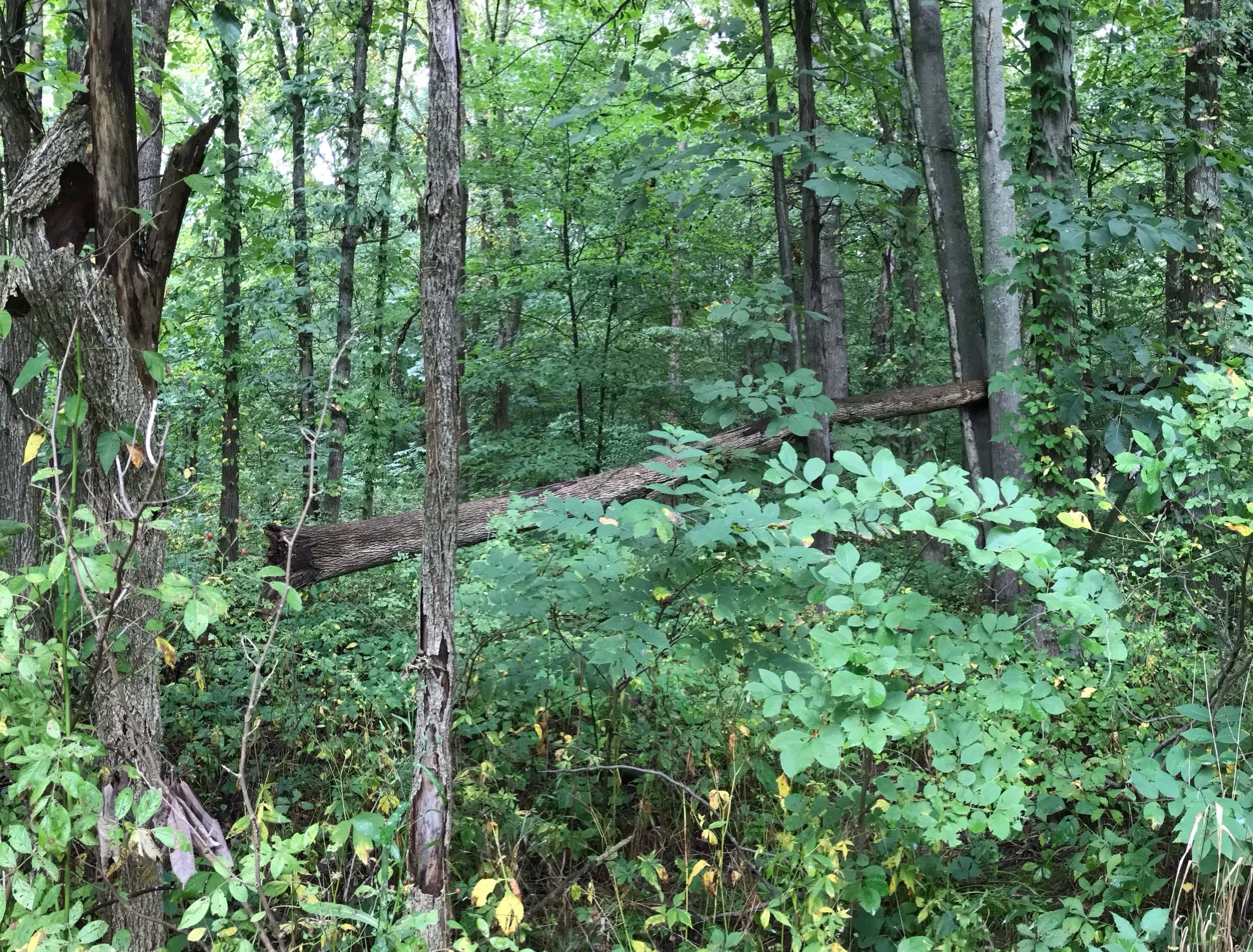
Just inside the woods that thicken up the north edge of the field, about six yards in, a stand of young black walnut and blue beech saplings holds the body of a much larger fallen ash, suspended four feet above ground. It looks almost staged, an art installation set in place by some invisible human hand.
I first came upon the scene three years ago, the day after a fierce storm flattened what remained of the open field’s goldenrod, thistle and ironweed stalks and left gaping holes in the forest’s canopy, taking out hollowed and vigorous trees alike. I pushed through the brambles and Virginia creeper, approaching it with a respectful curiosity tempered with caution (widow makers like these are everywhere in the woods; perhaps it wasn’t done falling). As I gingerly placed my hand on the grooved bark, I felt the solid heavy length of wood beneath. Wedged snugly in the line of trees that caught it, this gentle giant wasn’t going anywhere. In the morning walks that followed, I tried to find the sheared-off stump and couldn’t, feeding my ever-hungry love of questions that have no answers. The forest had apparently held its own retreat, conducted a trust fall activity for its participants and I got to bear witness to the small group that stayed behind still cradling one of its own. On one particular walk, for no particular reason, I whispered "“hello, Wonder of Physics” as I went by, and this benedictive ritual wove its way into my daily steps, becoming once again prayer and acknowledgement of my place in the scheme of things. Many steps and sunrises later, that whispered greeting has grown into the following: “Hello, Wonder of Physics, Testament to Interdependence, Evidence of Community, Example of Support, Sign of Trust, Thing of Beauty”. I then lower my gaze and ask whatever leaves and wood rot might be listening, “may I be some or all of that for someone today” and keep walking, intent on making that promise stick before my head hits the pillow so many hours later.
Not a bad way to start the day.
Patrick and I live in the belly of a perpetual classroom with endless teachers, some of whom we’ve never met, whose lessons are delivered while we sleep. While our shared existence has no grand and singular Purpose, we are rooted in and pivot from an anchored place of attentiveness as we move through our days. It’s exhilarating and exhausting and sometimes we miss things. But those lessons are always there, on the other side of windows and doors that we try to leave open for as long as the seasons allow. It’s wondrous how the same apple tree on the edge of the meadow has something slightly new to reveal each time I stand beneath her slender branches. When I stop to pat the ring-striped bark of her trunk, I smile and imagine who she’s fed in her lifetime. Who have I fed in my lifetime? No comparison and yet, we’re both doing our best with what we are. Thank you, sister.
I walk on good days and not-so-good days, and I don’t mean the weather (editorial note: the weather is neither, since it doesn’t exist to please us. If we find rain or the endlessness of February uncomfortable, that’s ours to reckon with. The universe isn’t arranged for our convenience). Sometimes, I boot up and step out, all preoccupied and self-absorbed, and the land receives it just as generously as she does my full attention, healing me no matter what I think I need. Troubled thoughts are composted until they become a fresh outlook, a more honest perspective, all of which usually resolves by the time I get back to the house. I feel a slight twinge on the way to work, wishing I hadn’t squandered all my walking time being harsh and judg-y about others (or myself). Maybe I’ll get to try again tomorrow.
When I do get that chance, I slow down on the path as I come to that place of Humility, and now the dead ash’s bark is hanging in strips from the solid wood beneath, on its way to becoming some other being’s home, or breakfast, or day’s work to recycle. It’s still a wonder, still evidence that living things are designed, designed, to support one another and that includes the human community too. Call it luck or burden or both; we are asked to join in and do the best we can. Lessons like these are to be carried forward; this place of majesty, mystery and wonder on the path reminds me to do just that.
Dear reader, whom will you catch in your strong and capable arms today? How will you live up to the Wonder of Physics that you are? Are you willing to be someone’s evidence that community is not just possible but real? And can you claim your own beauty without question, denial or false modesty?
Fellow student of life, I deeply and sincerely hope you’ll consider it.
A Love Letter to Sound
Face-up on the massage table, I let the tears run down my temples and past the top curve of my ears, enchanted and profoundly, wordlessly grateful.
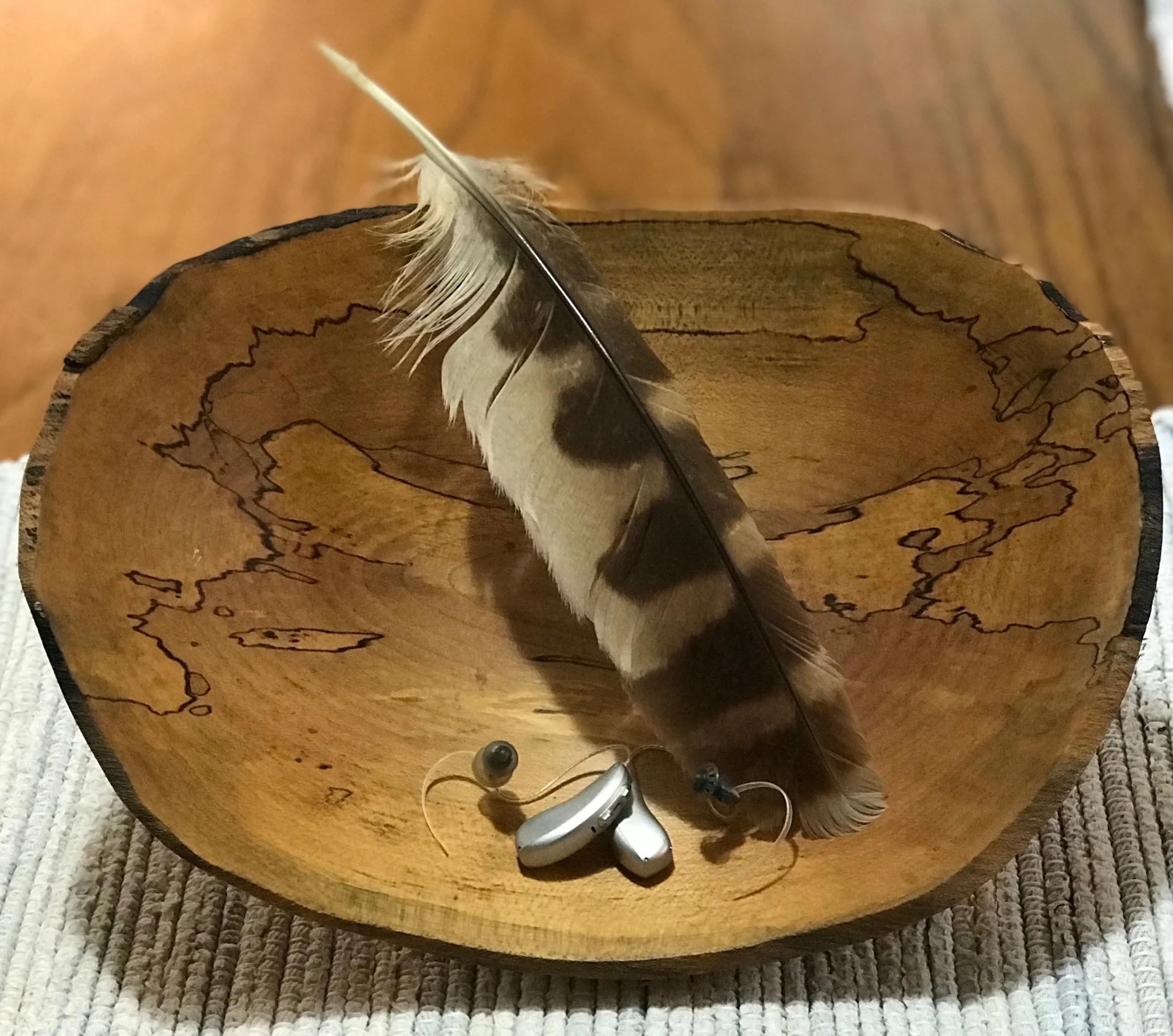
I took my hearing aids for their first walk in the woods the day after I got them, and my brain is still unpacking what I didn’t know I’d been missing.
Apparently, bird communities above my head arrange themselves in layers, hidden from sight most of the time save for a quick flash of wings and teasing me with their throat-filled songs as my head swivels about trying to spot them in the canopy. It’s an audible melange of industrious woodpeckers, taunting crows, the sharp scolding tones of a single blue jay and a handful of laughing towhees. I stand small below their feathers and tiny talons, at the base of trees that will always know more than I do, captivated and reluctant to continue on with the morning walk. Can’t I just stay here, in this green gilded place where time dissolves into the Eternal Now?
And did you know that a wet sycamore leaf underfoot has its own song to sing, a squishy and slurping sort of refrain that settles right behind the speaker nestled snugly in my ear canal while my feet keep sliding forward along the path, kicking more sounds upward to live in my head?
I am overwhelmed and overstimulated. And loving every minute of it.
Twenty some years ago, I had surgery to correct what was at the time significant hearing loss in both ears, caused by otosclerosis, a condition that renders the stapes immovable. The procedure, called a stapedectomy, replaces the smallest bone on earth with an equally small platinum filament that, when successfully implanted, gets right to work, doing its portion of the mighty and miraculous enterprise of carrying sound through our ears to our brains for processing, interpretation and sheer wonder. I had this done twice (once for each ear), six months apart and still recall the moment when I heard the water from a small desktop fountain in the room where I took my bi-weekly massages trickle and whisper down the resin and miniature rocky cliffs to land with a soft splash in the inch-deep reservoir at the base of the device. Face-up on the massage table, I let the tears run down my temples and past the top curve of my ears, enchanted and profoundly, wordlessly grateful. In the days and years that unfolded, I drank in every drop of sound around me. Woodpeckers who lived in the black walnuts and ash trees that lined the creek had been there for years and I never knew. The hum of traffic on Rt 661 a mile beyond the tree-lined farm fields felt loud and intrusive as I turned the corner on the walking path that skirted the western edge of the old cornfield. Patrick, has it always been that loud? I stopped cupping my left ear in conference room meetings at work to hear our soft-spoken medical director offer charting advice to one of the team’s nurses; her gentle tones landed clear and kind from the far end of the oval table.
When I’d noticed earlier this year that I couldn’t hear Patrick’s rhythmic breathing at night while sleeping on my left side, couldn’t hear the sparrows in the mulberries just on the other side of the bedroom window’s screen, I calmly made an appointment with the wizard physician whose skill had brought me back into a louder world all those years ago. The hearing tests confirmed what I’d suspected: my stapedectomies’ warranty had pretty much expired and it was time to consider other options, one of which was to do nothing. That surprised me, especially since the good doctor had discovered a small hole in my right eardrum. “It’s not urgent that we fix that, given its size”, he said. “Just don’t go swimming in any dirty lakes.” All other options were laid out before me, from redoing the stapedectomies to fixing the eardrum to trying hearing aids, each accompanied by a sliding scale of risk and benefits (and expense). Hearing aids intrigued me as the least invasive and most economical, though I wasn’t going to let cost alone drive my decision. I have yet to put an exact price on hearing Patrick tell me about his day or the papery sound of a just-plucked ground cherry’s husk in my fingertips.
So here I am, two weeks and some change from that first extended consultation with the hearing specialist who showed me how to put the almost-weightless apparatus behind each ear and insert the tiny dome-covered speaker into my ear canal, then hold the button for six seconds until the magic began. I now register every click of a coworker’s heels on the laminate wood flooring of our lobby, the piercing beep of the lunchroom’s microwave telling me my leftover cumin noodles and chicken are done warming up. The car groans and rattles in ways I haven’t heard before (a bit unnerving) and I’m certain I can hear two cotton balls rubbing against each other in their resealable bag hanging from the pegboard hooks at a nearby drugstore. Each maple leaf’s rustle in the late summer breeze is distinct, different and almost too much to bear. I suspect it won’t be long before I’ll be able to hear what Patrick is thinking (a prospect that worries us both). And it’s only been two weeks. There’s more to come, I know, and I’m bracing myself for it (eating raw carrots, pushing garlic cloves into the soil for next spring’s harvest, hearing the last of this season’s tomatoes ripen on their vines, the first snowflakes landing on the treated wood of the front deck and melting, the kittens shedding their fur before their morning naps…).
On that inaugural and audially indelible morning walk, the birdcalls and wet leaves and little fallen twigs and crickets who made themselves known to me now live in my head forever. I could have sworn I heard the sun reaching its golden fingers through the grove of musclewood trees as it hoisted up the day in all its cacophonous glory, a rich and still indescribable sound. I will keep walking until I find the words, which I secretly hope never happens as I move through this new adventure, grinning from one sound-soaked ear to the other.