

What Spring Does to an Open Heart
We’re suckers for this season and she knows it.
In the back of the Tacoma last Friday, two Black Tartarian cherry saplings rested on their sides, their tender slender trunks crossing each other as I took the last corners of the ride home more gently than I usually do. Here we are, twenty-three years later on this generous and patient piece of land, finally planting fruit trees. I don’t know what we were waiting for. A peach tree will soon join these two in the cut field to the east, where we used to pasture our meat chickens in the years when we had that kind of time.
Spring gets us all riled up and we foolishly reach beyond our capacity with wild dreams about that Country Living photoshoot of a garden, only to wind up with bindweed climbing the t-posts that barely hold up the orange snow fencing around the tomatoes and beets. We’re suckers for this season and she knows it, smiling indulgently upon our ferocious weeding sessions, all the while carrying on some secret arrangement with the stickseed and sumac shoots lurking just beneath the soil. We laugh together about it all and shake our heads, wondering when we’ll learn our lesson (so far, the answer to that is a resounding “never”). We know that fruit trees need a sort of semi-constant surveillance and some babying at the start, and we are motivated by the thought of our first cherry harvest to get us off the couch to cover them with netting when the first fruits appear. With summer approaching, I’m even considering pitching a tent to keep watch through the night.
My uncle’s recent gift of about forty tulip bulbs, descendants of my Opa’s collection that he meticulously tended during the last century, has me swooning and focused on their daily safety and welfare, the closest I’ll ever come to raising children (except for the cats, but they can live outdoors for days and no one will call the local authorities on us). I planted exactly ten on the northern edge of the new potato patch (still waiting for potatoes) and have seven left. Someone with paws or hooves neatly removed three of them in the night, not even trying to backfill the holes with any dirt. Three of the remaining seven have either bloomed or are about to burst forth in all their parrot-variety glory. It’s all I can do to not call in sick for work and camp out to witness that moment.
The other thirty are growing nicely in front of an old railroad tie that borders the mulched flowerbed in front of our living room windows. As if signaling some numerical significance, three of these stand in full bloom, lemon drop-yellow cups atop bright green stems. They are perfect and I can’t stop smiling at them. Only yesterday I noticed that the petals had begun to turn orange-y red on the edges and this morning, one is fully blushing with random red streaks (probably all that attention she’s getting…not used to it, I suppose). I remember reading in an “all things tea” magazine that tulip blooms are edible, and a photo display showed a tray of robust red and yellow ones filled with tarragon chicken salad. The accompanying article reassured the reader that the taste would be bland or at least delicate and I found the presentation quite elegant. But I’m not sure I could ever eat one…it feels too extravagant and I’m simply not done admiring them as they are yet. Maybe if I had a field full, I’d feel differently. I’ll keep you posted.
In other springtime land news, the morning walks are leading me to an eventual summer, as evidenced by the increasing number of silken spiderweb strands that crisscross my face as I make my way up the Hill on the western path that is quickly becoming its customary tunnel of green—sycamore and black walnut saplings entwined with voracious brambles. A spider’s real estate dream, every thorn an anchor for that first thread and once they get a-going, it won’t be long before I walk straight into a full-spoked spun wonder that will keep me blinking rapidly (and pointlessly, for nothing adheres to one’s lashes better than spider silk) until I get to the open field again. Most mornings it’s me and my two walking sticks but on occasion, I get this ambitious idea that I can singlehandedly free up each tree from its tangle of blackberry and grapevines on the strength of two swallows of rooibus tea and a pair of lopers. If I just did one each morning, the woods would be un-brambled by August. Yeah, right. I hear the distant laughter of some wiser and sentient being who seems eager for a front row seat to such folly. Of course I’ll oblige them and a good time will be had by all. We signed off on that agreement twenty-three years ago.
As the day’s agenda stretches out before us (and some of it already in the rearview mirror—three trays of granola cooling in the fridge, awaiting a late afternoon bagging and restocking session for the market), I fully expect more of this delicious season to work its way under my skin and fingernails until I’m all entwined like a sycamore sapling.
I hope no one with lopers thinks I need to be freed up anytime soon.
Getting There
Just when you think you’ve got something sorted out, a sudden yank of the rug beneath your feet and there you are, staring upward from your vantage point on the floor.
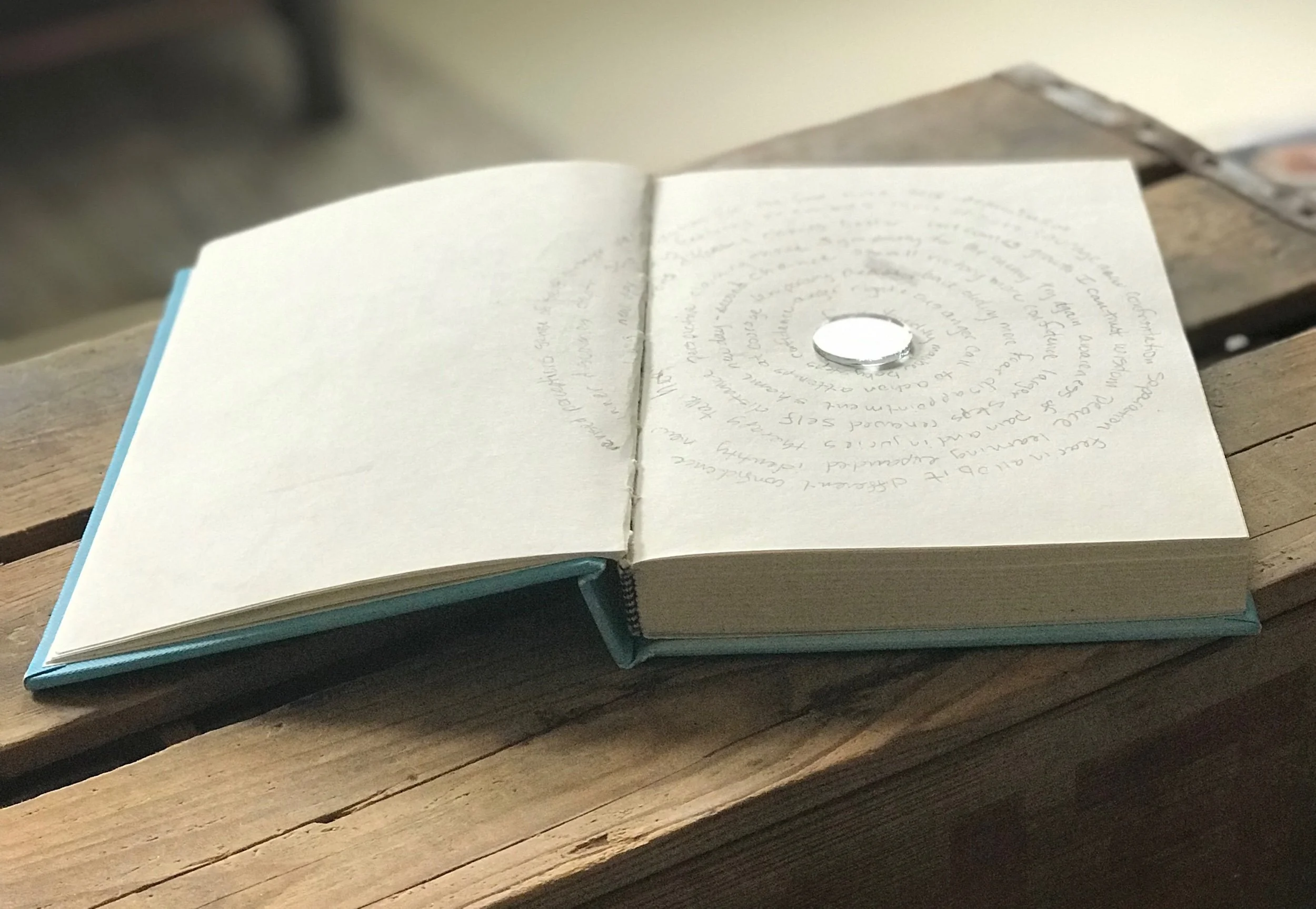
A few years ago, in a pebble-textured blue sketchbook I bought at the local indie bookstore, I practiced using a new set of colored pencils. I drew simple images, like daffodils on a rolling green hill, abstract angles and curves framed in rainbow dots that quickly wore the newly-sharpened tips of said pencils down to nubbins. A few turns on the pencil sharpener I inherited, the one that Dad had mounted on the wall near the door of his downstairs workshop at the family home, and I was back at it, shading in the distinct outlines of a tulip’s red petals and alternating between yellow and black for the bee making its way across the page.
Somewhere, though, my attention span (never really long to begin with) turned in another direction and I began to write, in short phrases and appropriate single words, the story of my journey from fear to compassion for the people who had made life difficult for me. It took the shape of a spiral. Hard to read (you have to keep turning the book in a circle and it made me nauseous after a few go-arounds) but no other physical arrangement of the words would have captured such an important and necessary outpouring. In the center of it all, I had glued a small circular piece of mirror that needs no further explanation.
I was rearranging the shelves in my studio a few months ago when I found this book—hadn’t gone looking for it—and sat for a moment in silent respect for the depth and breadth of these two pages. My fingers traced the edges of the tiny mirror and smudged it a bit as I recalled the years of abuse and bullying at the hands of a family member, the men who raped me, the therapists who reassured and released me from their guidance when the time was right, the husband who saved my life—literally—twice, and the days when sweet peace wasn’t just within reach but sat comfortably in my lap, no plans to go anywhere. None of these experiences moved in a one-way linear direction. My feet have doubled back on lessons I needed to learn more than once (usually in front of a couple of people), carrying me forward into healing and heartache in equal measure. And isn’t that how it goes? Just when you think you’ve got something sorted out, a sudden yank of the rug beneath your feet and there you are, staring upward from your vantage point on the floor, humbled and blank slate once again. Rinse and repeat say life’s instructions on the back of the bottle. I get up, towel off and head into my day. Like Dad used to say, “self-revelation is not for the squeamish.”
Neither saint nor victim, I considered what the spaces in between the carefully selected words and phrases held in their invisible silence. What choices had I made that moved me from “shame” and “righteous anger” to “sympathy for the enemy” and “necessary separation”? I recall a stretch of indifference that gave me a break from all the work of trying to understand the mind of a bully, the logic of an abuser. I came to understand denial as a valuable coping skill until I found my more confident feet and could stand sure-footed once again. And in an undefined, unchronicled moment, I introduced myself to the practice of compassion and forgiveness, finding a path to liberation and release. Some days it’s easier to get there than others, but I keep trying. I have forgiven the one who intimidated and controlled with fear and fists, the ones who took violently without asking, wondering what their lives must have been like to select, from all the tools in their toolkits, the most hurtful and abhorrent options. Even on my worst days I can still do better than that.
Two pages of graphite and a circle of mirror can certainly pack in a lot.
The story isn’t finished yet, and I don’t mean just because I’m still alive and typing these words. It’s good and healthy to look over your shoulder now and then to see where you’ve been before strapping on the backpack and heading into the next leg of the trip. I think about the current State of Affairs, with so much distance between us and our better selves right now, who we were created to become and what we’ve settled for as a human species. I wonder what my own personal experience of compassion and forgiveness could look like on a larger scale, if such a thing is even possible. The folks up the road with their “***k Biden” signs and Putin orchestrating chaos and horror more than five thousand miles from my spot here on the couch…how can I possibly touch that in any meaningful way? I don’t have an answer for that yet but compassion says to keep looking for it, so I do.
I have no idea what shape that part of the story will take, but one thing’s for sure—I’m gonna need a few more blank books and a heck of a lot more pencils.
In Good Company
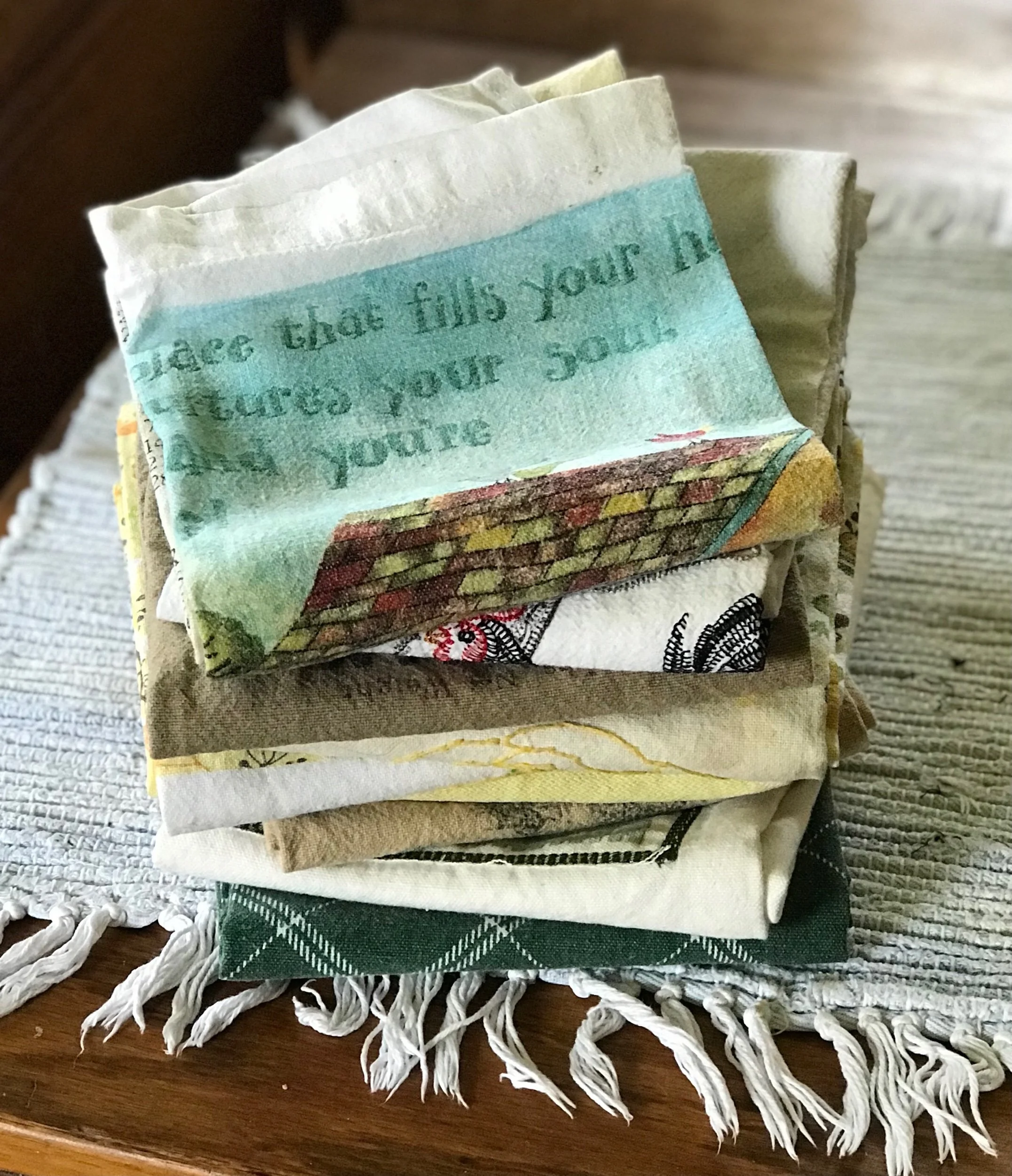
They sport mostly bunnies and bees, chickens, sunflowers and stripes in various designs from vintage to contemporary.
I have exactly twenty-two dish towels.
I only know this because today is all about the kitchen. I’ll be in it for several hours, restocking a few of our granola flavors for the market and in the flurry of gathering all the necessary supplies, I couldn’t resist a bit of tidying up. I opened the drawer of the Hoosier-style hutch where they live (alongside a stack of handmade cloth napkins) and touched each one, counting as I went.
Of these twenty-two dish towels, I purchased only five; the rest were given to me by dear friends and sisters or inherited from my mom when the family home was sorted and emptied of its tangible memories. We use each and every one of them at some point in the calendar’s unfolding. Small as our house is, the kitchen is rather roomy, second only in square footage to the living room, and there are strategic places to hang these towels after wiping down the long countertop and antique wooden kitchen table. Our stove can hold three of them from its oven door handle, as long as they’re folded lengthwise in thirds. So far, the kittens have resisted the temptation of playing with these dangling soft toys, distracted instead by food and each other’s tails. A damp one (towel, not kitten) drapes nicely over the stand mixer to the right of the sink to dry.
It’s gently surprising, in a comforting sort of way, how their presence cheers me. Laundry days are that much brighter for their presence among the line-dried pile waiting to be folded, because I remember the occasion that brought them into our home, the women friends who carefully selected each one before wrapping them up and handing them over as a thank you present for that evening’s dinner invitation. They sport mostly bunnies and bees, chickens and sunflowers in various designs from vintage to contemporary, and the holiday collection…well, those rich blue, burgundy and gold colors make a humble space look extraordinary any day of the year (I’m not a stickler for seasonal decorating; the ones with winter scenes of deer and snow-covered trees are as welcome in August as in the weeks leading up to Christmas). Function and decoration are the dish towel’s two-handed contribution to our daily rhythm and if you asked, I could tell the story behind each one.
What catches me today, though, are the feelings of warmth and appreciation for the women who gave them to me. When I hang the one Jen gave me that reads “Find the place that fills your heart and nurtures your soul, settle in and you’re home!“, I think of her baking prowess and creativity for her girls’ birthday cakes and how many other love-filled meals we’ve eaten at their table. My sister, Peggy, found a set that perfectly captures the vibe of our house in wintertime—a simple red clapboard house embroidered near the hem while snow falls softly around it, represented as a postage stamp. Peggy is all about hospitality and one glance at these towels puts me right in her generous presence. Jackie and I used to haunt antique stores together, so the ones that look like old feed sacks must have caught her eye at the Amish hardware store up north where she lives. The black outline of a rabbit rests atop a slogan for flour against a primitive tan background and it charms me every time I see it. My sister, Jane, brought us whimsical bees stitched on the border of a cream-colored towel whose texture is honeycombed. I know she wouldn’t mind that this towel has been loved through more than a few pasta dinners, as evidenced by the slight pinkish tinge to one of the bee’s wings after I hastily dabbed some tomato sauce splatters from the stovetop. We keep using it because we like bees and we love Jane. Patrick’s late aunt Gracie hand-embroidered sweet begonias on a set that she gave him at her ninetieth birthday party. Those will never see pasta sauce, I can assure you, but they do come out when the kitchen is all clean and begging for those bright yellows and greens as a finishing touch.
Of course, none of them match, not in theme or colors, and that’s the beauty of such a collection. Our days are an ever-shifting kaleidoscope of events and moods that would quickly outstrip the blandness of a monochromatic stack of pure functionality. We dress our kitchen accordingly, randomly and with memories that keep bringing us joy, wash after wash. But today, even more wonderful than all that, I will get to bake with Jen and Peggy and Jackie and Jane just a hand’s reach away, cheering me on as I measure, chop and stir, and Aunt Gracie overseeing it all in unblemished splendor.
I am surrounded by women who know what our kitchen means to me and it feels good.
Seven Deer
I chase ideas through the woods, listen for new and returning winged relatives tapping holes into dead trunks and wonder what will be asked of me today.
The hammock spinners are back.
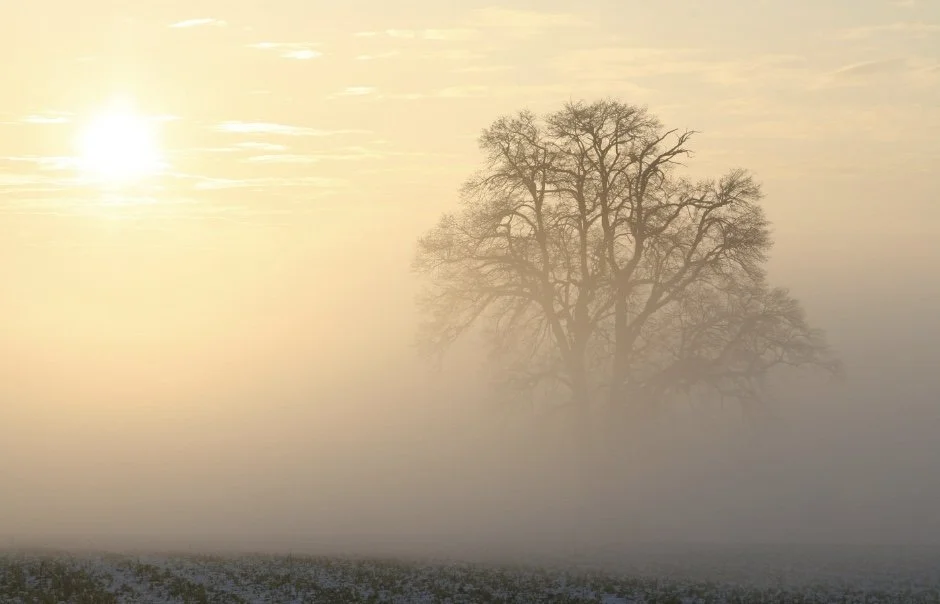
On a warmer than usual morning last week, the sun rose over their gossamer village, silken cups of arachnid architecture slung and hanging motionless from the dried tips of last year’s goldenrod stalks, the ones the winds couldn’t smack down. Thin cottony tufts of fog (known to us as the breath of God) move imperceptibly across the field, shape-shifting their way into the soft golden light of this fresh day. I move among them in silence, caught in a web of wonder.
Making my way to the southeast corner of the land on a diagonal path smoothed by Patrick’s skill on the mower, I headed toward the site where we buried what was left of the goat barn that burned to the ground one humid July while we slept. We call this spot '“the Grave” and it lies exactly opposite another memorial to the land’s pain, “the Wound”, in the far northwest corner some seventeen acres away. The previous owners leased this acreage to a local farmer who had cobbled together a patchwork of fields from different neighbors, growing the usual corn and soybeans on alternating annual rotations. We met him that spring we arrived on the land, shook his hand to continue the lease and got about planning our land blessing ceremony, not realizing he would cut down several mature trees along the property line so he and his farming equipment could access our field from the neighboring one. We discovered the damage during the land blessing and ended the arrangement the next day. It was a hard lesson in city-kid assumptions about rural handshakes and leased acreage, and a reminder that not everyone lives by the creed to ask permission before taking something. In the twenty-three years since, no trees have grown in that spot.
Somehow, though, between these two points of reckoning, a thriving and vibrant bowl of life has emerged and carries on; we get to traverse its expanse as often as we choose. The field is turning to woods one season and one section at a time as thick stands of rapidly maturing sycamore saplings fill in where the corn used to grow. Mockingbirds have made their secret nests in the uppermost branches of the black walnuts and blue beech and beneath their leafy canopies, the walking paths are a spongy carpet of moss I could easily nap on top of without a care (the minute the paths are dry, I promise). How does Spring still surprise us with its familiar newness each year? In January’s dark and bleak embrace, we wonder if we’ll ever see a hummingbird again and now here they are, buzzing us as we walk from the front deck to our car, demanding to know when the feeders will be refilled. Can the fireflies be far behind?
We need surprises these days. The shock and horror of the world’s ongoing wars and violence parade in front of our sickened faces each day and it’s impossible to look away as our sisters and brothers live through nightmares in their waking hours. If we really are all in this together and for the longest of long hauls, we need a season like spring to distract us even for a moment with her raucous avian symphonies, riots of color and warm reassuring breaths from the south that give us renewed strength for whatever will come. We cannot survive without beauty, spontaneity and moments of wonder. We rightfully hunger for spring’s generosity and kindness because we need to remember our own and then fling it in all directions.
I think that’s why I prefer to walk in the morning, just as the sky is shredding the darkness with shards of new light. I hold dawn’s hand and we step into what’s possible, what’s spread out at our feet to pick up and offer to someone else. I chase ideas through the woods, listen for new and returning winged relatives tapping holes into dead trunks and wonder what will be asked of me today. It’s anyone’s guess and I plan to show up for it, like those deer did last week…
There were seven of them and they were just ten feet away on the other side of the bathroom window’s wavy glass pane, browsing for new grass among the dead ironweed sticks. I saw them from the upstairs east-facing window first before racing down to get a better look, hoping not to startle them (need to do more research about a deer’s eyesight, how they register motion, what’s their peripheral vision like—all that stuff) as I went about my morning ablutions. Even more graceful and elegant up close, they slowly picked their way from one patch to the next, lifting their magnificent heads now and then when they heard or saw something I couldn’t see at all. A young buck was among them, seemed to be leading them farther south with his velvety antlers when it happened. I moved just one step closer to the window and all seven heads raised up, fourteen eyes on the movement they saw through the glass. As one, the herd leapt high, white tails pointing upward in near-perfect formation until their hooves found the path to the Grave, leaving me once again silent in wonder. Within minutes, I was dressed with walking sticks in hand and out the back mud room door to follow them, or at least find where those hooves met the soft chocolate earth.
Spring…it never gets old.