
Soup is Life
If you’ve ever made soup, you know about the importance of layering the flavors.
Patrick roasted a 24-pound turkey last Sunday (a Kroger substitution for the 11lb one we originally ordered) and…I think you know where this is going.
While we ate the inaugural dinner of tender breast slices and meaty legs accompanied by mashed potatoes and salad, the bones and roasting pan vegetables were bubbling into broth on the stove (he managed to put up six quarts, now bagged and resting in flat stacks in the freezer). We chatted casually about what else we might do with the remaining 23 pounds. The gravy he made was sublime and plentiful, so that became the base for a turkey and vegetable melange poured over baked potatoes Monday night, and pasta Tuesday night (ask me what I had for lunch at work Monday and Tuesday).
I chunked up a hefty portion of white meat and made turkey salad (let me just say, when you add some mayonnaise, a dollop or two of plain Greek yogurt, thinly sliced red onions, a spoonful of horseradish and a few shots of cayenne sauce, that’s pretty darn good sammich filling) and eyed a full container of dark meat sitting on the bottom shelf in the fridge with a measure of poultry fatigue. Wednesday’s meals were a blur of turkey swimming in something poured over something else, with a salad’s bright greens doing their best to liven up the monotony. I got good news on Thursday and decided to celebrate with a cauliflower pizza. Patrick good-naturedly muscled through the last of the turkey vegetable potpie.
Just curious—how much tryptophan is too much tryptophan? I’ve felt uncharacteristically mellow and relaxed all week.
When I got up yesterday, I made good on plans to try a new cranberry orange pecan granola (turned out a winner and will join the sellable lineup at the farmer’s market when we resume in February) and found a recipe for vegan lemony red lentil soup while scrolling through my morning breakfast. We had most of the ingredients on hand, so I dove in as the granola was cooling. If you’ve ever made soup, you know about the importance of layering the flavors. It’s not simply a “dump it all in the pot and hope for the best” proposition (just last Friday, someone gifted me with the wisdom, “hope is not a plan”, and I’m sharing that with everyone I know. You’re welcome). Onions and celery, maybe some diced carrots, sauteed in oil until transparent and slightly soft, fill the house with a lovely aroma and promise until it’s time to put the other elements in with the right amount of stock. I was obedient to the recipe until it came to the broth and that’s where it went off the rails. Not in a bad way, mind you, but more in a creative and unfolding sort of way. You know, like life.
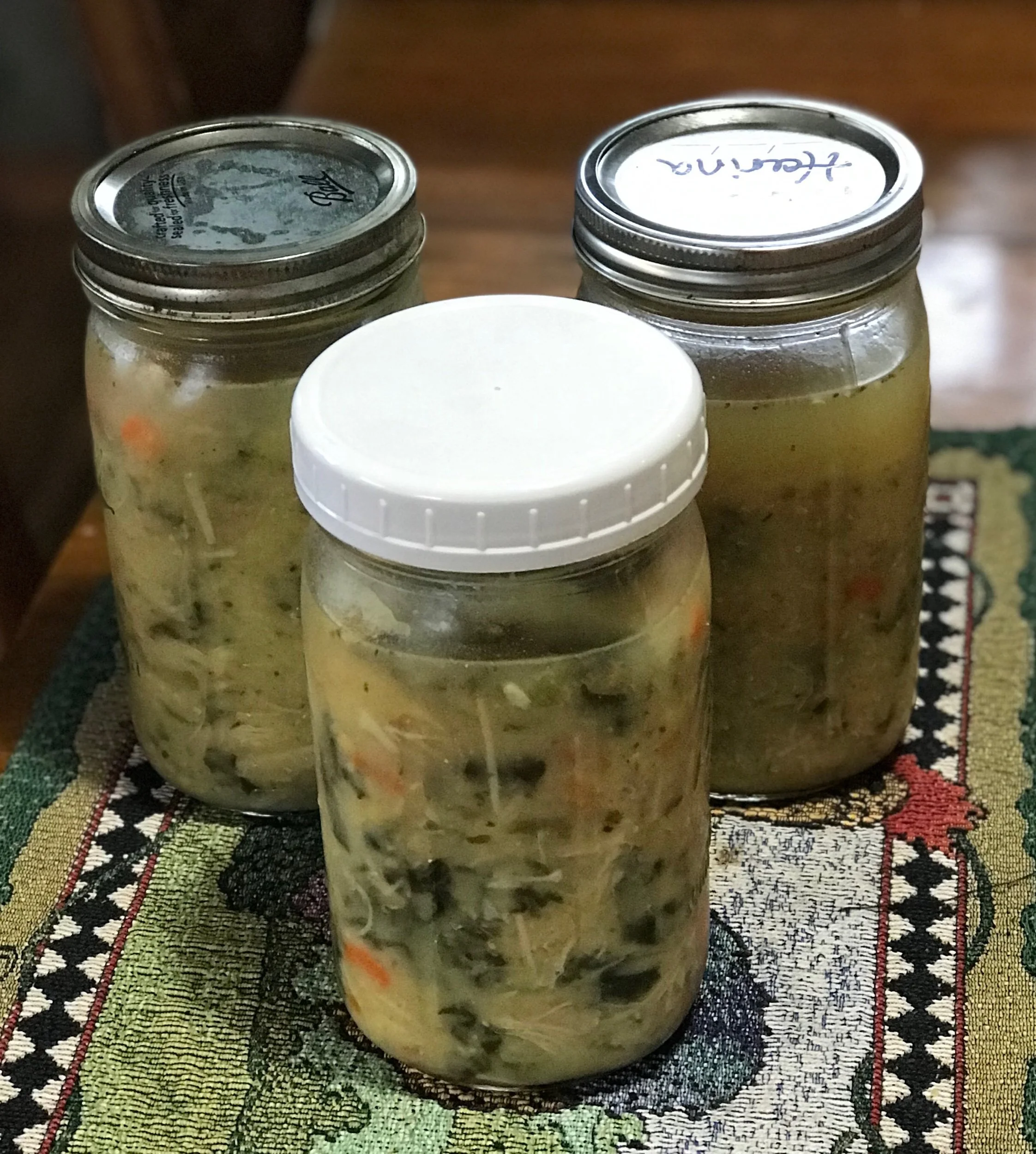
While the red lentils and diced potatoes were coming to a gentle simmer (I even peeled the potatoes), I zested and juiced three plump lemons and cut up the last of the turkey, crouching down and reaching all the way into the back of the bottom shelf in case any of it had tried to hide. The crowning glory would be a heaping bowlful of rough-chopped kale to add just before taking it off the heat and pouring in the lemon juice, giving it a stir and serving. An hour later, I had four quarts cooling in mason jars on the counter, lids resting like derby hats while the soup’s escaping steam rose lazily into the warm kitchen air. All I really wanted to make was granola and now we have soup for the week. I expect some will find its way to the freezer and we’ll be glad of it when neither of us really wants to cook dinner on a snowy weeknight in February. When it’s just the two of you and Kroger practically gives you thirteen more pounds of turkey than you originally planned for, you do your best not to waste it. I feel like a champion at the end of a marathon, and the fridge looks lighter than it did a week ago.
I understand the importance of disaster preparedness (we have “go-kits” in our cars and know two ways out of most rooms in our house should the need arise), but I’m not sure we’re as equipped to cope with abundance when it presents itself. Creativity is the common thread in both situations, but I think we lean toward expecting the worst instead of the best. When a good amount of good stuff does come around, it’s like quenching our thirst by drinking from a firehose. That’ll take your lips clean off if you’re not careful. After a week of nonstop turkey transformations, I’m more inclined to rethink my preparedness mindset toward the positive. Am I ready for when we’ve got this pandemic under control? What would I really do if we won the lottery? Suppose we receive enough viable volunteer applications to meet and exceed our hospice patients’ needs? Remember, hope is not a plan.
I’m gonna give this some serious thought…over a bowl of lemony turkey kale red lentil soup.
Mending
Her smile wide and grateful, she tucked the heart in her pocket and promised to take good care of it.
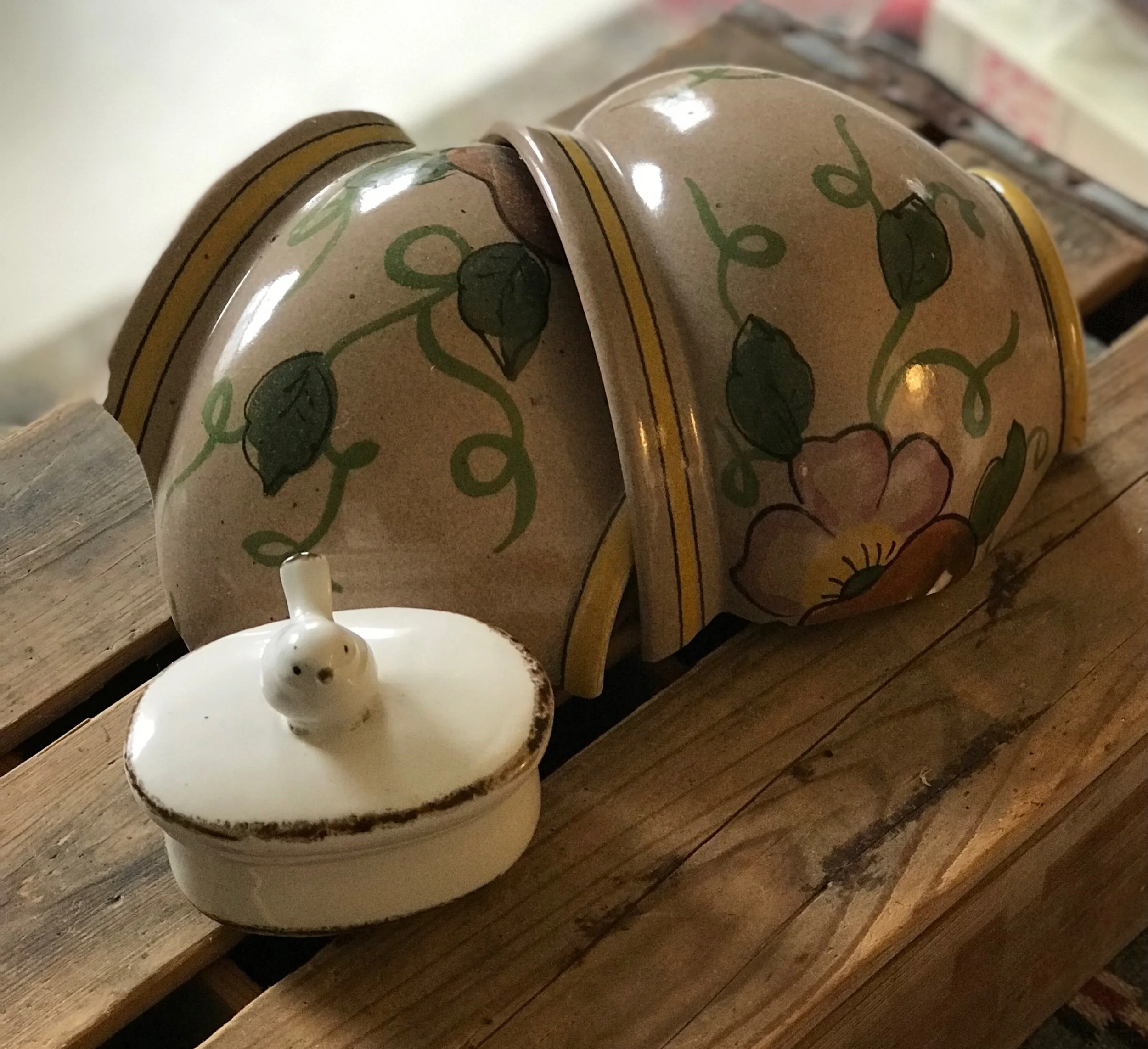
I’ve had the little glazed ceramic trinket box for years. I bought it from the Hartville Hardware store as Jackie and I browsed the home decor aisles while our husbands wandered through the actual hardware section of the six-acre store. The box caught my eye with its sweet little bird perched atop the oval lid, its flat tail upright and perky. I was sure I’d have a few trinkets back home still homeless, in need of a decorative hiding place like this. Sometime last year, the finial bird’s tail broke (cats: why we can’t have nice things). I tucked the piece inside the box with a vow to glue it back on Later.
Last year also saw the shattering demise of two vintage 7-Up water glasses, one of our unbreakable Corelle cereal bowls, a rust-glazed vase made by Patrick’s aunt Ann, the lid to our Q-tips holder in the medicine cabinet, a brandy snifter we kept on top of the fridge with an unmatched collection of shot glasses, a ceramic ice cream bowl with a fish painted on the inside (the fish had legs, which was the feature that caught our eye, Patrick’s nickname being Running Fish. Long story. Will tell it Later) and a large hand painted planter from Italy that I plucked from a pile of discarded belongings left behind by a migrant family in Fostoria, Ohio back in the late ‘60’s (knocked over by two of the cats during a pre-dinner hangry chase through the living room).
Some pieces were beyond repair, swept carefully into the dustbin and moved onto that place where broken things go, but I held onto the ice cream bowl, Q-tips holder lid (the entire holder a gift from our late friend, Jeannie), Aunt Ann’s vase, the planter from Italy and the bird-adorned box, promising to set aside time on a breezy summer afternoon to restore them to partially functioning glory. Summer came and went, so did fall and here we are, standing on the fresh edge of a new winter, a new calendar year, broken shards still sitting on the hutch in my studio where the glue lives. I’m not a big new year’s resolution person but in a flush of impulsive inspiration, decided to begin the next twelve months by putting the tail back on the bird. It felt portentous, prophetic and productive. Next up, the ice cream bowl. It won’t be able to hold food again, but with adhesive carefully dabbed in all the right places, I’ve just doubled my options for corralling other stray trinkets. From their place on the hutch, the remaining broken items rustled hopefully; their turn would come.
At our hospice’s annual kids’ grief camp (on pandemic hold for the past two years), we take them on a “grief hike” to explore the different emotional aspects of coping with loss: sadness, anxiety, anger and healing. When they get to “worried woods”, they sift through a large wading pool filled with sand in which we bury colorful little ceramic hearts. They get to keep the one they find, a portable symbol of their courage for the days ahead. One year, a young camper was running back to the main building after the hike and dropped her courage heart on the concrete walkway where it split in half. Tears welling up in her eyes, she approached the camp chaplain, showed him the pieces and asked (as only a child could do), “Can you fix my broken heart?” He said he’d try and took her five-year-old trust home with him, the rough-edged heart pieces in his pocket. When he found her at camp the next morning, he gave her back the heart, now repaired with a thick line of dried adhesive running along the break line. “I couldn’t fix your broken heart”, he told her, “but I mended it. What do you think?” Her smile wide and grateful, she tucked the heart in her pocket and promised to take good care of it.
The past year left a lot of us in pieces, broken bits and large chunks of our hearts and lives scattered on the shifting floor beneath our feet. We salvaged what we could and swept the rest into the day’s trash, learning the harsh lesson of letting go over and over until it was part of our skin. Whatever we decided to hold onto, whatever might be fixable, still waits patiently for the right adhesive to put it back together. My money is on love, forgiveness, grace and humor. Those are my words for the year ahead and the promises I make to my heart with its mended places still healing, still holding fast to whatever repair work I’ve done. When I struggle with anxiety about what’s to come, I lean heavily on the salvific glue of the present moment to fill in any cracks where worry might seep through. So far, it’s working.
When I woke up this morning to check on the pieces I’d repaired, the ice cream bowl was still holding together, and the bird’s tail was pointing upward again. I’ve cleared a space on the studio worktable for the vase, the planter and the Q-tip lid.
One piece at a time.
All I Really Want for Christmas
In the absence of the additional stimuli that saturates the senses when gathering with family and friends, we’re making good use of the rich silence that enfolds us.
I took my head cold out for daily walks all last week, determined to help move it along and out of my sinus cavities with some good old-fashioned fresh air and wintertime humidity. I haven’t been sick in over three years (as evidenced by the blister packs of expired decongestants I jettisoned from the medicine cabinet) and forgot for a minute how to behave under such conditions. Two negative COVID tests helped ease some initial anxiety and then I just got on with it—gallons of hot water, tea, clear chicken broth and the reliable Adamshick stand-by of refusing to accept that I was sick at all. That only goes so far, I can tell you, but I took it all the way to the edge and it helped, not wallowing in too much self-pity. Litter boxes still needed to be emptied, chickens fed, dishes washed and laundry folded. I worked from home for the first time since April, which was like remembering how to ride a bike for the first few hours attempting to connect our rural WiFi to my organization’s network. A rather bumpy re-entry but our stalwart and exceedingly helpful IT guru, Chris, got it straightened out. The added bonus of being back in Extremely Casual Working Remotely dress code (I won’t go into detail here, lest I offend with way too much information) made it a more pleasant week than it could have been.
We’re on our own for another Christmas, Patrick and I, keeping our germs to ourselves (he’s not sick but we’re not taking any chances of some dormant viral load finding its way to a loved one’s innocent inhalation across a festive dinner table) and enjoying the enduring gift of each other’s company. In the absence of the additional stimuli that saturates the senses when gathering with family and friends, we’re making good use of the rich silence that enfolds us. We have our respective studios where art becomes life each and every time, a kitchen that will need to smell like cinnamon at some point and an expanse of wonders that perform year-round just on the other side of the window’s glass, crooking their fingers at us to come out and play. We obey and are never disappointed.
It’s still a slog, though, composing emails through a thick veil of congestion, stopping in between coats of acrylic paint to blow my nose or chug the last warm mouthfuls of sencha tea. And…we achingly miss our families, the chance to create more memories within reach of one another and some excellent food. Feeling the weight of this, I try to recall what unfettered breathing feels like and realize…somewhere in an ICU down the road or in an overwhelmed city hospital five states away, someone else wonders the same thing but with far more tragic outcomes looming in the hours and minutes ahead. I reach for another Kleenex, the fiftieth one that morning, and let my tiny cares dissolve in bowed head humility.
A dozen or so years ago, I directed a cultural competency training program for healthcare providers designed to deepen their understanding of the myriad cultural layers to their patients’ health practices and beliefs. A key link in a long chain of impact indicators, this program set its sights on reducing health disparities by equipping providers with better questions, broader perspectives and consummate respect for any and all who didn’t look, think, believe or act like they did. The class discussions were lively and memorable, to say the least, and I recalled one activity where we invited participants to share how they treated the common cold in their families. We heard everything from gargling with diluted kerosene to sipping on warmed honey spiked with bourbon and one of my personal favorites involving a dishtowel soaked in tea, then wrung out and wrapped around the afflicted one’s neck with a dry towel fitted snugly over that. For maximum effectiveness, it was to be worn for the day, changed with fresh dressings as indicated by the wearer’s emerging symptoms. The common thread in all of these (with the exception of the honey and bourbon tonic) was that the discomfort of the remedy had to be greater than the symptoms themselves. If one eats enough garlic, no one would will want to get close enough to pass any germs. That’s as far as the research and development needed to go.
In my memory of childhood ailments, illness was eyed with suspicion if it coincided with a school day but treated tenderly nonetheless, with Captain Kangaroo on the black and white Zenith and a folding tray table set up next to the couch, holding mom’s nurturing best comforts: oatmeal with cinnamon and chunks of apple, Jell-O “drink” (warm and watered down so it would never set) and a couple of chalky orange baby aspirin at regular intervals. Science would say, “doesn’t matter. Got a cold? Seven to ten days, regardless of what you throw at it.” Symptom-altering medications don’t cure anything but make us feel marginally better until the next dose. I suppose that’s true and yet, last week found me on the couch wishing mom had set up my tray table with all of her curative, folksy love. I don’t think I ever asked how her mom managed things for her and my uncles, especially without Jell-O.
Being sick for any holiday is a bummer (an outright abomination if you’re a child on summer vacation) and home remedies or not, we give them whatever attention we have left, try our best and wait it out, reassuring ourselves that we can gather and celebrate any time of year. And while the pandemic has altered that view slightly or a lot (depending on your approach), it still rings true. Love is eternally elastic and does not answer to the confines of a calendar date. Patrick set his heart to a year-round giving practice decades ago and, lucky me, I’m cooped up with him for the day. Even if I dabble in fits of wistfulness, they’ll be random and fleeting in the face of his generous spirit. Family members are cheerfully telling us to get better soon and how fun it will be when we’re all parked in front of the tv to watch that holiday classic “The Ghost and Mr. Chicken” with Don Knotts.
All I really want for Christmas, then, is what I already have. Pass me another tissue; we’ll get through this.
Epilogue: Around 4:00a.m. Christmas Day, my congestion loosened up and broke free, so I took my newly-cleared head for a walk. A young buck we thought had been tagged during gun season made a mighty leap across the field path to my right, a Christmas miracle on strong and elegant hooves. The shaggy grey sky threatened rain and made good on that promise just as I stepped into the northwest corner near the woods but up until that moment, I remained dry and could only hear the drops hitting a carpet of dry sycamore leaves curled and thick on the ground. Strange and wonderful, to walk in and out of intermittent showers until the skies let loose with a steady and most refreshing downpour, soaking both sweatshirts I was wearing. I made all my usual stops to greet some of the trees I have come to know, leaning my grateful forehead against them as the rain ran down their grooved skin in rivulets.
I can breathe again. I won’t take this for granted, not for a long, long time.
A Lean Toward Clean
Removing even a thin layer of dust on the bookshelves reminds me that I can do something to improve my lot, no matter how small.
Last Wednesday morning found me on my hands and knees in the bathroom, vigorously wiping down the floor mats from the new-to-us Tacoma truck. In the small space between when Patrick leaves for work and it’s just light enough for my morning walk, I crossed that task off my to-do list with inordinate joy. I know trucks and mud naturally pair up, but we don’t drive this one much (for a 2018, it’s in almost pristine condition, low miles and not a scratch anywhere, I swear) and I’m not above taking a pair of tweezers to those little grains of grit that the dust buster hand vac missed. Considering it was just over a year ago that we’d totaled our other two trucks in a span of two weeks, I’m determined to make this one last as long as I possibly can, coming right up to the edge of neurotic.
Such devotion calls up a sweet memory. A few Toyotas ago, on the day of my dad’s funeral, I was filling up our new one at the gas station and noticed a gathering of rust on the rear chrome bumper (four flakes, if you must know). Without even stopping to consider my options, I spit-shined it away, amusing a fellow traveler at the next pump who, noticing the temporary tags, remarked rather wryly, “they gotta get dirty sometime, ma’am”. I smiled at him, assumed he was channeling Dad’s humor and climbed back into the cab, making my way toward one of life’s more difficult days. How often grace wears the face of a stranger.
Visitors to our home (when that’s safely possible again) probably wouldn’t use “pristine” to describe our humble dwelling, but I think “tidy” would be within reason. We all have our quirks and rules when it comes to keeping house. I can overlook quite a lot depending on the work week I’m having, but I own those non-negotiables that begin and end my day’s routine no matter how tired I am. I won’t head to the office or work in my studio unless the dishes are washed, even though I can close the door to the studio and forget we have a kitchen for a few hours. I clean as I go when I’m baking and have a hard time sitting down to a weekend lunch unless the sink is empty. Common areas are monitored closely for stray socks and jackets that didn’t quite hit the coatrack behind the living room door and handmade throw pillows nestle in the corners of chairs, arranged carefully by height and size (smaller ones in front, and directional patterns on the fabric must be right side up). I get a kick out of seeing my distorted reflection in the unblemished and gleaming bathroom faucet and the week is off to a good start when I’m the first to use the restrooms at the office on a Monday morning (as evidenced by the calm blue water in the toilet bowl of the first stall). Is that weird? That’s probably your call, not mine.
A dawning realization here: cleaning is about control. And while I’m not inclined to describe myself as someone with control “issues” (c’mon, who doesn’t?), I’d like some latitude for taking care of my small sphere of influence while a global pandemic crawls into its third year and I slept through the gust of wind that toppled our outdoor grill last night (yes, I needed to set it up on its now-questionably sturdy metal legs before I could finish that last sentence). Removing even a thin layer of dust on the bookshelves reminds me that I can do something to improve my lot, no matter how small. These days we need those victories.
It may also be a simple winter survival strategy. We’ll be spending a little more time indoors surrounded by the stuff within our walls, so best to keep things uncluttered and bright. Having a clear place to sit and a kitchen ready for those impromptu cozy baking sessions is just plain smart, good for one’s morale. But curiously, at the end of this morning’s walk, I puttered around in the almost-sleeping garden for nearly an hour, covering the longest of the raised beds with some empty paper leaf bags made soggy by yesterday’s rain and finishing it with a blanket of straw mulch. A drizzly snow fell while I gathered up the remaining bits of hardware cloth-turned tomato cages, corralling them in the bed of a trailer we bought to haul topsoil and t-posts. I felt nurturing and motherly and not at all fussed that my gloves were soaked. The landscape was dressed in muted browns and grays fuzzed over in a thin fog; I rotated my gaze slowly across the expanse of dormancy, losing myself in a swirl of appreciation for my circumstance. Apparently, “clean” has a wide orbit in my life and benefits that stretch well into the realm of spiritually satisfying. Not a bad way to start the day.
Whatever it is that nudges me toward order out of chaos, I’m especially thankful for it lately. Forecasts for the season ahead include far more than some rough weather. In the calm of a clean house, I’ll do what I can.