
A Lean Toward Clean
Removing even a thin layer of dust on the bookshelves reminds me that I can do something to improve my lot, no matter how small.
Last Wednesday morning found me on my hands and knees in the bathroom, vigorously wiping down the floor mats from the new-to-us Tacoma truck. In the small space between when Patrick leaves for work and it’s just light enough for my morning walk, I crossed that task off my to-do list with inordinate joy. I know trucks and mud naturally pair up, but we don’t drive this one much (for a 2018, it’s in almost pristine condition, low miles and not a scratch anywhere, I swear) and I’m not above taking a pair of tweezers to those little grains of grit that the dust buster hand vac missed. Considering it was just over a year ago that we’d totaled our other two trucks in a span of two weeks, I’m determined to make this one last as long as I possibly can, coming right up to the edge of neurotic.
Such devotion calls up a sweet memory. A few Toyotas ago, on the day of my dad’s funeral, I was filling up our new one at the gas station and noticed a gathering of rust on the rear chrome bumper (four flakes, if you must know). Without even stopping to consider my options, I spit-shined it away, amusing a fellow traveler at the next pump who, noticing the temporary tags, remarked rather wryly, “they gotta get dirty sometime, ma’am”. I smiled at him, assumed he was channeling Dad’s humor and climbed back into the cab, making my way toward one of life’s more difficult days. How often grace wears the face of a stranger.
Visitors to our home (when that’s safely possible again) probably wouldn’t use “pristine” to describe our humble dwelling, but I think “tidy” would be within reason. We all have our quirks and rules when it comes to keeping house. I can overlook quite a lot depending on the work week I’m having, but I own those non-negotiables that begin and end my day’s routine no matter how tired I am. I won’t head to the office or work in my studio unless the dishes are washed, even though I can close the door to the studio and forget we have a kitchen for a few hours. I clean as I go when I’m baking and have a hard time sitting down to a weekend lunch unless the sink is empty. Common areas are monitored closely for stray socks and jackets that didn’t quite hit the coatrack behind the living room door and handmade throw pillows nestle in the corners of chairs, arranged carefully by height and size (smaller ones in front, and directional patterns on the fabric must be right side up). I get a kick out of seeing my distorted reflection in the unblemished and gleaming bathroom faucet and the week is off to a good start when I’m the first to use the restrooms at the office on a Monday morning (as evidenced by the calm blue water in the toilet bowl of the first stall). Is that weird? That’s probably your call, not mine.
A dawning realization here: cleaning is about control. And while I’m not inclined to describe myself as someone with control “issues” (c’mon, who doesn’t?), I’d like some latitude for taking care of my small sphere of influence while a global pandemic crawls into its third year and I slept through the gust of wind that toppled our outdoor grill last night (yes, I needed to set it up on its now-questionably sturdy metal legs before I could finish that last sentence). Removing even a thin layer of dust on the bookshelves reminds me that I can do something to improve my lot, no matter how small. These days we need those victories.
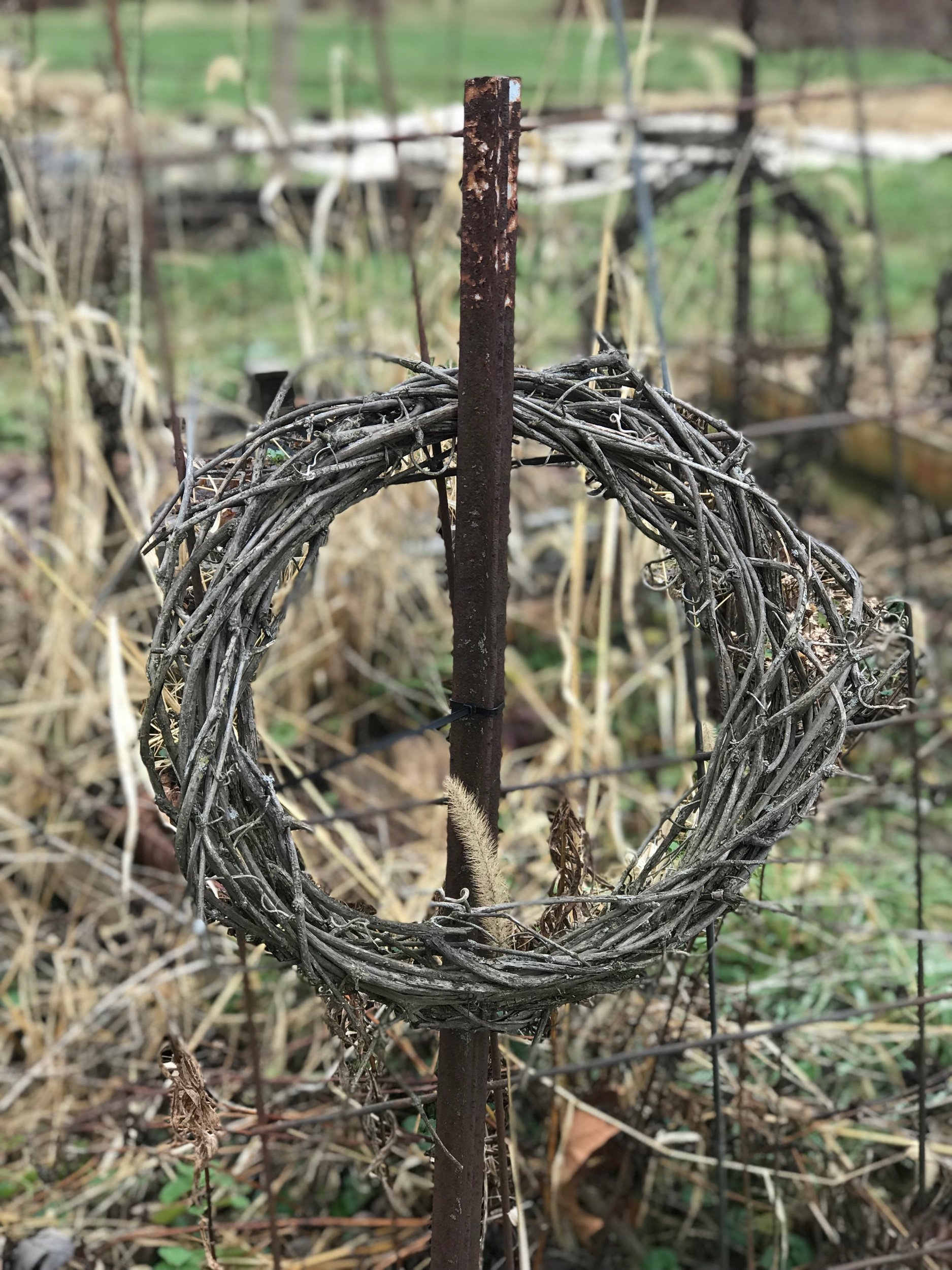
It may also be a simple winter survival strategy. We’ll be spending a little more time indoors surrounded by the stuff within our walls, so best to keep things uncluttered and bright. Having a clear place to sit and a kitchen ready for those impromptu cozy baking sessions is just plain smart, good for one’s morale. But curiously, at the end of this morning’s walk, I puttered around in the almost-sleeping garden for nearly an hour, covering the longest of the raised beds with some empty paper leaf bags made soggy by yesterday’s rain and finishing it with a blanket of straw mulch. A drizzly snow fell while I gathered up the remaining bits of hardware cloth-turned tomato cages, corralling them in the bed of a trailer we bought to haul topsoil and t-posts. I felt nurturing and motherly and not at all fussed that my gloves were soaked. The landscape was dressed in muted browns and grays fuzzed over in a thin fog; I rotated my gaze slowly across the expanse of dormancy, losing myself in a swirl of appreciation for my circumstance. Apparently, “clean” has a wide orbit in my life and benefits that stretch well into the realm of spiritually satisfying. Not a bad way to start the day.
Whatever it is that nudges me toward order out of chaos, I’m especially thankful for it lately. Forecasts for the season ahead include far more than some rough weather. In the calm of a clean house, I’ll do what I can.
Still Standing
I’m grateful for our luck and don’t bet the rent on much or very often.
An indiscriminate wind roared its way through the land yesterday from late morning until well past sunset, arms flailing and invisible fists punching random holes in the tree line to the north. In the woods, the sturdy living caught the fragile dead as they tumbled down, turning vertical dwellings into horizontal ones for our most stalwart squirrels and woodpeckers. They’ll adjust in time, I know, once they recover from the shock (I wonder how long that takes for furred and feathered relatives?).
This morning’s walk in full sunlight gave a clear view of Patrick’s chainsaw to-do list for the week. The path back to the woods is blocked in two places by trees too large for me to maneuver, and how that one massive black walnut in the meadow crashed to the ground without either of us hearing it only reaffirms how soundproof our walls are. As I worked in the studio yesterday, I heard the occasional rattling of the metal lawn chairs on the front porch, which I had pushed back under the roof’s overhang, as if that would keep them from harm (it did, but barely. They skittered across the deck planks a few inches from where I’d put them, stopping just short of blowing off the edge). Bird feeders on shepherd hooks made it safely through the night as did the old silver maple behind the house, minus a few branches from her fingertips 40’ above our heads. Stooping to pick those up will be a good outdoor project today in between batches of granola and a handful of journals to be bound. In a heart-sinking flash, I imagine our fellow humans in Mayfield, Kentucky seven hours south of where I type this and humbly realize I am, once again, on easy street as my day unfolds.
I think about the rescue and recovery operations, staffed by veteran disaster response workers and novices alike, joined by community folks pitching in to help their neighbors. It’s a bittersweet camaraderie, picking through what remains of someone’s living room, touching broken framed photos of a niece’s wedding or last summer’s whitewater rafting trip, and in the first several tense hours, listening for sounds of life beneath the rubble. Any sound at all. I once worked a disaster relief assignment for a small town in Indiana where a tornado hopscotched through the village on its way to the forty or so miles of flat farm fields. At the makeshift family services center where those affected could complete damage assessment paperwork in between cups of coffee, I remember a man pulling up in his pickup truck, towing a trailer piled high with twisted metal, bent siding and splintered lengths of wood. Approaching the table where I sat, pen and forms at the ready, he asked, “do you know where I’m supposed to dump what’s left of my house”? Trained to be helpful first, shocked later, I directed him to the designated area and inquired if he and his family needed a place to stay. “We’ve got friends. Be stayin’ with them until we figure out what to do next.” He walked back toward his still-running truck, his shoulders low and heavy with the weight of a strange and unfamiliar burden. An hour later, a farmer stopped in asking if anyone had reported seeing a flock of ostriches running loose; the winds had ripped their protective fencing clean out of the ground. A dozen or so were found later that week, seventeen miles away in the corner of another farmer’s field, huddled under some trees.
Helpful first, shocked later.
We’ve had our humble share of crises triggered by weather events. Went without power for a week one summer after a derecho tore through from the west. In less than ten raging minutes, towering sycamores were uprooted from their places along the banks of the creek, some of them falling across power lines strung parallel to the driveway. I watched lightning strike an osage orange tree on the ridge near the house (too near the house), the flash, crack and smoke simultaneous as I hurried to the bathroom to take shelter in the tub with a towel over my bowed head. Patrick was away at Sundance, without access to internet or any media source; he only learned of the storm from a friend who had traveled to the dance grounds with the news. With no way to tell him I was ok, his first few hours on the trip home were white-knuckled and tense. That first connecting phone call with the reassuring rush of each other’s voices gave me a new and indelible understanding of the word “relief”.
We’ve been trapped on the home side of our creek-submerged bridge after the relentless rains of an already-soaked November and ducked our way through a barn full of pregnant goats after a heavy snow caused the roof to collapse in the middle, leaving the east and west ends serviceable enough to help them through that year’s kidding season. An ice storm caught our flock of guinea hens off-guard one winter, freezing their feet to the outdoor roosting post until Patrick and I gingerly chipped them free. So far, we've made it through to the other side of whatever’s been thrown or blown in our path, doing what needed to be done in the moment and years later, looking back and wondering how. On those chilly days when my joints are a bit stiffer and my bones creak a little louder, I remember I’ve worked them hard and give them a little more time to get a-goin’ to the next task. I’m grateful for our luck and don’t bet the rent on much or very often. Nothing is guaranteed out here except the unpredictable.
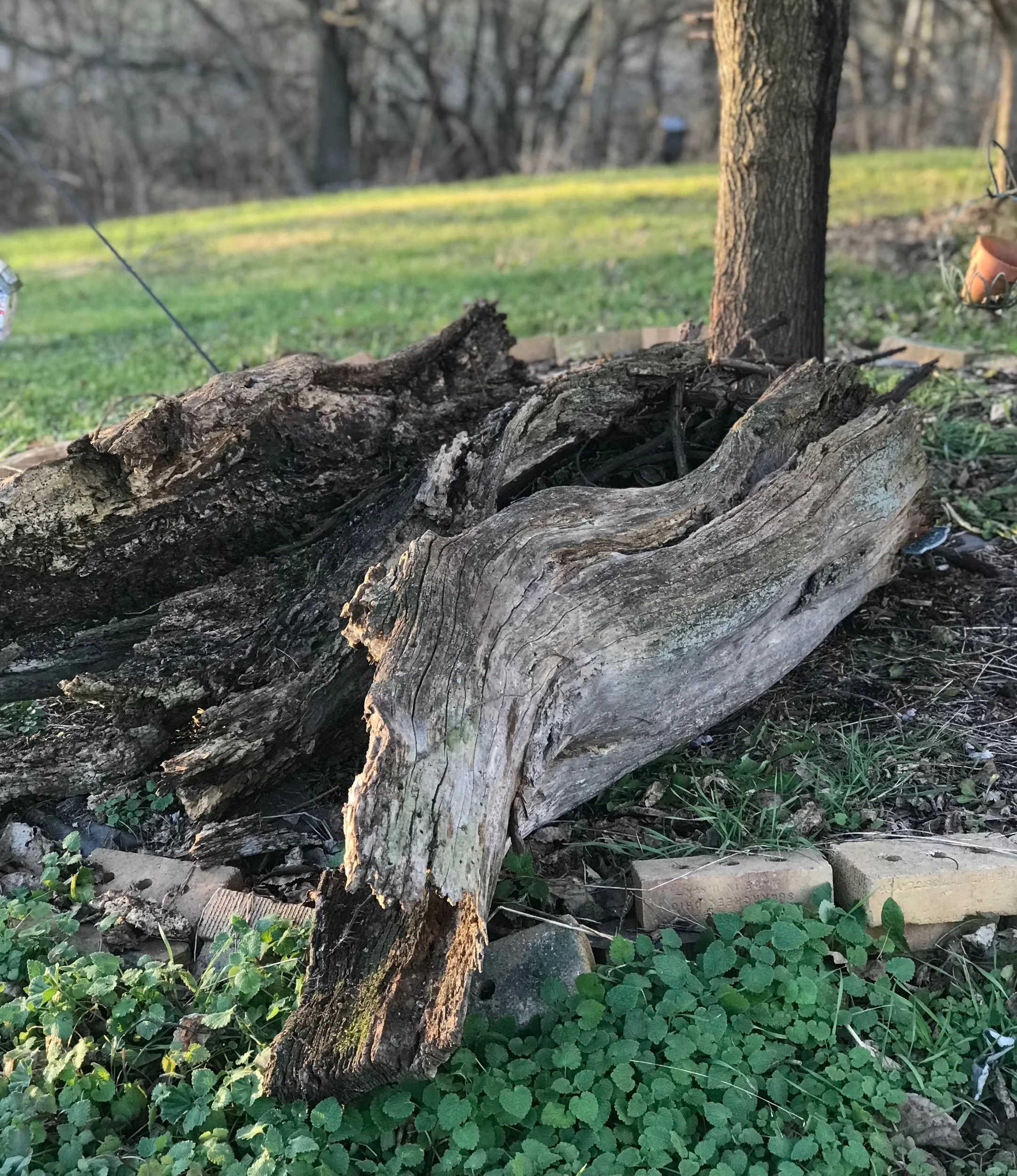
Including the loss, finally, of what remained of the old dead apple tree out in the front yard. The first half of it toppled in a storm about ten years ago, leaving a strangely hollow four-foot section standing tall, looking for all the world like a rough-hewn sewing needle with the business end inserted into the soil. A couple litters of kittens were born in the base of that hollow stump, and one summer’s flock of chickens claimed it as their daily egg repository (making breakfast a few steps fresher for us that year). I encircled it with a couple stacked rows of vintage bricks and planted purple wave petunias one summer, crimson mums that same fall. We buried our dear beloved Scout there and the birds that escaped his grasp perched on the uppermost edge of the stump, singing gratefully. I didn’t know I could love a chunk of dead wood so much.
It was encouraging a few springs ago to see a young mulberry sapling take root in that hollowed place and stretch its hopeful young trunk upward, reaching for all the sunlight it could drink. We’ve plucked berries from its branches every year since, tasting life from death and knowing what that means for the rest of us.
In the hard days ahead for the people of Mayfield, Kentucky (and also those in Arkansas, Illinois, Mississippi, Missouri and Tennessee), I send my heart to you on a gentler breeze, bearing comfort, strength and whatever else you need to keep standing.
Home Fires
Spending so much time indoors, surrounded by the cherished accoutrements of the life we’ve built within these walls, is equally gratifying.
At the topmost branches of a 60’ cottonwood tree on the edge of the woods, three leaves hang unmoving and resolute, curled into brittle brown fists. Everywhere else, the blue beech, black walnut, horse chestnut, buckeye, sassafras and red cedars stand bravely naked and ready for whatever will come. In the next four months we’ll get to look behind nature’s curtain and see the architecture that supports our early days of spring planting, summers down by the creek looking for salamanders beneath the shade of the creek banks’ towering sycamores and those October leaf-gathering afternoons as the sun shifts its position on the western horizon. It’s not an easy gaze, this season of exposure. Winter lays bare the blueprint that supports us through each season. We will see things as they are, stripped almost clean of what was never intended to last anyway, and it reminds us of our own temporary residential status here.
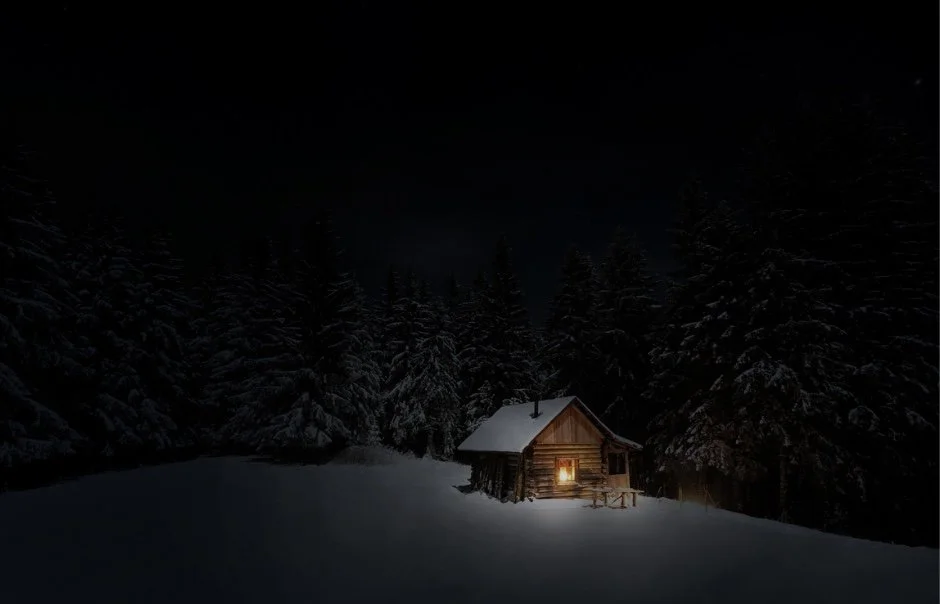
From the far southeastern corner of the field, where we buried the remnants of the barn after the Great Fire of 2018, the view of the house is reassuring. I notice this on the morning walk when my sticks and I take the diagonal path to what we now know as the “graveyard” (we have a few of these self-named spots on the acreage, a two-or three-word phrase to tease the vast and layered story that each location holds). Its buttery yellow siding glows at dawn’s first light, a candle on the highest point our land offers, and we get to live inside it. From the lowest point in the meadow, down by the Old Man Tree where the creek straightens herself before elbowing around a stand of the most magnificently grapevine-draped black walnuts (we’re talking dark woods fairy tale grapevines, thick and full of years as they snake up from the soil), our home looks the epitome of sweet and pure country living in its presentation. Climbing the steep slope through the mouth of the meadow to the front porch makes me feel like I’ve just finished the last leg of a long journey from Somewhere. My destination is this golden lap, ready to gather me and my weary but sturdy bones into some mighty fine comfort (I have an almost unnatural love for our vintage-style metal lawn chairs as fold myself into one of them and sigh).
Even though I walk almost every day (making good on my promise “as often as I can, for as long as I can”) with little or no inner convincing to leave a warm house and step into the frozen air, I look forward to the season of tucking in and taking shelter from the brunt of the cold winds and chilly rains our sentinel trees will soon take in their rooted stride. Spending so much time indoors, surrounded by the cherished accoutrements of the life we’ve built within these walls, is equally gratifying. Yesterday, I sat for seven mostly uninterrupted and focused hours in the studio making miniature books and journals with a view out the south-facing window to the still-smoldering burn pile by the old goat barn. Stitching signatures and gluing up book board, how could I not remember that one kidding season where seven of our Boers each gave birth to twins in a span of 16 hours? An eighth doe had triplets, one of which Patrick had to intubate almost the minute it hit the straw-covered ground. My nephew Robbie, ten years old at the time and present for the birth and emergency goat first-aid, named it “Lucky” and added the phrase “barn words” to our family’s vocabulary after Patrick let loose with a few choice expletives during the more tense parts of Lucky’s rescue proceedings.
I think winter turns our heads in a gentle lookback direction, an over-the-shoulder lingering glance at memories now embellished and good-naturedly exaggerated. While we’re inside and the furnace is exhaling its warm breath on our toes, it’s as good a time as any to call up the legends we’re made of and read aloud the chapters we’ve written so far in the grand Book of Life. It passes the time and softens the edges of the darkness that swallows us whole from November to March, making us even more grateful for the incremental slivers of light that spread out each morning beginning the day after winter solstice. Sunny days will be sparse in the next few months (Ohio averages only 178 of them annually) so we’ll look to each other’s company for the brightness our hungry spirits crave (I won’t be disappointed; Patrick is such a wonderful companion). This wintertime lookback also reminds us of what we’ve pushed through, endured and survived, stronger and better for the hardship (bruised and scarred too, but scars mean something healed. Let’s not forget that). Looking today’s headlines in the eye, I welcome any and all evidence of my own ability to persevere. A trembling gut tells me I’m going to need it.
In the face of an unstoppable winter, it’s good and helpful to blow on the embers of the home fires that keep our souls pliable and elastic. Find your warmth, dear ones, keep a quilt nearby and listen to the echoes of your own stories.
Spring will come…spring will come.
Anniversaries and Tulip Bulbs
It has been neither easy nor heartbreaking all of the time and who would want that anyway?
Twenty-eight years ago on November 19, 1993, Patrick and I stood before 125 of our dearest family and friends, promising to take care of each other with a deep abiding love that would have no expiration date.
On November 28, 2021, we’re still here, unexpired and in love and working on the next twenty-eight years.
In the past week, most of my sentences have started with “honey, on this day twenty-eight years ago, we were…” as I plucked stories from the days leading up to our wedding, the ceremony itself and the two-week honeymoon that followed. This year, our anniversary fell precisely on the day of the week we were married, an alignment that made it easy for me to take the long view over my shoulder and pull those memories forward. I’m probably driving him mad doing this, but if he’s annoyed, he’s keeping it to himself (evidence of the “abiding” part, with a healthy measure of patient tolerance, bless him). The other night, a memory surfaced for both of us.
Twenty-eight years ago on our honeymoon, on Thanksgiving Day, we were serving dinner at a soup kitchen in Flagstaff, Arizona when Patrick saved a little boy from choking to death on a chunk of turkey. One moment we were sitting across from the young lad, all of us digging into our plates laden with traditional holiday fare and then suddenly, Patrick was leaping over the table to perform the Heimlich on a six-year-old (successfully, thank goodness). The little guy’s family rushed over in alarm that soon mixed with gratitude, and as the scene settled down, they gave the child a king-sized Snickers bar to calm him (adrenaline still flowing, Patrick kept an eye on the boy in case there was an encore). Somewhere in the commotion, NBC news was filming on location for their usual Thanksgiving Day segment on good folks helping their neighbors and got the “live-at-5” bonus story every reporter dreams of. We politely declined an interview, preferring to keep our heads humbly down and grateful for time, place and Patrick’s pre-professionally-trained paramedic instincts. The boy’s parents insisted on treating us to dinner at the pizza place they owned and that offer we accepted, enjoying some mighty fine pies the next evening (I don’t think we’ve had better restaurant service since then, truly).
After that, the stories from those first two weeks of our marriage kind of pile on top of each other, and the exact days they took place all those years ago are more elusive, mixed up with other memories and blurry around the edges. It’s ok. The accompanying images and feelings are still vivid and filled with the time-dissolving power that all good reminiscing offers.
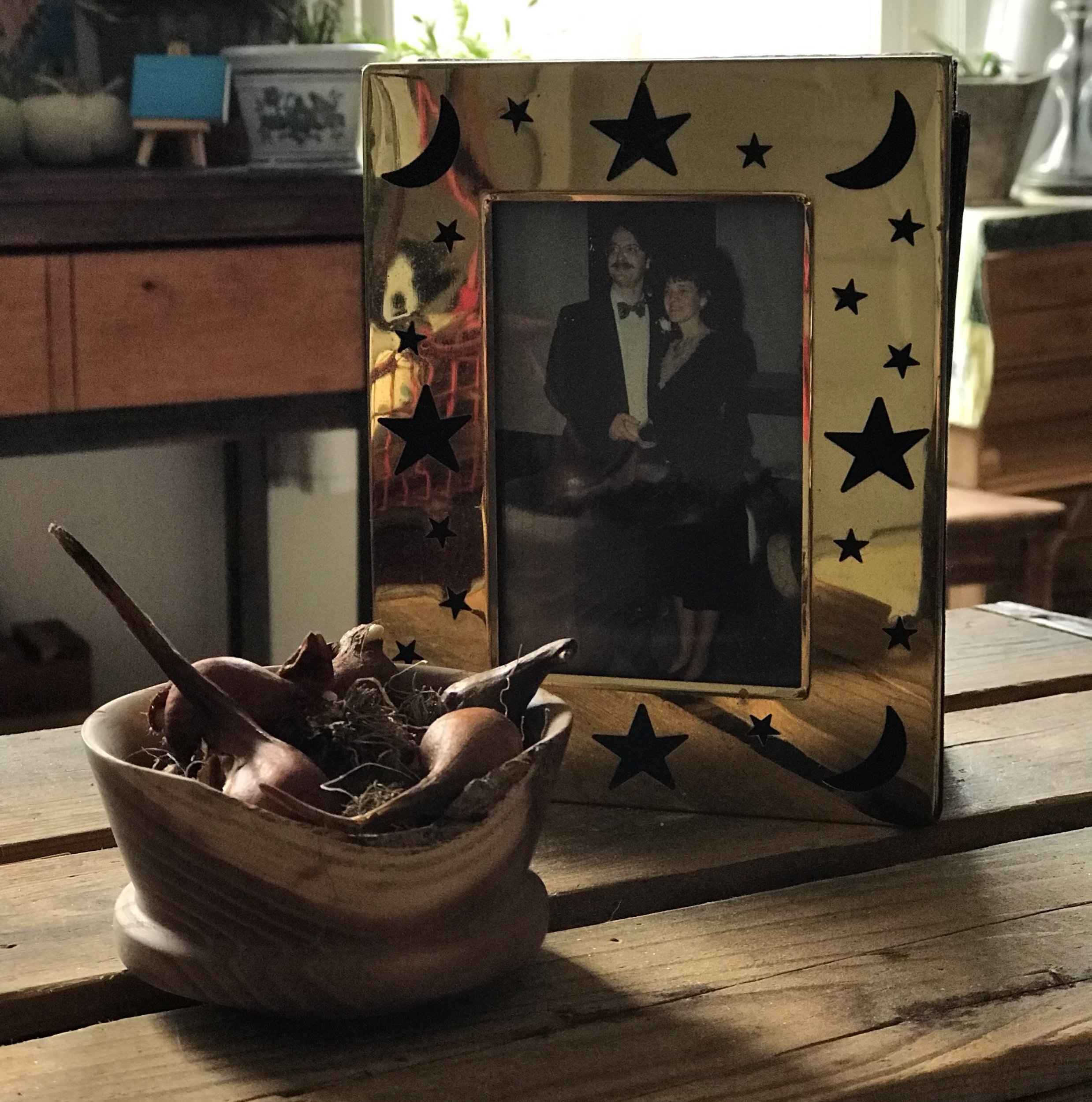
In a not-unrelated sort of way, my uncle surprised me this week with an offer of tulip bulbs descended from the ones that his father, my Opa, had grown and tended decades ago in the back yard of the family home in Tiffin, Ohio. They arrived priority mail on Saturday, landing gently on our front porch along with a small cannister of bone meal and a copy of The Complete Book of Bulbs by F. F. Rockwell and Esther C. Grayson (copyright 1945) to guide me in keeping this precious Dutch legacy alive. Like any living thing, they require effort and attentiveness to keep them upright and thriving, and I am definitely showing up for that task. The challenge will be where to plant them, with 41 acres to choose from. Even as my head wraps around the next steps for getting them in the ground as soon as I can, I’m seeing images of the Tiffin house grow sharper and clearer through the child-Liz lens of my mind’s eye, and it makes me feel happy. Those were good times and, fingers crossed, I’ll smile upon the sweet petaled faces of their offspring in a few months, moving the past forward another botanical step.
How did I come by a life so sweetly shaped into stories that dance a rhythmic push-and-pull between what was, what is and what might be? When I take that look back, I see hard-won lessons holding hands with and walking alongside the days of deep contentment, and it feels balanced and right. It has been neither easy nor heartbreaking all of the time and who would want that anyway? This collection of stories, which I add to daily, is both who I am now and a road map for who I want to become. I know I’ll never fully arrive and now my head hurts from the sheer expansiveness of it all, the landscape of Possibility given to each of us. Seems best to keep moving along until I can’t anymore and recognize the present for the gift that it is.
For now, that present is a box of tulip bulbs asking to be given another season and a twenty-eight-year marriage stepping comfortably into whatever the future may hold, one conversation at a time.