
When Things Change
In both abundance and want, it’s important to be aware of what’s happening and how we’re feeling about it, no matter where we’re standing on this rotating planet.
In what used to be a small open field at the end of our quarter-mile driveway are two natural gas holding tanks and an intricate system of above-ground pipes and other assorted mechanicals caged in a chain link fence. Semis regularly pull up to fill up before heading off to who knows where, their eighteen wheels crunching in the gravel parking pad covering my memory of grass and soil that will never see daylight again. Installed and evolving for going on five years or so, this energy enterprise sort of crept in and settled itself in our peaceful little agrihood, rearranging the landscape in a way we’re not quite used to yet.
I’ve noticed in the past couple of weeks a loud and high-pitched whine coming from the site. It sticks in the air like Velcro, an irritating earworm song that follows me to the farthest corners of our acreage with its relentless and burrowing sound. I can abide the episodic hum of tires in the early morning hours when the neighbors and other good folks are commuting to their respective bill-paying destinations. But this…this is an audible invader threatening all future walks, outdoor gatherings and after-work longings for stillness on the front porch with its alien annoyance. I never took any of that silence for granted and this morning, a heavy heart grieves the loss of it.
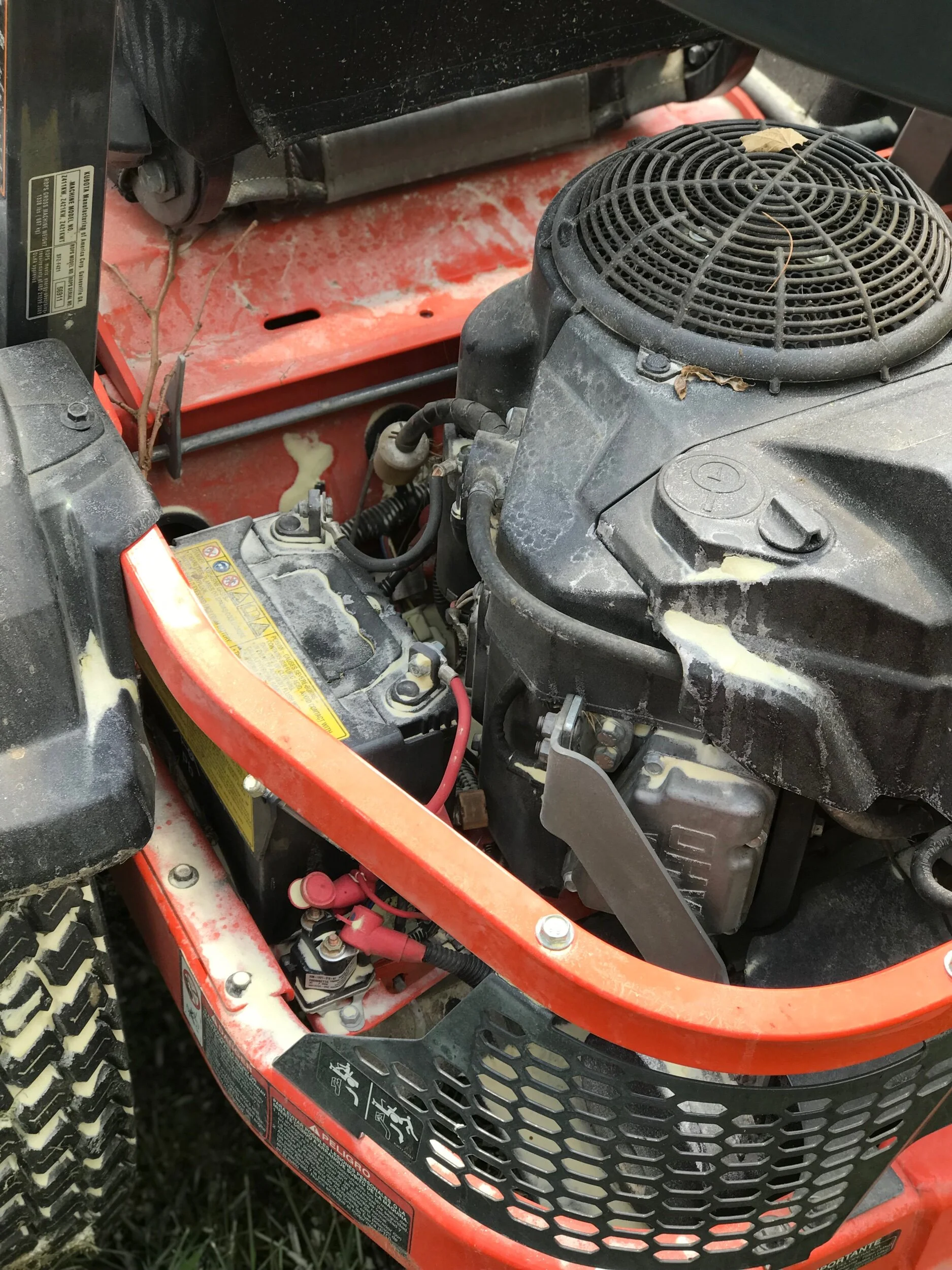
In other news, the mower caught fire yesterday (in the driveway, thank goodness, and not out in the field path, far from the fire extinguisher we keep in the shed) and so now one of today’s to-do list items is moving its lifeless hulk onto the half-cut lawn so it will be easier to load and haul off to the repair shop. I was hanging laundry out back when it happened and heard a string of expletives careening around the corner of the house as Patrick sprinted up the slope toward his shed, unable to tell me what was going on no matter how many times I asked him. More gratitude for how organized he keeps his shed, combined with his firefighter training and experience; in seconds the fire is out and the mower is covered in that white foam-turned-powder. It really was too hot to be mowing the lawn anyway.
I realize that in light of current world events and the suffering of others, these are just a couple of disappointing days for us and we’ve already recovered, moved onto other Things. I have no context for what it’s like to live in a place where forty years of war have shaped and filtered my every thought and daily routine, into which children are born and know no other way of living. I’m not one of hundreds in a tight anxious knot on an airport tarmac, pressed against a fence with no hope of boarding any flight out of government-collapse chaos. And no hurricane or tropical storm is bearing down on my impoverished island homeland, flattening the only hospital for over fifty miles and knocking out power, blocking roads with debris toppled by its ferocious winds.
That reframes the burden of a fracking plant’s whine and a temporarily out-of-service lawnmower.
Completely.
It’s not about comparing struggles in some pointless competition to see who has it worse. To borrow a line from Downton Abbey’s housemaid, Anna, “all God’s creatures have their troubles”. And we do. My treasure will always be someone else’s trash, my heavy load someone else’s paradise. It’s more about perspective and recalibrating my present outlook in order to move forward in hope, doing what we can to ease someone else’s heartache. It’s always a risk to push even the whiff of a complaint or concern out there, knowing that there are bigger and more serious matters to contend with. But as I noticed that unending industrial hum for the duration of my morning walk, I registered the moment of realization that something important to me had changed, and all the feelings that accompanied that shift from “what used to be” to “what is”. In both abundance and want, it’s important to be aware of what’s happening and how we’re feeling about it, no matter where we’re standing on this rotating planet. Consider that a permission slip for your own slice of the human experience. Our hearts can hold more than one anguish or joy at a time. Every day’s headlines test the elasticity of our compassion.
Change is hard. It can be exciting, but usually only when we’re the ones initiating it. If it’s imposed upon us or catches us off-guard, that’s an uncomfortable reckoning and we tend to thrash about for a while until acceptance or futility or creativity demand that we choose one of them and get on with it. Where there are additional options laid at my feet, I pray to be awake enough in the moment to see them. I can call the parent company of that fracking plant and let them know about the sound their equipment is making (maybe they don’t know?), politely ask what they can do about it. I can review the warranty on our mower to see if fire damage is covered. I can—and will continue to—pray fiercely for Haiti and Afghanistan and firefighters in California and the people in chairs taking chemo at cancer centers.
As Patrick heads off to the hardware store on a Sunday (a helpful change from the way things used to be a generation or two ago), I’ll content myself with enjoying the feel of the long cool grass on my shins and give thanks for the ratchety mid-August symphony of cicadas moving from one stand of maples to another. Their song is louder than the one at the end of the driveway and my ears shall welcome it until winter swallows them up for another year.
We do what we can with what we have.
For the Record
If nothing else, our nieces and nephews would stumble across this collection someday and gain a deeper appreciation of their aunt and uncle’s active inner life.
“Honey, remember when you wanted to be a chimney sweep?”
Patrick burst out laughing before he could put words to his answer. “How long ago was that—fifteen, maybe twenty years?”
“At least that”, I smiled back at him, this man who’s mind is a nearly nonstop churning factory of possibilities.
“How about that time when we wanted to build a curved footbridge over that narrow section of the creek about halfway through the meadow? Hadn’t been here a full eight seasons, didn’t know what a solid weekend of steady downpours could do to that creek…” he had a faraway look in his eyes, his brows raised in gratitude and relief that we never moved forward with that project. In one soggy November weekend, we saw what happens when the skies give the creek more than it can swallow in two days.
This brief exchange took place on Saturday afternoon, another busy morning at the farmers’ market now unpacked and set to rest in the mud room. We’d each settled into our own quiet time (two semi-introverts on full tilt for five hours, engaging happily with a steady stream of pleasantly chatty customers wanting to know all about the granola we make…it says a lot about a relationship when you find your respective corners and sink into that blessed solitude without judgment or pouting). Patrick was on the couch, meditating, and I chose to head into town to browse a favorite shop on it’s annual sale day (I was almost out of elderberry tincture). It’s a plant-based remedies apothecary with additional inventory that’s part global bazaar and part museum of natural history. With wellness and goodwill toward others at the heart of the owners’ intentions, it’s a good place to be reminded of what we humans can manage, given the opportunity and the right herbal blends. Plus, they have a gorgeous selection of handcrafted leather journals. I swear, I was mainly there for the tincture.
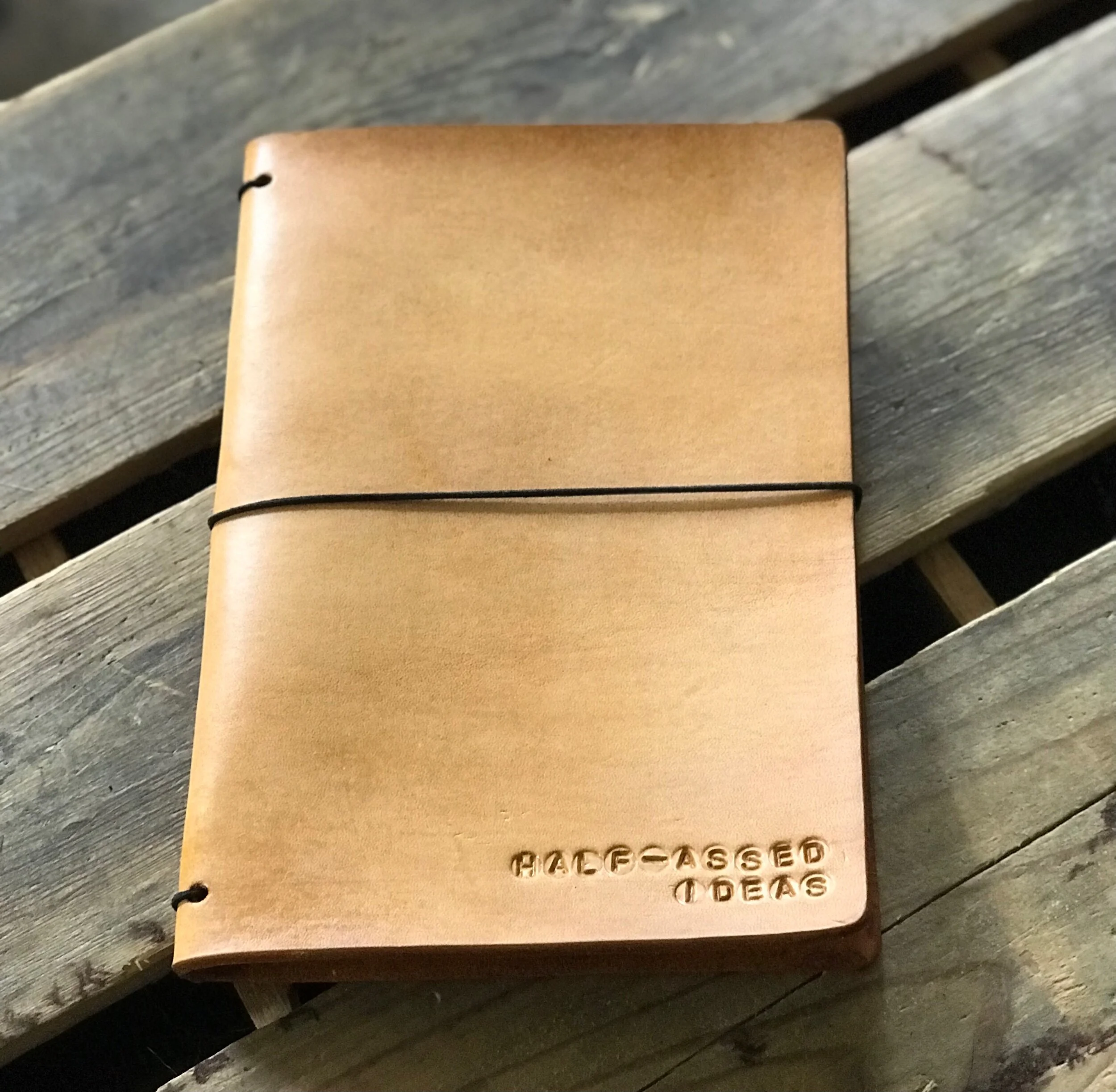
But resting flat on a round wooden tiered display stand in the center of the shop was a small journal with the phrase “half-assed ideas” stamped into its stiff leather cover. I chuckled to myself and moved on, making my way to the selection of teas in their tall silver canisters. We have far more tea at home than anyone could ever drink (make note, nieces and nephews—you’ll likely inherit most of it when we pass), but you never know if there’s a new one making its debut. A quick scan of the shelves’ offerings told me we were up to date on our home tea inventory and so I wandered back to the round display stand where that little blank journal blinked back at me, wondering what took me so long on the double-take. I scooped it up, and along with my tincture and a tiny free paper cut-out of a red-capped mushroom, stepped back out in the mid-Ohio sunshine, ready to put my weary bones on the couch next to Patrick for a bit.
As is our custom when either of us returns home from a solitary retail endeavor, we pull each treasure from the bag with a story (or explanation, or defense of spending) and a flourish; exclamations of approval or surprise are expected, or at least appreciated. Given the humble quantity of my purchases, I knew it wouldn’t take long, and the journal was an impulse acquisition. As I reached for it, the inspiration for the explanation came naturally.
“Honey, this is for us to use when we have an idea that needs a little more, um, development, and is too good to just toss into the ether, hoping it will stick to something. Don’t you wish we had one of these back when we first moved here?”
Another burst of pure laughter as we both began thumbing through our collective memories’ pages, landing on those moments that at the time seemed like brilliance but were, in fact, the essence and definition of lunacy. Thankfully, most took place or were discussed without witnesses and could sink back into the obscurity of the drawing board without the embarrassing wince of ridicule. But maybe those ideas were just ahead of their time—shouldn’t we revisit them to make sure we hadn’t overlooked some key variable of genius? It was Patrick who called it: “Let’s start jotting down Past Half-assed Ideas and see where that leads”. The title alone got us giggling and we spent the next hour reminiscing and guffawing, endorphins flowing like that November-flooded creek of years ago. If nothing else, our nieces and nephews would stumble across this collection someday and gain a deeper appreciation of their aunt and uncle’s active inner life, accompanied by a few cups of really old tea…
I know some folks who journal and then shred what they’ve written as a daily ritual. I’m sure such a practice can leave one feeling liberated and clean as a whistle inside. As a writer whose genre leans heavily toward memoir, I save every scrap of sentences that show up inconveniently while I’m behind the wheel or in the post-midnight hour demanding my attention. I sometimes forget which jotter or notebook on which nightstand or end table contained that train of thought that will certainly rocket me into the Memoirist Hall of Fame, but I’ll find it eventually. Having kept journals for the better part of forty years now, I also understand that unless there’s an all-consuming house fire, someone will come across the pages of my most vulnerable moments in life, see exactly what I was thinking at the moment, and where I decided to name names. As I get older, I grow less concerned about what others think of me and my meandering rationales or fleeting perspectives. A random list of half-assed ideas seems a goldmine for future generations to stumble upon after I’m dust.
Too bad I won’t be there to join in their laughter, especially if they find this current work-in-progress inspired by a shop owner’s artistry with leather and an alphabet stamping tool. An impulse buy, perhaps, but one with an infinite return on investment.
(Author’s note: The shop I describe here is Old Mr. Bailiwick’s, located in Mt. Vernon, OH. If you live in Ohio, it’s worth the trip, no matter your starting point. And if you’re not a resident of the Buckeye State, their website is the next best thing, though you’ll miss the charming ambiance of the place. Owners Josh and Becky are filled with talents both hidden and out there for everyone to enjoy, and really know their way around gathering, foraging, decocting, leather stamping and infusing. I hope you’ll find your way here someday and claim a few treasures for your own).
Rethinking a Box of Rocks
Yes, I paid money for rocks that weren’t going to resurface our long driveway or dangle all polished and shiny at the end of a silver chain around my neck.
Patrick is hand-turning a wooden rattle.
No, we’re not expecting (if that were the case, I wouldn’t have a baby shower. I’d hold a press conference). It’s for ceremony and prayer, and he’s been artistically thoughtful about it.
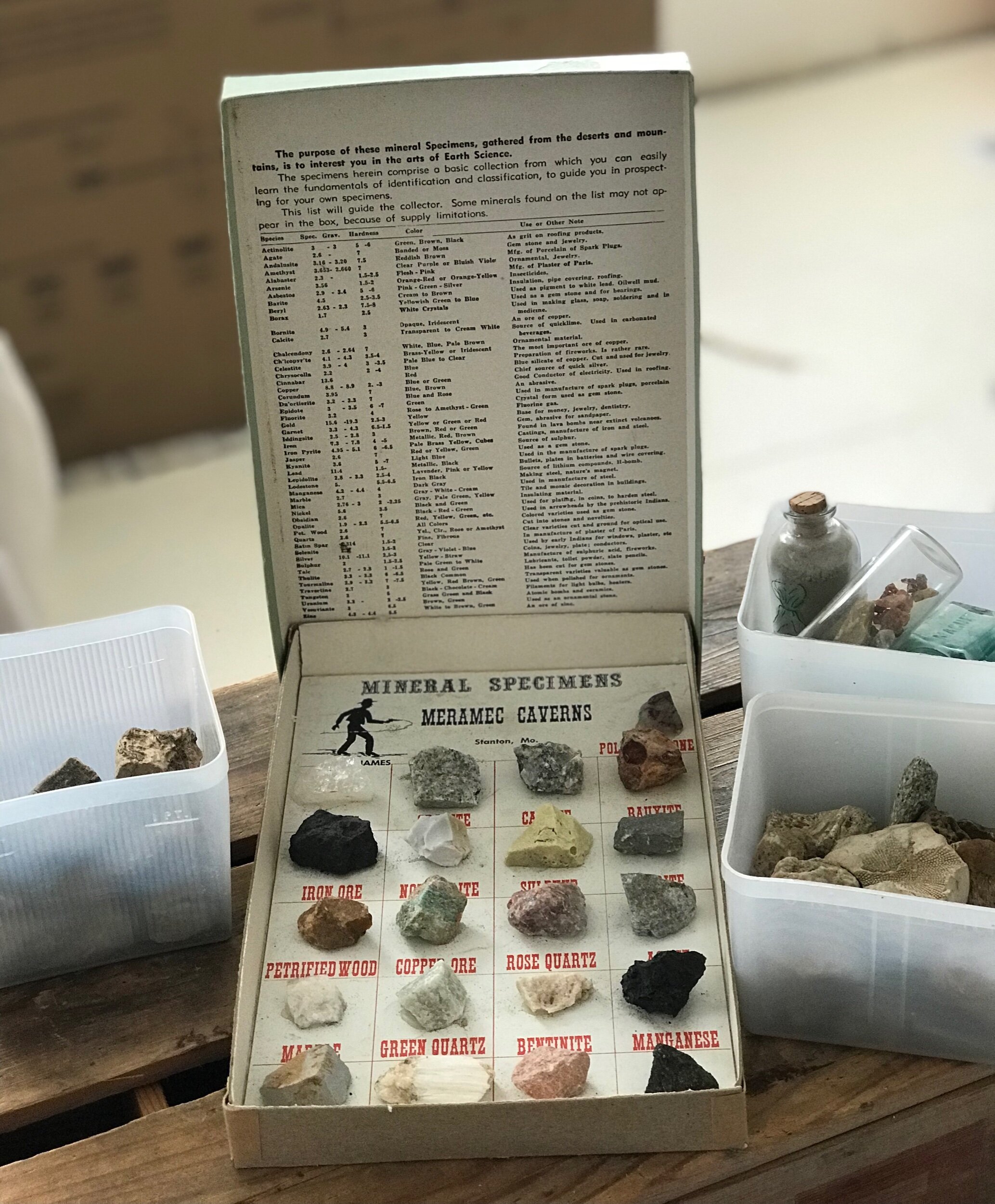
Two weeks ago, he was describing the rattle’s design and asked if he could look through our late neighbor Joe Berg’s rock collection, some of which we’d purchased at Joe’s estate auction several years ago. Patrick was hoping to find a few smaller stones to seal inside the rattle’s seedpod-like shape. Before I continue, yes, I paid money for rocks that weren’t going to resurface our long driveway or dangle all polished and shiny at the end of a silver chain around my neck. But the ones we bought weren’t just any rocks up for bid. Joe and his wife Bea traveled extensively in the early years of their marriage, across the U.S. and abroad, collecting rocks from each place they visited, labeling and cataloging them meticulously for future generations. The sheer story value alone got my attention as I wandered through rows of folding tables set up on the east lawn of their 100+ year-old farmstead, past avocado and harvest gold-colored countertop kitchen appliances, dusty silk flower arrangements and carefully placed Tiffin stemware, some with the original silver sticker still clinging to the base (I came home with some of that too, some creatively acquired road signs and a vintage accordion, but that’s another story…).
The rock collection had been distributed among several shallow cardboard trays that covered at least seven of the two dozen or so 6-foot tables near the farmhouse’s back door. The auctioneer grouped and offered the trays for “choice” (the highest bidder gets to select which and how many box lots they want) or “one money” (all the trays sold to the highest bidder), the crowd inching along with him as each tray was won, and I kept pace with them, knowing exactly which ones I was hoping to bring home. Some of the rocks were massive and needed no box at all for display purposes, their random glints of crystal and quartz winking at us in the summer afternoon sunlight. Like magpies with money, we ping-ponged our bids off one another until the going price sifted some of us out of the running. The large rocks from mostly western states (Arizona, Utah, Colorado) sold first and fast, their new owners cradling them carefully back to their cars and trucks each time the auctioneer hollered “SOLD!” Eight trays remained, their contents small and sorted into square 70’s-era food storage containers without lids. Rose quartz, fool’s gold, bits of real gold in tiny tube-glass lidded containers, obsidian and geodes and flint (polished and unpolished) sat waiting their turn. I’d evaluated all the trays’ contents carefully before the auction began and now stood ready, my cardstock number in hand while the auctioneer offered these last eight trays as “choice” (best auction advice I can give is show up early and examine everything, even the stuff you don’t want to buy. You just never know).
I came home with the six trays I wanted and spent the rest of the afternoon turning over the past, touching pieces of places I’ve never been and imagining the feet of ancestors pressing against the rough surface of time, now scattered in bits on our kitchen table. On this side of things, I will not know what caught Joe’s eye when he glanced down and saw a nondescript gray shard of something that turned out to be petrified wood. It is enough that he paused, held it in his hand and shared it with his children for decades.
I’ve moved these rocks more than once in the past five years, from the bottom of a dresser drawer to the upstairs guestroom and once again this morning, to rest atop the vintage blanket chest that serves as our coffee table in the living room. Where some of them go from there is up to Patrick and the rattle that will eventually enclose them for another who knows how many years. It’s his story to tell, not mine. But for an hour or so after breakfast on a summer Sunday morning, our imaginations meandered across the miles, passing through the ghostly whispers of lives and stories now mingling with our own.
Let the ceremony begin.
And continue.
The Bones of a Thing
I live most of the time in wonder and curiosity, hungrily filling my plate with the knowledge of others who spend their days watching and making notes.
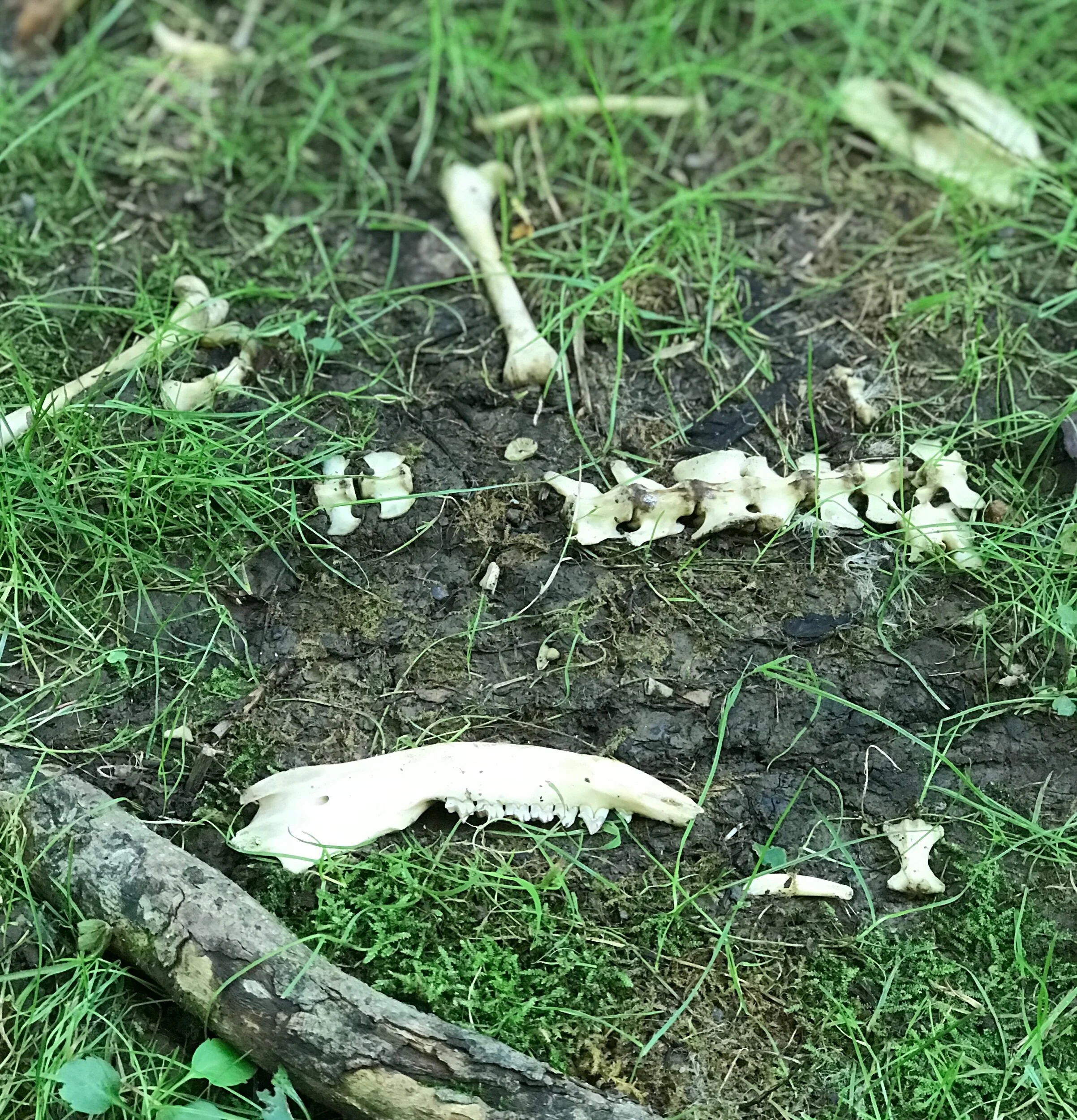
At the northwest corner of the walking path parallel the woods, past the Hill and beneath a stand of young sycamore saplings, what’s left of a possum is scattered and pressed into the cool clay soil, the work of some mystical arboreal curator who tends to the living and the dead with equal measure while we sleep. But for a wooden frame and some glass, I could be passing a museum of natural history’s exhibit entitled “Not That High on the Food Chain” or “Late Night Coyote Snack”. One of the creature’s mandibles, incisors perfectly intact, offers a ghostly half-smile and I sift through memories of all the encounters I’ve ever had with a living possum who might have been protecting her newborn babes, that snarling face frozen in defiance and indecision. Sections of lumbar vertebrae here, a radius there, the remaining missing bits carried deeper into the thicket of blackberry brambles by a predator who wanted to eat its meal in peace—I can only imagine what unfolded for both of them as one life was sustained by another (unwillingly perhaps, but how do I know? I wasn’t there at the time and mustn’t assume anything about how such arrangements are made). This pause on my morning walk moved silently from observation to tender memorial service. A whispered “Mitakuye Oyasin” reminds me that I'm not the only one here and someday, my bones too will rest somewhere in the cool clay soil. I hope it’s not a violent end to a life I’ve cherished on this side of gratitude. Having meant that as a prayer and not simply a meandering musing, I send it out and upward to the canopy above, resuming my walk with fresh humility and more than a side eye to the Grand Scheme of Things in whose circle I continue to dance my days.
There’s so much I really don’t know, or ever will.
I live most of the time in wonder and curiosity, hungrily filling my plate with the knowledge of others who spend their days watching and making notes (I know there’s more to it than that, and am certain that such work can be tedious or painstaking, even boring at times. But I daydream about it anyway). I do my own informal research, noticing how this year it seems the sycamores are shedding their bark in greater volume than I recall from past seasons as I step over the curling gray pieces in the short feathery grass of the walking paths. Their now-smooth trunks and branches are a pale celery color and somehow, they look stronger for it, less burdened. Stretching out of their old skin like tall snakes, they push themselves upward into a still-summer blue sky. I join them impulsively for a moment, raising my own arms as far above my head as I can. It does feel good (though my own skin remains intact, which I consider a good and helpful thing for now).
Until scientist Wilhelm Conrad Rontgen accidentally discovered a way to view the bones of a thing while testing cathode rays in 1895 (leading to what we now know as the x-ray machine), we humans had to content ourselves with wondering about the inner supporting structures of a life form, or disassemble a once-living thing to get a closer look at how it all fits together. I’m like more than a few folks in wanting to know what goes on inside a being, how it stands upright or crawls sleekly through the wet grass, soundlessly and with such grace. What gives its flesh a place to hang, how does the architecture know when it’s time to get a move on and what sets it all in marvelous motion? It fascinates me in those last minutes of my lunch hour and I image-search the internet for a visual to satisfy my curiosity for a while. Then it’s back to work, to an aspect of my job that is equally fascinating, and privileged, truly—I get to interview people who want to become volunteer members of the hospice team. It’s no small ambition. The respectfully curious questions I ask help me get to a different set of “bones”—the structure of someone’s beliefs and perspectives, the rich soil of their most precious values, from which everything else springs forth, the nexus point on which all their decisions pivot. In an hour’s time I hear stories that give evidence to a life framed and enriched by giving, a gentle insistence that they be allowed to keep a promise to a dying parent, a clear vision of a future filled with patients of their own as they put their shoulders to the hard wheel of medical school. They tell me much more than I’d ever be allowed to ask, and I hold their answers in sacred trust, fully aware of the gift I’ve just received.
Some people’s values are as loud and clear as a trumpet, others ask that we watch carefully for the slightest nuanced clue before drawing an incomplete conclusion. And some don’t tell us at all until after they’re gone, having lead by example if we were paying attention. All this from what’s left of a possum beneath the watchful rustling leaves of a few young sycamores…
There’s so much I really don’t know.
Or ever will.