
No Degrees of Separation
I shudder to think of the elaborate capers that escaped our scrutiny as we labored miles away, unawares.
It’s Tuesday around 12:30pm. I’m eating lunch at our kitchen table, taking a break from the upstairs home office, when Copper, the feline matriarch of our clowder, settles herself beneath my chair, farts, and growls disdainfully at Bumper, who’s at the water dish rehydrating. He ignores her and she walks away, the kitchen now sufficiently cat crop-dusted.
Not twenty minutes later, a red tailed hawk slams into the living room window and drops into the mulch, talons pointed skyward. Patrick was on the phone trying to sort out some banking business and let fly a string of expletives in the ear of some poor but patient associate. I threw on my flannel jacket and grabbed one of our walking sticks on my way outside, thinking I could gently flip the bird right side up, but from a safe and respectful distance. It worked and, back on its feet, the hawk—a young’un—stumbled drunkenly through the cold flowerbeds in front of the kitchen windows to the back door and stood trying to collect his dignity. I sang to it, a sweet Lakota lullaby I know, until it flew shakily into the meadow for a restorative perch on the branch of a shagbark hickory. Meanwhile, back inside the house, all four cats were on full alert, watching the drama unfold through the window like a row of ducks at a shooting gallery line-up.
My life sure has changed since I started working from home.
For nineteen of our twenty years here, pre-pandemic, we’d leave the house in the morning to work elsewhere and not return for hours, the cats and chickens in charge of our belongings. I shudder to think of the elaborate capers that escaped our scrutiny as we labored miles away, unawares. I remember one day being sick at home on our old couch; I looked up at the ceiling fan to see a small squirrel sprawled across one of the paddles. Our cat at the time, Scout, was sleeping on my stomach and when I woke him up and pointed upward, he looked at me, shrugged and fell back asleep (I suspect there was some sort of Arrangement going on here, and I just happened to be home to witness it). Suddenly, the squirrel leapt from the fan blade, skittered down the wall and across the kitchen floor, sprinting to the mudroom. I had to pick Scout up and carry him there so he could at least pretend to give chase (sigh…some cats are born to their purpose, others have to be held by the paw the whole way).
We’d come home on occasion to find a few upended plants sitting askew on the carpet in a scattering of their once-tidy potting soil, but the rest of the kittens’ unsupervised deeds remained dark and unpunished. They still hide the evidence well, putting on an irresistible mantle of innocence and purrs that not even Patrick can ignore. We feed them little salmon treat nuggets, stroke their scheming heads and let them sprawl on the couch until we’re displaced to the deck chairs on the porch. I try to recall the constellation of circumstances that brought our cat total up to four. In a small bungalow-style home, with winter’s breath on the windows, that’s about three cats too many.
Until last spring, the wall between my work and home life was tall and thick, and not as transparent. The twenty-two minute commute from the office door to our screen door allowed for a slow and final evaporation of any unfinished business that followed me from my desk to the car. By the time I parked and walked across the front porch, it was all about gardening and field walks and winsome kittens and, for a time, forty Boer goats spread out across seven acres wrapped in electric fence. Copier breakdowns, policy revisions and new hire orientations blurred into the background, waiting restlessly but contained until the next business day. Exhales were the rhythm of my breath until dinnertime, and isn’t that why we moved out here? I know my computer will outlive me, but the current bend in the creek near the Old Man sycamore and the pairs of bright red cardinals dancing in his branches may not, so I’d best get out there and be with it all, unfettered and free in mind and body.
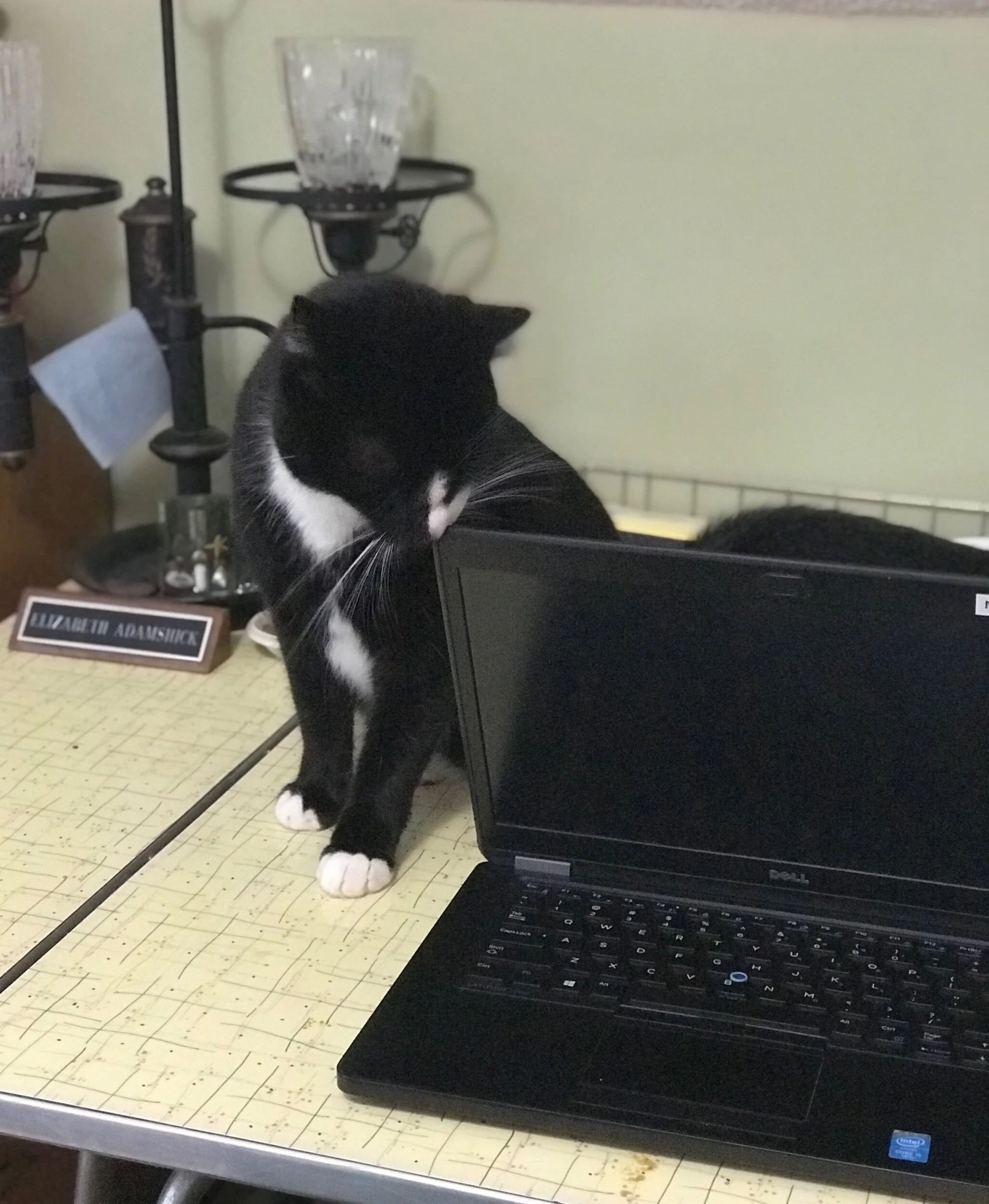
It’s different now. Lines have been crossed, blurred and shattered out of safe necessity. On Mondays, I touch the corporate workspace for ease of making copies, a faster WiFi connection that works well for some of my more graphic-rich projects, and virtual meetings with colleagues on the other side of my office walls. When I leave at the end of the day, I put my wastebasket outside the door and step into the remainder of a workweek spent in the guestroom-turned-home office on the second floor of our 100-year-old farmhouse. Kittens become coworkers (though they’re productivity is hard to measure by usual business standards) and my commute is now a steep set of stairs with two landings and a window with a view to the south. This is wonderful, because I don’t have a window back at headquarters. But it still feels strange having emails come into the house that have nothing to do with chickens or our recent seed order. And there was that twinge of guilt at first when I’d skip the day’s shower because who’s going to know, right? I look in my closet, where a professional wardrobe hangs unemployed, on hold until it matters again how I look between 8am and 5pm. (out of courtesy for my coworkers, I leave the camera off for our virtual meetings. They know enough about me already).
Straddling two worlds that were once separated by the chasm of my work-life balance construct, I’m getting better at keeping a daily schedule framed by healthy starting and stopping points. The gentle click of the home office door closing behind me is the new exhale moment at day’s end. Whatever was left undone or in process will be there when I’ve finished breakfast the next morning, brushed and flossed my teeth and at least run a quick brush though my hair. I’ll take the current convenience of fixing lunch one floor below as a temporary luxury and the absence of a morning commute as retirement practice. We’ll be back in the office soon enough, bumping into each other at the copier and exchanging pleasantries as we pass in the hallways, reheating our lunches in the microwave and receiving visitors in the lobby whose smiling faces we will happily get to see in full.
Until then, it’s occasional cat farts and a comfy clothes dress code and red tailed hawk rescues. I’ll make it work.

A Body of Work
Today began like most other days, with a walk around the land and a good bit of taking stock of the projects that await us when the winter melts into spring.
Yesterday I backed into the long handle of a golf club that we use to prop open the door to the chicken coop and fell backwards, landing on arthritic left thumb. I watched it all in slow motion on the way down to the cold ground, and don’t remember if I did the classic arm wind-milling in an attempt to right myself. Flat on my back and looking up at the blue above me, I smiled and chuckled to myself, rolled onto my knees and stood up.
I used to be so graceful and surefooted.
I also had fewer lines on my face, more energy and could even sprint when I wanted to. Whatever happened to that ageless thirty-two year old who could work sun up to past sundown and not reach for the Advil on her way to bed? She was the one who chuckled while considering the chicken run from a different vantage point yesterday. I expect I’ll be giving her a few more laughs before I pack up and head to the Other Side.
Before we took up the mantle of caretaker here among the trees and the furrowed fields, our bodies lent themselves to less rigorous activities of the outdoor sort. Cutting the grass, maybe trimming a hedge or two, but that was about it. Oh, and dragging a couple of trash cans to the curb once a week. Hoo-boy, talk about mopping one’s brow, eh? At our last official suburban home, we got ambitious one summer and put in a concrete path off the back steps using one of those molded heavy plastic forms that Quikcrete called a Walkmaker. You’d fill the randomly-spaced sections with a stiff crack-resistant concrete blend, lift off the form carefully and set it down again to refill until the stepping stone path of your dreams reached the garden. We were so young and in love, we drew a heart in the wet cement and put our initials inside it, using a stick to make the point and the fletching ends of an arrow on either side of the heart’s edges. It was easier back then to go through the stooping, shoveling, smoothing and tugging motions necessary for such a project; we could carry on that way for hours without a break and still have energy to safely make dinner while the cement dried. We didn’t quite get that path to its intended destination, and became distracted by some other outdoor event until we sold the house and left the molded concrete stones behind to tell an unfinished story for the new owners. If nothing else, they knew we were smitten.
There’s no marker on the timeline of my accumulated years where I can pinpoint that moment when I could no longer lift eighty pounds of Quikcrete like I used to. Or the exact day when my left thumb grew more stiff and in need of coddling at the end of a long stretch of handwriting my memoirs. It’s never that precise, the aging process. It’s far more subtle and gradual when one’s muscles don’t quite lengthen the way they did during the Big Barn Cleaning of 2002 or the trimming of goat hooves when we kept a herd of forty-two (do the math on that one: four hooves per goat x forty-two and that’s a mighty lot of chasing after four-leggeds to wrassle them into the pedicure position). It’s easier to run through a list of the surgeries I’ve had and remember to send a Christmas card to each of my anesthesiologists. Let’s see…I’ve come through a tonsillectomy, wisdom teeth extraction, two stapedectomies to replace the stapes bones in both ears (with a platinum filament, no less. Ain’t I all fancy now?), brain surgery to remove a benign tumor on my skull, a total hysterectomy and treatment for Graves disease (not surgery, but I did get to drink radioactive iodine from a tiny brown bottle while sitting upright in a chair with a heavy lead apron that covered my torso. The nurses who administered the medicine made sure they were safely on the other side of the glass door to the treatment room before I raised the bottle to my lips and said a silent “bottoms up!”). Thyroid now shrunk into oblivion some twenty years later, I dutifully take my levothyroxine every morning as the sun rises through the bathroom window.
Living where we do is a daily physical commitment that needs our regular attention, and our bodies must show up in working condition. The projects themselves are enough to get our blood moving and our lungs expanding. Who needs a gym membership when you’ve got 41 acres of squats, overhead presses and ab crunches during the planting and harvesting ends of the season? Our mortgage payments ensure that we’re motivated to get the most of what this natural weight training program has to offer, and I stop just shy of saying we’re now sculpted in our 50’s. We’re not couch potatoes, but neither are we ripped. I’m grateful to make it around the paths by the woods and in the fields every morning no matter what precipitation falls on me and around me during those seventeen acre treks. I feel sturdy and alive. And that’s worth a tick mark in the achievements column of my life’s ledger.
We know that at some point, it’ll be the day’s big event to walk down to the barn to fire up the riding mower and cut the meadow’s two and a half acres of grass down to size. There will still be another eight acres to go but we’ll save that for the next day and hope it doesn’t rain before we get to it. We’ll be less fussy about keeping the weeds down around the house; as long as they don’t climb up the siding and obscure our view from the second floor window to the west, that’ll be fine. Of course, by then we may have moved the master bedroom to the first floor and will only venture upstairs to see what that snuffling sound is in the attic that’s almost empty now.
In some sort of cosmic paradox, this rural tenure of ours has both invigorated and aged us in equal measure. We’ve more lines and spots on our skin, that’s true. But we also take in every molecule of oxygen the trees put forth; it hits our bloodstreams like the tonic it’s meant to be. I feel more renewed than fatigued more days than not, and I relish those evenings when I’m exhausted from the days’ physical work rather than the “wired-tired” of too much mental stress. The difference as I drift off to sleep is decidedly distinct and I don’t even remember my dreams. Delicious.
Today began like most other days, with a walk around the land and a good bit of taking stock of the projects that await us when the winter melts into spring. This morning, though, I was determined to get a head start. When the trees are bare and the fields’ contents a transparent brown, it’s clear which thickets need cutting, which trees need to be freed of the grapevines that cling to their nubby bark and weigh down their upper canopies. I set my sights on a small group of black walnut saplings just on the other side of the meadow, draped in straps of grapevines swaying in the cold winter winds. My technique is fairly simple: cut the thicker section of vines that lie closer to the ground, then pull on the thinner dangling end of the vine above until it comes loose and cascades down past my ear-muffed head to the ground. All was going according to plan until I grabbed hold of a rather stubborn vine and gave it a mighty tug. I toppled backwards as the vine slipped out of my grasp and held fast to the sapling’s uppermost main branch, laughing my way to the ground in a soft tuck-and-roll maneuver. I could almost hear the nearby thorny blackberry stalks snickering as I lay there for a long minute, wondering if two falls in as many days was cause for concern. I sat up, fixed my gaze at the end of the grapevine still swaying above me and pushed myself off the ground to full standing position.
One of us was coming down, and it wasn’t going to be me.

In Our Dreams
The seed catalogues have started to arrive, in nonstop glorious full-color succession.
In the luscious quiet of a new morning, I tiptoe past the garden on my way through the field to the woods. She’s asleep beneath her blankets of compost, mulch, and flattened cardboard boxes I repurposed from the recycle bin at work. The 6 x 6 planks that frame the raised beds are stoic and patient as the space above them flutters with the ghosts of last year’s harvest. We’ve already mapped out the area where we’ll plant potatoes and onions this spring, garlic is in and out of sight, doing whatever garlic does in mid-January, and a pile of woodchips from the grandmotherly silver maple we trimmed last November is looking forward to covering the paths between the rows of future strawberry spinach and amaranth. In the middle of it all, a young volunteer mulberry sapling pauses its stretch toward the sky, saving its strength for a spring growth spurt. Tucked into the morning’s latest winter scene—bare trees dusted with a confectioner’s sprinkling of snow—the garden looks peaceful and trusting, willing to hold on carefully to the tender roots of whatever starts we truck out on planting day in the two-wheeled garden cart that still holds the top spot on our “Best Purchases for Outdoor Projects” list. She’s counting on our careful planning and discretion and we’re determined not to let her down.
And…the seed catalogues have started to arrive, in nonstop glorious full-color succession.
Some of them are just too indulgent to be allowed, with their vibrant and precisely staged layouts of rich purple cabbage and pole beans, twelve varieties of basil (I want them all), melons with neon orange or red insides wrapped in dark green striped or speckled outsides, and those Atomic Grape tomatoes that almost change colors as you watch them ripen (we have a couple of strategically-placed lawn chairs in the garden’s paths so we can do just that). As much as I love winter’s muted palette of greys and whites interrupted by tawny browns and deep evergreen, I freely admit to leafing through the pages of the catalogue du jour on the top of the stack to soak in the electric colors of this year’s zinnias and cosmos. My eyes drenched in such ocular delights, even for a few moments, helps me push on through some of the rougher days. I encourage you to try it.
Today, under a moth-eaten blanket of clouds and slow-motion snowfall, the warm breath and cheerful technicolor displays of spring aren’t even visible on the mind’s horizon. I’m fine with that—you know, live in the present—but at night I can set my dreams to a different station, and so I do. In the dark behind my eyelids after midnight, I imagine those raised beds bursting with kale and corn mache, tender French Breakfast radishes and Bull’s Blood beets (the dark blackish-purple leaves an excellent shot of color for any mixed salad). Butterflies and bees flit about pollinating anything they can get their little feet on, and the row of cattle panels bent into curved trellises anchored with t-posts are dripping with Lemon cucumbers and three different kinds of plum tomatoes. I walk through this tunnel of lush green in a flowing cotton sundress and eat the warm fruit right from the vines (this girl knows how to dream).
I can hear Patrick’s garden dreams as he slumbers by my side, though his imaginings lean heavily toward soldier-straight rows of everything we’ve planted, each seedling in its place and perfectly spaced per seed packet directions. He built all those raised beds so he’s entitled to a vision of precision and orderliness (I’m quite fine with a more higgledy-piggledy layout, letting our green children run wild and barefoot in their formative days until my inner adult tries to tame them after its far too late. One of the many reasons I don’t have human offspring). When we both wake up after a long and delicious night of such meanderings, it’s a harder task to transfer these images to paper, drafting a Garden Plan that each year, we swear we’ll abide by no matter what. We write down what goes where and in which raised bed, who’s in charge of what garden sections, and a daily maintenance schedule that resembles arriving and departing flights at O’Hare. Being mere mortals, however, our ambitions can easily dissolve in the weariness at the end of our day jobs (which help fund this whole botanical enterprise) and we make a less-impassioned promise to get out there tomorrow and dig the rows for those Ruby Crescent fingerlings we’ve been eager to grow. Thinking of those potatoes on our plates, roasted and drizzled in just the right amount of olive oil and pink Himalayan salt, is enough motivation to follow through.
Given the current state of affairs, these garden dreams have sometimes been hijacked by others, manifesting our worst fears (more violence and riots, a virus that has no “off” switch) and creating nightmares that don’t end when we open our eyes. We keep falling asleep anyway, night after winter night, tucked trustingly in the arms of hope, holding fistfuls of seed packets and tiptoeing past the promise of spring asleep in the humble field behind the house.

A Tired Soul Still Knows
For now, I blame Wednesday and a weary spirit that has held up its hand, saying give me a minute. Give us all a minute.
Somewhere deep within me, underneath the motions of a daily routine committed to muscle memory, the what’s for dinner and did you get the mail and how was your day churns a sob so thick and wide, a storm of tears that will have its time above ground and soon. I’ve been sitting on it since Wednesday, January 6 at 3:11p.m. or so, but when doesn’t really matter. All I know is I’d best let it loose, get out of its way. I heard it somewhere (don’t recall when or from whom) that one can either walk with the Creator or get dragged. Well, you know how much I like to walk. And while I appreciate the surface sentiment, I thoroughly reject as abhorrent the theological notion of any higher power that would drag its oft-times reluctant and frightened creations around. The One I understand is much more patient than that.
So I wring from that bit of limited wisdom the importance, indeed—the necessity—of giving way to the surge of emotions that carries healing with it on its rocky tides. No, it won’t feel comfortable at first, or at all, but I’ll be better for it, less burdened and afraid. Any first-year psychology student knows that what we ignore between our ears, behind our rib cages and in our guts simply bides its time until it becomes bigger than what our skin can contain. I love my friends and family and co-workers too much to let unattended rage or sorrow come splashing madly at them sideways. And I love myself enough to forego that interior damage. So there it is—a grief manifesto and playbook, all wrapped into one small paragraph. Writing it was easy; implementation will be less so. We’ve got enough Kleenex. I checked.
Maybe this is similar to how you’ve taken in the events of the past four days (as of this writing): shock, repulsion, deep deep sorrow, disbelief, anger, perhaps even rage, roiling fear, relentless anxiety and a small glinting sliver of hope that we can push through this, our arms entwined and heads up, gaze planted firmly on a horizon that wobbles but stays within sight. I’ve not slept well, have you? The couple of hot baths I’ve taken didn’t wash away anything except the day’s sweat and dust. Apples still bring comfort in their simplicity and nourishment, but my appetite is shot otherwise. I must learn to put down my phone, to strap on my hiking boots more than once a day and get out there where whatever’s stirring within me has room to spread out and maybe even dissolve in the tolerant space around me. But that rumble of a sob is still waiting for its right and proper moment. I listen and wait. Listen…and wait. What else can I do?
Well, for one, I can let you know that I’m not in that “got it all sorted” place. That I’m frightened, even when I take those recommended deep breaths for a count of four on the inhale, eight on the exhale. I felt flat and bland when I closed off my work day for the week last Friday. No relieved anticipation of the weekend like I’d usually feel. For now, I blame Wednesday and a weary spirit that has held up its hand, saying give me a minute. Give us all a minute.
But I am tired.
Tired of waiting for something to be over.
Tired of waiting for something to begin, for people to come to their better logic and senses, to choose wholeness instead of fractioned factions.
Tired of evil mislabeled as mental illness, or worse, patriotism.
Tired of the hate…the hate…the hate.
I’ll keep wearing a mask until it’s no longer necessary, but I’m tired of what it now represents.
And tired as I am, I still can’t sleep. Isn’t that odd and wrong? Just…wrong.
And yet, somehow and in almost tender defiance of my fatigue, one of my feet keeps moving forward, followed by its trusting companion. I cover ground and find myself in a different place after moments or hours or days; the view is different enough to feed my hungry curiosity and pull me forward. A blue heron, out of place and way too early for its usual spring arrival, glides gracefully past the upstairs home office window this morning as I’m hanging laundry on a retractable clothesline, and I stop to admire its beauty. Wish I could fly. Half an hour later as I’m suiting up for the morning walk and glancing out the kitchen window, I see it slowly stepping its way past a bend in the creek. I don’t think the fish have returned yet, but what do I know? Not as much as a blue heron, apparently. I let the chickens out and place my trembling ungloved hand on the rough grooved bark of a black walnut sapling along the path to the woods. Maybe the weather-guessers will be right, and the sun will come out today.
Until then, I carry that sob with me and reassure myself I’ll survive its tsunami. The creek has told me on more than one occasion that she can handle some excess water, so I’ll be ok. We will be ok. Don’t ask me how I know that. I just do.