

Tree-Hugging: A User's Guide for the Pandemic
I made my heart as humble as I could before stepping off the path and over the remains of the rusty razor wire fence into their Their World…
Outside the living room windows, in the dark-before-dawn gray, the trees along the ridge sway as one in a mighty and warm southern wind. Determined clouds, backlit by a sinking full moon, roil and churn overhead on their way to somewhere while the spindly fingers of the trees’ uppermost branches clack madly into each other, their remaining leaves stripped and thrown to the ground. Halloween, held over one more day.
I just got a new raincoat—brilliant red and fleece-lined, perfect for layering when the temperatures drop—and as I suit up for the morning walk, I know it will get a workout today. Those determined clouds above me look swollen and if I’m caught in a downpour blowing sideways, I’ll be ready (and stylish, for however much that matters to any of the deer I might meet). Walking past the old rabbit hutches, the dual compost bins and the spot where we plan to dig the new outdoor privy, my hiking boots connect solidly with the earth as leaves blow in clusters across my shins like schools of brown crunchy fish. I feel great, filled with anticipation of yet another thirty minutes or so spent in the company of sentient living beings whose language I only know a little.
It’s only the first of November and there’s still plenty of autumn to be had. A few mulberry and ash in the meadow are dressed in leaves still completely green, and I pat their hopeful trunks as I walk by. It’s still summer. It’s still summer, they say, and I whisper along with them in a moment of tender longing and wistfulness. Wasn’t I just marveling at the colorful leaf-treasures at my feet a couple of weeks ago? We are fickle about the weather, no doubt. But today, with tree bones unadorned and all manner of squirrel condos now visible in their precarious perches along the upper landscape, I have other plans in mind. With the wind roaring and pushing against the oaks and walnuts of the meadow and woods, it’s time for some good honest tree-huggin’.
Our friend and brother, Kevin, showed us how to hug trees shortly after we landed here, quite spontaneous, actually, as he and the wind happened to show up the same day, and he asked if we’d ever experienced trees that way. We shook our heads and walked with him to the woods on the far northeast edge of the field. At the time, we still hadn’t been introduced to a lot of the different trees that lived there—buckeye, cherry, shagbark hickory, poplar, and my favorite, musclewood (botanically knows as carpinus caroliniana, and commonly known as hornbeam or blue beech). It’s trunk and branches have the look and feel of a gym rat’s sinewy arms, all smooth and ripped, and now whenever I get to that part of the woods, the walk would feel incomplete if I didn’t run my hands along a branch or two before moving along.
We found a mixed stand of young black walnut and ash, and with the wind blowing more fiercely than before, looked up at the swaying canopies that towered above us. Following Kevin’s movements, we each stood at the base of a tree and wrapped our arms around the trunk in a scissor-armed hug (one arm at an angle upward, the other in a downward position). “Wait for it”, he said, and sure enough, the next gust of wind caught the trees in a sway that slowly moved down their trunks until we were gently swaying along with them. The sensation was unlike anything we’d ever experienced. Clinging to this vertical highway of water and wood wrapped in bark, our torsos pressed into it all, we were along for the ride with our feet still planted firmly on the forest floor at the trees’ feet. For an added vertigo thrill, we tilted our heads back 90 degrees to gaze up into the branches as they caught the brunt of the wind’s push, back and forth…back and forth…(not something one should do for very long if one leans toward motion sickness). Some of these trees, young as they were, still stretched over thirty feet high. That’s a lot of height you’re wrapped around the base of, and when it all gets a-moving, best to mind your inner ear fluid and know when to unlatch.
This morning, watching the shadowy ridge trees just before dawn through the living room windows, I just knew being inside wasn’t an option. Of course, the north woods is older now, and its lanky residents have known their share of wind-toppling deaths. Some of the stronger trees have caught the others, but it’s still a dangerous enterprise to walk among them in a mid-autumn windstorm. Widow-makers dangle and perch above my head, and though they look weightless and innocent in the grooved-bark arms of a sturdy black walnut, they are unforgiving as they crash to the ground, taking out whatever or whoever stands below. I made my heart as humble as I could before stepping off the path and over the remains of the rusty razor wire fence into their Their World, touching a familiar musclewood on my way to the black walnut that was just the right size for a morning embrace.
No rain yet (though by now it wouldn’t have mattered), so I lowered the hood of the sweatshirt I wore beneath that brilliant red new raincoat, and removed the unicorn headwrap my godchildren gave me for my birthday. The sound of wind and hundreds of branches meeting in the air above me was constant and almost deafening. I checked the bark for any denuded poison ivy vines (not putting my arms around that, I can tell you) and moved in, arms open wide. Pressing my bare cheek against the tree’s rough skin, I wrapped around and held on, feeling that gentle sway. Almost imperceptible at first, it grew stronger as I bent my head back to get that dizzying view of its trunk narrowing skyward into those fingered branches. A shower of leaves swirled down, and time disappeared. Writing this, I barely remember the walk back to the house.
It’s been months since I’ve hugged anyone besides Patrick (not complaining at all, truly), and any full-torso reunions with the fellow humans in my circle are still not even visible on the blurry edges of the future we face together. I don’t know if any tree needs a hug from me, but in their own way, on a windy day, I think they hug back, a reassurance that life still courses through our respective veins and we’re all strong enough to stand as the storms blow through and past us. We’ll tenderly catch those who fall, and surrender to the strange and different beauty of a leafless season until spring comes.
Such wisdom is worth embracing in a gentle swaying hug. That’s gonna get me through the winter.
A Moment in Nicaragua
I didn’t want to see someone whose body had been insulted by bullets and grenades.
(Author’s note: A few posts back, I mentioned coming across a stack of homilies I wrote and delivered back in the mid 90’s when I worked at the Newman Center, the Catholic faith community at The Ohio State University. I sifted through them and found one in particular that rises to the surface of my thoughts ever so often. I wrote and shared this particular reflection in my early 30’s, at a Holy Thursday liturgy where the traditional Washing of the Feet ritual takes place.
It is necessary to let you know that I no longer follow or practice Catholic Christian (or other Christian) ways. But I have deep respect for any tradition whose spiritual outlook anchors itself in service to others, and relationships, and getting about the messy business of being community with and for one another. When I was twenty-five years old, I took my own understanding of all that to the mountainsides of Nicaragua, and came home with this one of many stories. I wish only to share, not offend or make demands of your own belief systems. Take what works, and leave the rest).
“It is better to die on your feet than to live on your knees.”
The words of a 17th-century Spanish revolutionary have often been my own. The passion they express feeds the rebel in me, a rebel who sees too many people forced to beg for what is rightfully theirs. To them I say “Yes! Fight to the end! You’re a human being! Don’t sacrifice your dignity. It is better to die standing proud than to live groveling at the feet of power abused.” I used to believe that, and some days it still sounds good—an empowering message to those who are oppressed.
But then I remember an encounter I had six years ago in Nicaragua, and the rebel in me gives way to someone else, a part of me that I fear. And love. And hope for…
His name was Donaldo. I think.
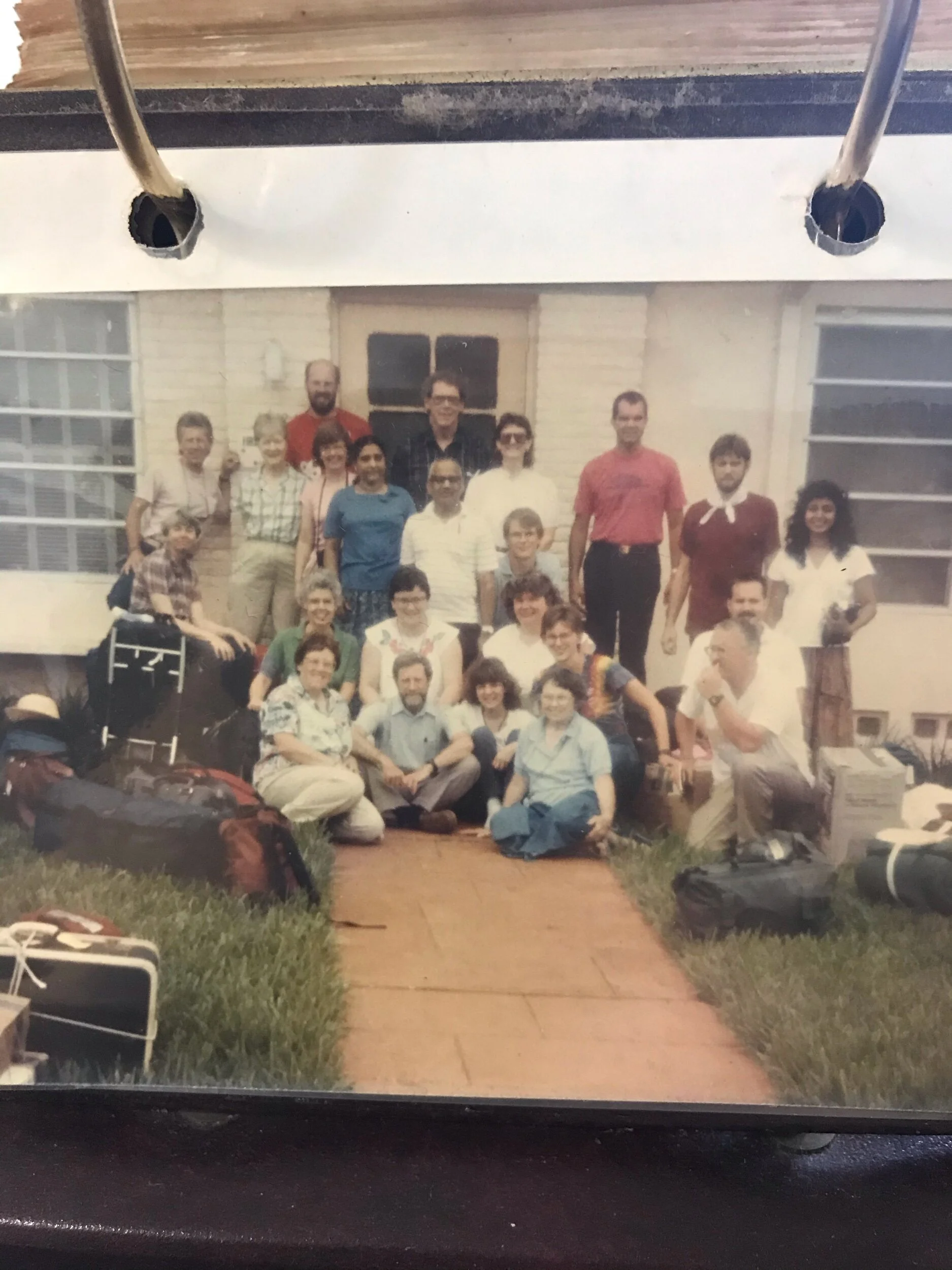
As a member of a Witness for Peace delegation in 1988, I traveled to Nicaragua to document the war between the Contras and the Sandinistas, how it impacted the people caught in the middle of too many opposing ideologies. We trained in nonviolent resistance, attended scheduled meetings with community and government leaders and stayed with various host families as we moved through the countryside, listening and learning. Donaldo was not on our itinerary.
One afternoon in the hills of San Juan del Rio Coco, we were supposed to celebrate Mass with a priest from the town nearby, but he hadn’t shown up. First one, then two, then three hours passed, until finally Erik, our WFP guide, suggested we visit with Donaldo while we were waiting. It seemed like a harmless idea to me, until Erik explained that Donaldo was a soldier, bed-ridden with injuries he had sustained in a late-night Contra attack.
I was immediately anxious. You see, back then, at twenty-five, I had lived a rather cushioned life, hadn’t seen a lot of suffering, much less the physical effects of that kind of violence on a human being. What would he look like? Smell like? What if his appearance was more than I could take? I didn’t want to see someone whose body had been insulted by bullets and grenades. But there was no way to politely decline Erik’s offer. Our delegation traveled as a group. We had chosen to be in that country. It just wouldn’t have been right.
As we emptied out of the bus that brought us to his home, somehow I ended up the first one to enter his small, hot shack (what was I thinking?). The other twenty-three delegates filed in behind me. The only way out of this room was now blocked, and I was feeling more than claustrophobic. It was as if those walls held nearly every fear I knew—pain, loss of control, violence—and it wasn’t possible to look away.
He was lying on a cot. Half of his left arm was gone, the fingers of his right hand curled into a permanent fist. He couldn’t even sit up, but he did roll onto his side because he wanted to face us as he spoke. And in that moment, as he looked at each of us, and at me, I slowly fell to my knees. No other posture seemed appropriate, for here in the bed, twisted and insulted by bullet and grenade, lay the body of Christ. We listened for an hour or so to his story, his spirit. He encouraged us to continue to work for peace. We never did have Mass that day, at least, not in the way we had expected.
Donaldo didn’t die on his feet. And I had never understood what it meant to live on my knees until that afternoon.
When Jesus tied a towel around his waist and knelt to wash the feet of a tax collector, a few fishermen, someone who would later betray him, he did more than just remove a day’s accumulation of dust and sweat. He gave to them, and to us, a ritual, a lifelong posture of a heart oriented toward recognizing and serving the God in everyone. Everyone.
That orientation of heart is passed onto us each time we gather here, and is realized at the feet of our children, where we learn innocence and forgiveness again. At the feet of one who stops us on High Street asking for change or directions to North Central Mental Health. At the feet of creation which sustains us and supports us, delights and frightens us. And perhaps it is realized as we kneel in front of our own reflections, deeply aware and thankful for the incarnation that happens every morning when we open our sleep-crusted eyes.
Tonight, we gather to recommit ourselves to life on our knees. Not in submission to dignity exploited or power abused, but in conscious adoration of and compassionate service to the body and blood of Christ present all around us.
Let all creation bend the knee…
Humbled. Again.
So there I am on a Tuesday, and a Wednesday, trying to deconstruct the process for making a catheter bag cover.
Last week was pretty rough at work, so I thought I’d make a few pairs of lounge pants for some friends and my husband.
Why did I think that would help? It didn’t.
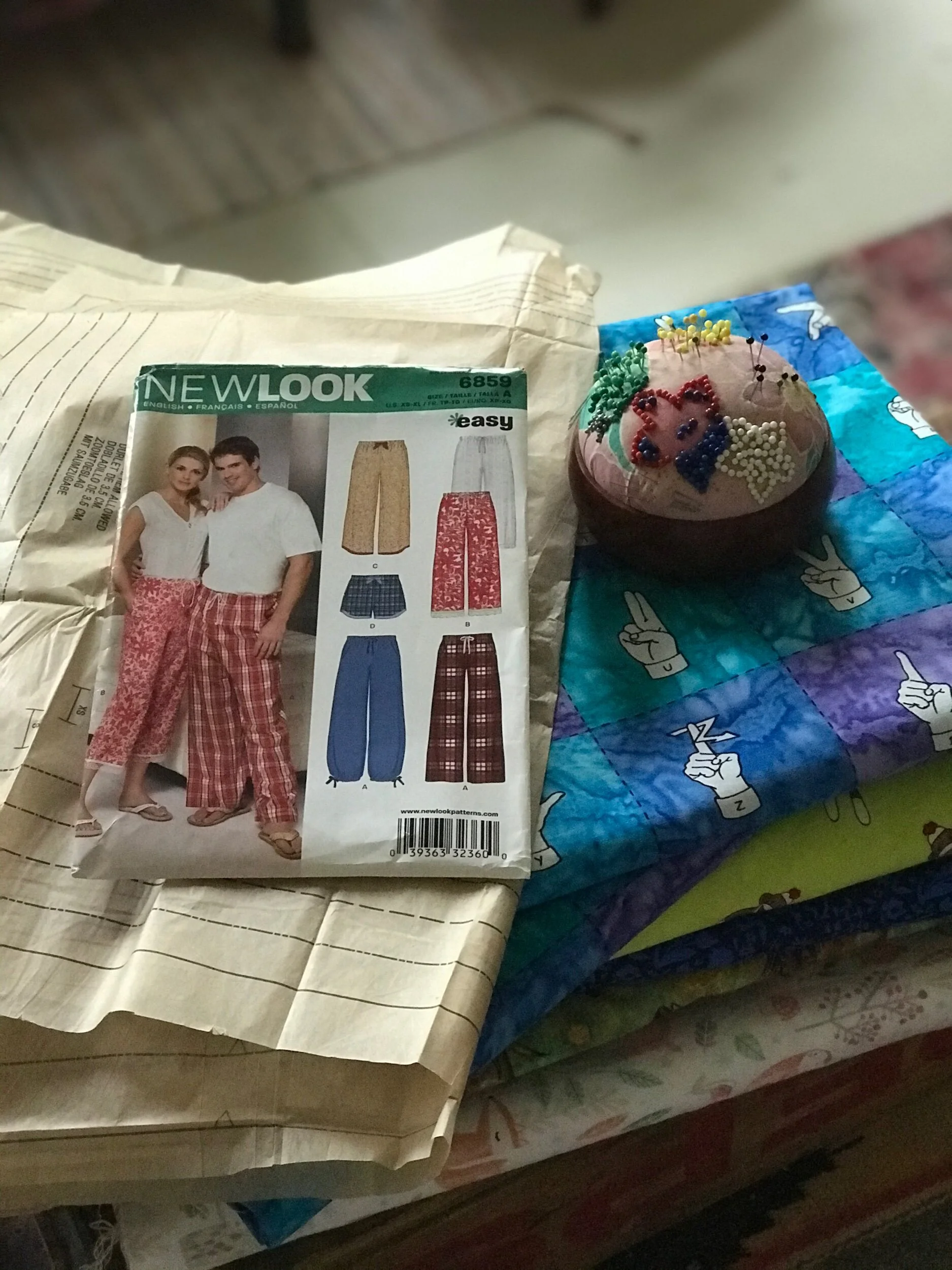
Two months ago, I gutted my art/sewing studio in a pandemic lockdown-fueled burst of tidying up, and found a lounge pants pattern I’d used before the turn of the century. I set it aside on the “don’t give this away” pile and plowed ahead with sorting buttons or some other Important Craft Supply. I remember making a pair that was far too big for me, out of fabric with small chickens and eggs on it, and lounged about the house in them for a few years before giving them to the thrift store in another burst of studio/sewing room tidying up (non-pandemic-fueled). Now I wish I’d saved them, because I can’t find the pattern and ended up buying a new one deceptively labeled as “easy” and “ for the beginner.”
I don’t know what skill level comes before “beginner”, but I’m currently in that category (probably all by myself), at least with this pattern, while the ghosts of my more capable sewing ancestors giggle and roll their eyes from their perches on my family tree. It’s embarrassing—must I always make my mistakes in front of a crowd? It would seem so.
Right now there are thirty yards of fabric patiently waiting their turn on the ironing board while I teach myself again how to read a sewing pattern. I made it as far as pinning the frighteningly-fragile tissue paper pattern to the fabric and cutting out the pieces (I want points for that—it’s not hard, but tedious). Then, with “right sides together”, followed the instructions to stitch the “pants front to the pants back along the inside leg seam.” That’s where things went wrong and haven’t corrected themselves (meaning, I went to bed and the elves didn’t finish the job). I’m glad I did laundry Friday and no one is waiting in a state of undress somewhere for me to finish these. At ease, folks. Smoke ‘em if you’ve got ‘em. It’s going to be a while.
If you know me even casually, you know I lean a lot toward connecting thoughts and events and circumstances that occur a few miles or days apart. Earlier this week, one of my day job’s to-do list items was rewriting pattern instructions for the good and talented volunteer team members who make items of comfort and dignity for our hospice patients. This team is a solid group of heart-driven individuals whose sewing and crafting skills cover a broad spectrum. My own sewing skills fall somewhere in the “fair to middling” spot on that continuum, and I create my own shortcuts, like every good sewing person does (slight departure—what do you call someone who sews? A “sewer”? I’m not sure I like the looks of that. I’ve seen a growing linguistic movement toward “sewist” in some spots—mostly social media—and it sounds only a bit better. I’ll stick with my commitment to people-first language and use “people who sew”. My apologies for its cumbersome-ness). Writing new assembly instructions for a patient gown or a bone-shaped neck pillow is more daunting than it sounds, since most of this team buzzes right through the process using techniques they’ve perfected over the years. When you slow that process down, step by step, and try to view it through the eyes of a beginner or someone who doesn’t sew at all, there’s a tendency to overthink and overcomplicate the wording.
Now we’ve entered my realm of expertise and mastery.
So there I am on a Tuesday, and a Wednesday, trying to deconstruct the process for making a catheter bag cover (which is a entry-level item on the sewing skills scale), and I’m leaning hard on my gift of overcomplicating the wording. I won’t bore you with the details, but as I continued to wrestle with describing when and how to attach the straps to the bag and where to put the hook pieces of the hook-and-loop attachments, I got a pretty bad case of the cranks, and may have even uttered a few unrepeatable oaths directed toward the yet-to-join-our-team beginner (but honestly, myself): it’s a simple tote bag design, for Pete’s sake! (but…I didn’t say Pete). Just look at the photo of the finished one and figure it out! I tried to put my heart back in a more charitable seat, but failed rather well. Not shy about asking for help, I did just that and now have better instructions without the stink of frustration all over them (thanks, Jo).
I wouldn’t wager much money on it, but I’d put something on the table that a day of internally berating some unknown, well-intentioned future hospice volunteer over the instructions for a sewing pattern, for Pete’s sake! (again, didn’t say Pete) may have come back with its mouth full of teeth to bite me when I saw the word “easy” on that lounge pants pattern and considered myself easily above that. Of course I can make five pairs of lounge pants in a weekend, and a bonus pair of boxer shorts for Patrick! How hard can it be?
Apparently, rather hard. In fact, at the moment, all quite impossible until I put on my factory-made (thank goodness) big girl pants and get back into that sewing room for another round of Liz’s Head Meets Sewing Pattern Logic. I’ve got six people and thirty yards of fabric counting on me not to wimp out.
(Hello, Jo?…)
What the Leaves Know
Goodbyes are high on my list of what I wish I could sidestep, but I’ve gathered them just the same.
For all kinds of reasons, or no reason at all, I’m unusually drawn to autumn’s bounty this year, in the form of dry or damp, colorful or nondescript leaves at my feet.
They’re everywhere. And I can’t take my eyes off of them.
I’ll need a good chiropractor to straighten the near-permanent curve in my neck, made so by the perpetual head-bowed position as my eyes rake the ground for these once-a-year treasures. As a former antique dealer, I know how to collect things and I’m not sure the switch ever turned off completely (see “Breaking Up With Stuff”, July 8, 2019), but in the category of Natural Things That Have Fallen to the Ground, I’m bordering on an obsession. Acorns, twigs, hickory nuts, empty and discarded black walnut shells from last year…but I leave the dropped buckeyes alone in the driveway. This year’s harvest is meager compared to years past, and I want to give the squirrels a fighting chance to make it through the winter. If you’ve ever peeled the blond, somewhat spiky and foam-like covering from a freshly-fallen buckeye nut to reveal the mahogany-colored jewel within, you know the importance of keeping that magic going year upon year. Best not to be greedy in our gathering.
This morning, as I rounded the corner on the last leg of my walk and entered the inner sanctum that is the meadow-woods, I watched from a distance as a black walnut tree on the path randomly (or not? I may never know) dropped one of its ovate yellow-tan leaves and some unseen pocket of air wafted it gently to rest atop a flat pile of others, now brown and wet with morning damp. It fell silently, solitary and brave. Has anyone ever contemplated the sound of a leaf falling in the forest, if no one is there to witness or cup an ear to catch its landing? For all that one little leaf knew, I didn’t exist at all. I thanked the meadow-woods for its quiet and stepped forward, my boots slooshing through the wet carpet of fellow mulberry, ash, and sassafras leaves, a few of them now plastered to the toes of those boots, stowaways looking for new adventures down the path.
I don’t want to overthink this, but an intuition deep within keeps bobbing to the surface asking for a moment of my mind’s time. Admittedly, I’m not that good at letting go. Goodbyes are high on my list of what I wish I could sidestep, but I’ve gathered them just the same, going on five or more decades now. You’d think by sheer volume and repetition alone I’d at least be approaching some level of Farewell Mastery. But no. Partings and movings-on still leave behind a wide range of searing scars and wincing scrapes; I lean heavily on the grace of new life, another Spring, and the endless gifts of a creative spirit to help me pick up and continue. Most days I do just fine, until I remember that I can’t call Mom and Dad to tell them about my day or hear about theirs. But this year, I stoop to get a closer look at the dying, the left-behind outer coverings or attachments of the once-living. I look up and in every direction, colorful end-of-life all around me. It’s making me go all quiet and introspective. A tree, any tree, dropping its leaves one or seven at a time, offers both wisdom and comfort. I sit upon her roots, listening for what I need to hear.
Patrick and I have come to understand and accept that something called us to this place of woods and wildness twenty-plus years ago, and the lessons are thick and rich each season. But I don’t recall paying attention to the comings and goings (mostly goings) in my life as much as I have these past several months. There’s an urgency lately to be more mindful than ever before, to notice and cherish and hold close to my heart everything and everyone that has knitted themselves into our lives. It may be a cosmic coincidental overlapping of an untamed global pandemic mixed with a turbulent election year that also happens to be taking place at this point in my developmental trajectory—I get that. Pluck any one of those elements from the others and it would be enough to make anyone seek out the company of a tall and patient cottonwood, its branches soaring 100 feet upward. Surely something that tall (and still here) must know something about life that I don’t.
But what is it about the leaves at their feet, dying and on their way to becoming next year’s compost, that captivates me so? The variety of colors alone holds my gaze and moves me forward seeking the next one that will be even more brilliant, more gasp-worthy (I hope Patrick doesn’t expect me to get any outdoor chores done quickly these next few weeks. It takes me fifteen minutes just to walk from the back door to the chicken coop a mere ten yards away to gather the day’s egg). I consider the possibility that dying leaves contain an element of beauty and poetic comfort while the tree still stands, naked and vulnerable and waiting for Spring. That birds and raccoons and humans receive the shade of a silver maple in the summer and marvel at the architecture of its leafless bones in winter, that season when we’re all in this together as the north winds blow away everything that no longer matters. As my thoughts travel such a bittersweet and balanced path, I find it uncharacteristically reassuring. Someday, I’ll shed colorful leaves of my own, in the form of stories and a modest collection of treasured objects that perhaps the young ones in my life will also cherish.
In the meantime, the child that I still am walks playfully beneath the swaying arms of these gentle giants and I gather their colorful fallen clothing, rationalizing that the red on this one is different than the reddish-orange on that one so I simply must have both. My growing leaf collection is the book I study in this autumn’s classroom, and for some reason this year, I read every word on the page.
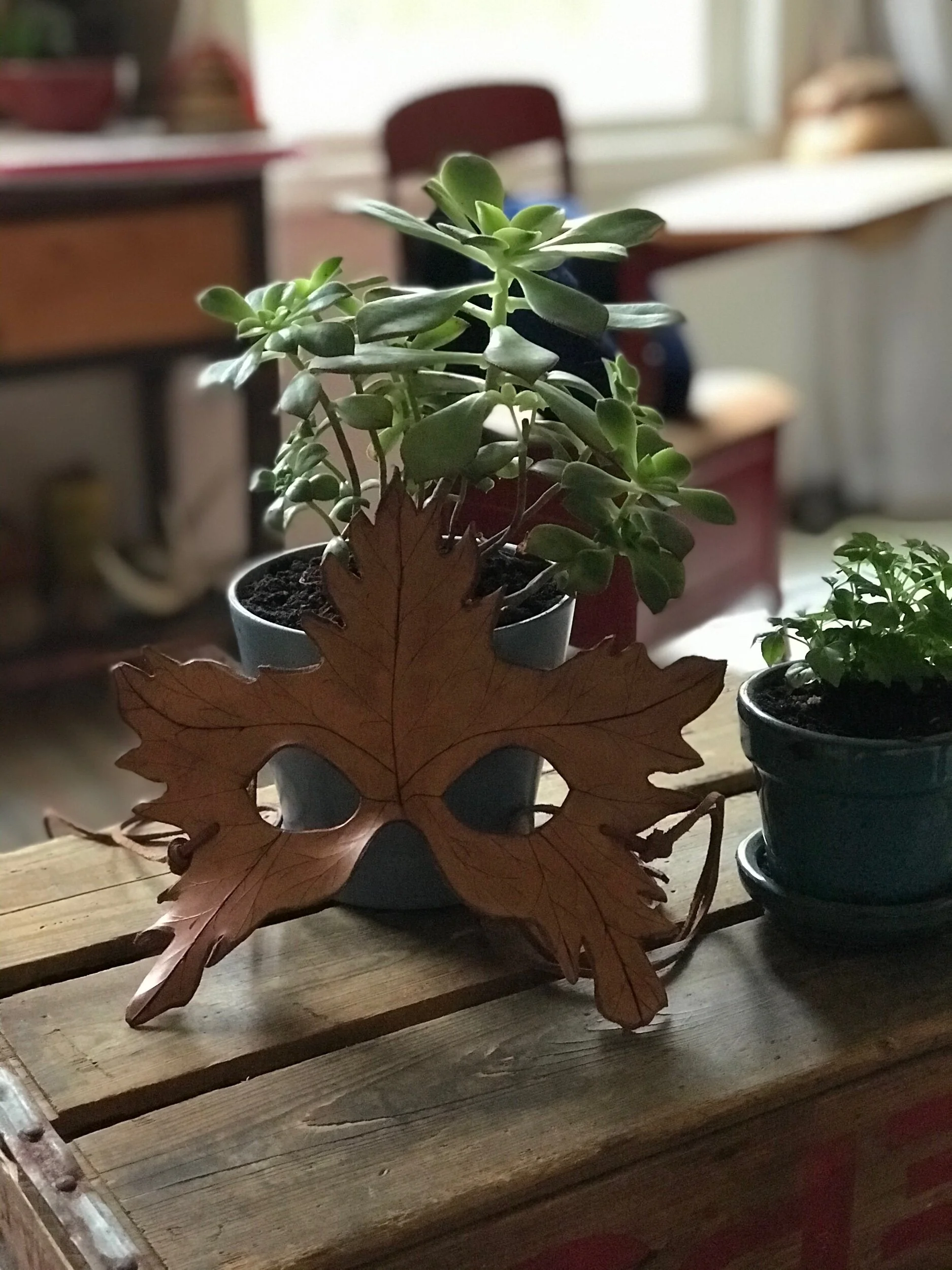
(The mask in the photo was a birthday gift from Patrick, made by Rebecca Wentworth-Kuhn. Others she’s made are for sale at Old Mr. Bailiwick’s in Mt Vernon, Ohio.)