
What the Leaves Know
Goodbyes are high on my list of what I wish I could sidestep, but I’ve gathered them just the same.
For all kinds of reasons, or no reason at all, I’m unusually drawn to autumn’s bounty this year, in the form of dry or damp, colorful or nondescript leaves at my feet.
They’re everywhere. And I can’t take my eyes off of them.
I’ll need a good chiropractor to straighten the near-permanent curve in my neck, made so by the perpetual head-bowed position as my eyes rake the ground for these once-a-year treasures. As a former antique dealer, I know how to collect things and I’m not sure the switch ever turned off completely (see “Breaking Up With Stuff”, July 8, 2019), but in the category of Natural Things That Have Fallen to the Ground, I’m bordering on an obsession. Acorns, twigs, hickory nuts, empty and discarded black walnut shells from last year…but I leave the dropped buckeyes alone in the driveway. This year’s harvest is meager compared to years past, and I want to give the squirrels a fighting chance to make it through the winter. If you’ve ever peeled the blond, somewhat spiky and foam-like covering from a freshly-fallen buckeye nut to reveal the mahogany-colored jewel within, you know the importance of keeping that magic going year upon year. Best not to be greedy in our gathering.
This morning, as I rounded the corner on the last leg of my walk and entered the inner sanctum that is the meadow-woods, I watched from a distance as a black walnut tree on the path randomly (or not? I may never know) dropped one of its ovate yellow-tan leaves and some unseen pocket of air wafted it gently to rest atop a flat pile of others, now brown and wet with morning damp. It fell silently, solitary and brave. Has anyone ever contemplated the sound of a leaf falling in the forest, if no one is there to witness or cup an ear to catch its landing? For all that one little leaf knew, I didn’t exist at all. I thanked the meadow-woods for its quiet and stepped forward, my boots slooshing through the wet carpet of fellow mulberry, ash, and sassafras leaves, a few of them now plastered to the toes of those boots, stowaways looking for new adventures down the path.
I don’t want to overthink this, but an intuition deep within keeps bobbing to the surface asking for a moment of my mind’s time. Admittedly, I’m not that good at letting go. Goodbyes are high on my list of what I wish I could sidestep, but I’ve gathered them just the same, going on five or more decades now. You’d think by sheer volume and repetition alone I’d at least be approaching some level of Farewell Mastery. But no. Partings and movings-on still leave behind a wide range of searing scars and wincing scrapes; I lean heavily on the grace of new life, another Spring, and the endless gifts of a creative spirit to help me pick up and continue. Most days I do just fine, until I remember that I can’t call Mom and Dad to tell them about my day or hear about theirs. But this year, I stoop to get a closer look at the dying, the left-behind outer coverings or attachments of the once-living. I look up and in every direction, colorful end-of-life all around me. It’s making me go all quiet and introspective. A tree, any tree, dropping its leaves one or seven at a time, offers both wisdom and comfort. I sit upon her roots, listening for what I need to hear.
Patrick and I have come to understand and accept that something called us to this place of woods and wildness twenty-plus years ago, and the lessons are thick and rich each season. But I don’t recall paying attention to the comings and goings (mostly goings) in my life as much as I have these past several months. There’s an urgency lately to be more mindful than ever before, to notice and cherish and hold close to my heart everything and everyone that has knitted themselves into our lives. It may be a cosmic coincidental overlapping of an untamed global pandemic mixed with a turbulent election year that also happens to be taking place at this point in my developmental trajectory—I get that. Pluck any one of those elements from the others and it would be enough to make anyone seek out the company of a tall and patient cottonwood, its branches soaring 100 feet upward. Surely something that tall (and still here) must know something about life that I don’t.
But what is it about the leaves at their feet, dying and on their way to becoming next year’s compost, that captivates me so? The variety of colors alone holds my gaze and moves me forward seeking the next one that will be even more brilliant, more gasp-worthy (I hope Patrick doesn’t expect me to get any outdoor chores done quickly these next few weeks. It takes me fifteen minutes just to walk from the back door to the chicken coop a mere ten yards away to gather the day’s egg). I consider the possibility that dying leaves contain an element of beauty and poetic comfort while the tree still stands, naked and vulnerable and waiting for Spring. That birds and raccoons and humans receive the shade of a silver maple in the summer and marvel at the architecture of its leafless bones in winter, that season when we’re all in this together as the north winds blow away everything that no longer matters. As my thoughts travel such a bittersweet and balanced path, I find it uncharacteristically reassuring. Someday, I’ll shed colorful leaves of my own, in the form of stories and a modest collection of treasured objects that perhaps the young ones in my life will also cherish.
In the meantime, the child that I still am walks playfully beneath the swaying arms of these gentle giants and I gather their colorful fallen clothing, rationalizing that the red on this one is different than the reddish-orange on that one so I simply must have both. My growing leaf collection is the book I study in this autumn’s classroom, and for some reason this year, I read every word on the page.
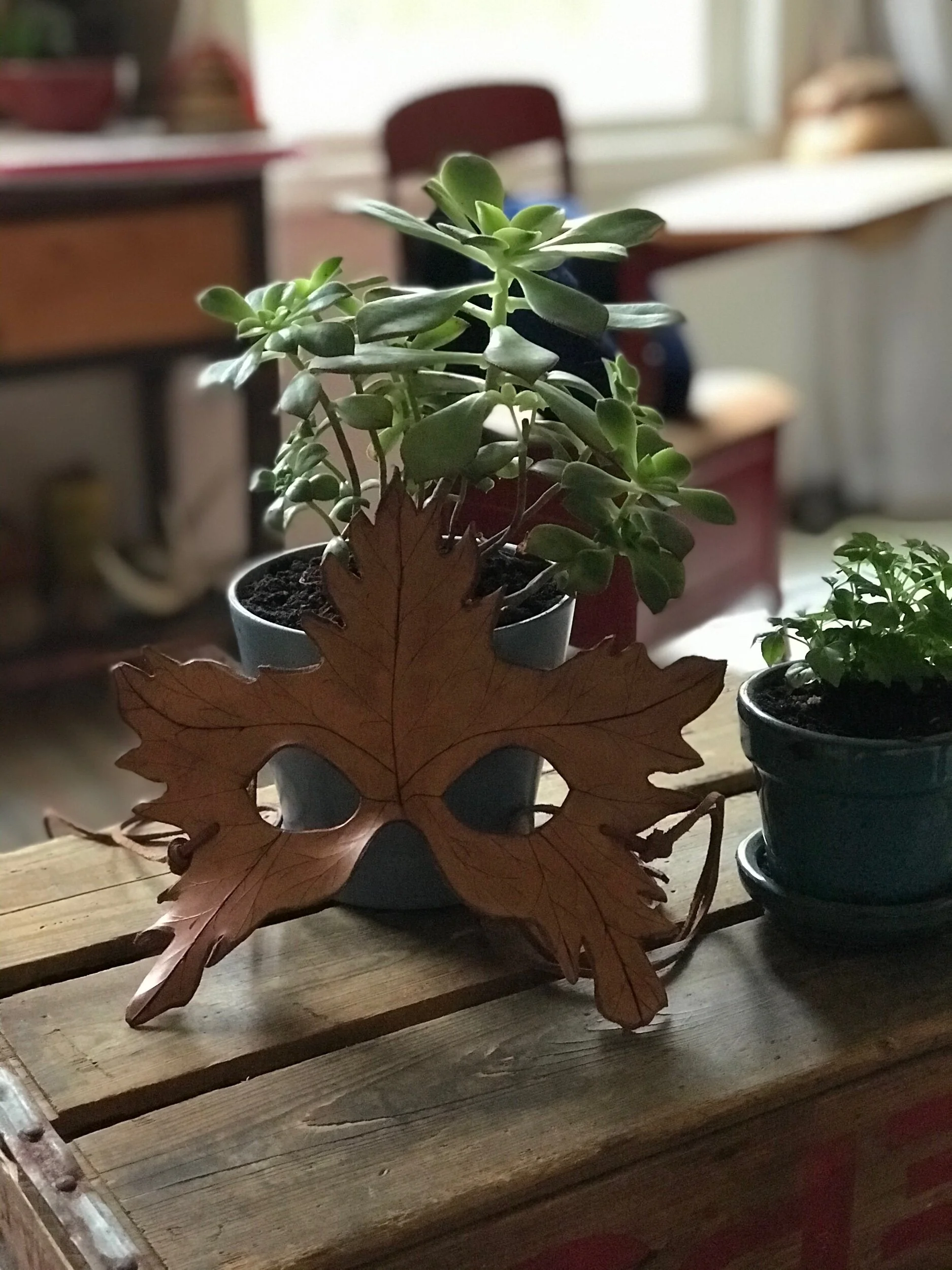
(The mask in the photo was a birthday gift from Patrick, made by Rebecca Wentworth-Kuhn. Others she’s made are for sale at Old Mr. Bailiwick’s in Mt Vernon, Ohio.)

Can You Hear Me Now?
Pre-pandemic, I’m sure communication was challenging at times, but these past several months, it’s become a real workout.
Copper, the feline matriarch of our household, circles my feet as I move into the Downward Dog pose. My four-legged yoga coach for going on five years now, she checks my form and balance before settling herself right where my palms need to be on the floor and assumes a pose of her own, Cat Must Groom Herself NOW, showing off a flexibility I can’t even dream of.
Such a scene is, more or less, how I start my days. The sun is still just a good idea and on its way to slowly pushing the dark canopy of stars aside, the house sits a quiet and protective shell around us and everything we’ve collected so far, and except for that one floorboard in the bedroom near the hutch that protests my weight as I step about in the darkness to gather my socks (peeled off and flung out from under the covers hours ago), not a sound pierces the air I’m breathing. Yet another moment I’d like to suspend in time, on the same list as holding Patrick’s hand after dinner and savoring the last sips of a most excellent and rich Argentinian Malbec.
It’s been a rather loud and raucous week (yes, that includes the first presidential debate).
At work, most if not all of our meetings are virtual as we continue to hunker down in our respective offices (some of them doubling as our bedrooms where we sleep). In my work office, I raise my voice and face the computer monitor on my desk, speaking into the screen, though I know the mic is actually located on the laptop anchored to a docking station just off to the right of my desk set-up. I wonder how that sounds to those listening? Like I’m tense or angry or forcefully trying to make my point, persuade them out of their own ideas? Not my intention at all, but I feel as if I’m throwing my full body weight into these discussions and when they’re done, sometimes I need a short walk outside just to shift the energy into a calmer place.
When I do go out in public, mostly for medical or must-be-done-in-person business transactions, I feel like I’m yelling through two layers of cotton, as if that will help me convey more accurately the intended message, and I’ve noticed that I’m forming the shape of the words on my lips more deliberately, even though no one can see the effort. I don’t think I’ve ever worked so hard to tell someone I’d like those test results emailed to me, or I don’t need a car wash today, just the oil changed, thank you. Pre-pandemic, I’m sure communication was challenging at times, but these past several months, it’s become a real workout. I so want to be understood, to be heard, to have my words and messages land as I hope they will—clearly, kindly, with a good heart behind them. That’s easier without the mask and a six-foot canyon between us, where tone and facial expressions can drop off the ledges and disappear into a craggy maw of misunderstanding. But my concern for the health of my fellow humans is still more important than my interpersonal communicative convenience, so I plod along, masked and far away, wondering if my eyes, eyebrows and forehead can bear the added weight of conveying those meaning-defining nonverbal cues.
Remember when we used to be able to whisper? When we could be that close? When meetings we attended gave us full access to the information we needed and our clarifying questions were minimal? When our throats weren’t dry from breathing in lint and shouting, and we knew what each other’s teeth looked like? (Diastemas, coffee-stained enamel and all. What a perfect time to have braces and not be self-conscious about smiling). This has been technology’s finest hour in so many ways—giving us video chats and helping us sharpen our texting game. But when the internet connection decides to go on vacation in the middle of an online training, or our physician’s audio cuts out during our telehealth appointment just as she’s outlining a treatment plan, we’re reminded that even the intricate wizardry of a motherboard has its limitations. Turning up the volume isn’t going to add anything helpful here, except perhaps draining the pressure valve on some pent-up frustration.
As a species, we’re normally a noisy bunch, and sound-mapping studies before and after pandemic-related lockdowns revealed the impact of not going about our loud business day after day. Birdsong and other natural sounds landed more distinctly on our ears, as global transportation’s relentless hum shrank to almost nothing. It fed both our hunger for silence and stillness and our anxiety about those same aspects of the human enterprise; some of us still navigate the tension between them. If that feels and sounds like your current situation, I encourage you to take a few steps back and let yourselves remember that we’re all still new to How You Carry On During A Global Pandemic. The playbook for all of this is being written as we’re living through it. Perhaps the silence is the gift that offers a chance to hear what we’ve been missing (which may be nothing at all, and that’s not a bad thing), and the stillness an opportunity to give our frantic, ever-cycling minds a healing pause. Unsettling, I know, but good medicine nonetheless.
Someday, dear friends, we will get to stand closer together like we used to, our smiles (laced with braces and diastemas and coffee-tinted teeth) in full view and our entire faces working those nonverbals for all they’re worth. We’ll get to add touch to our conversations, throw our heads back to get the most of an unmasked guffaw in response to a brilliantly-landed punch line, and not look over our shoulders at a cautionary medical finger saying “not yet, it’s not safe”. We will emerge on the other side of this, wiser for having wrapped our arms willingly around the gift of a temporary near-soundless existence, slowing our steps to a more attentive pace.
Until then, morning yoga with a learned feline coach is just one coping strategy.
What’s yours?
Another Trip Around the Sun
In a smooth but quick flash, they suddenly locked talons and spiraled downward in some unseen column of love and air.
Along the banks of the creek, at the foot of the Old Man sycamore tree, the wild asters open their tiny white faces to the east for a fleeting glimpse of the morning sun. Not even two hours past sunrise, they’ll spend the rest of the day in cool shade and dappled sunlight until the last winds of autumn strip the overhead branches bare. I love how they are not a bit bothered or preoccupied by headlines, deadlines, or the ticking of a timepiece. They simply push past the soil’s crumbly top layer, wedge themselves between the sawgrass and the ironweed and unfold their petals without fanfare. I register the tiniest shred of envy in my heart and then let it go. Who knows what they must long for sometimes from my own existence? Chocolate, perhaps, or the ability to embroider?
It’s my birthday (on a Saturday too—how’s that for luck?), and I’ve parked myself on a blanket down in the meadow with a full and grand view of the slope up to the house. I’m sitting in the lap of All Things Sacred, encircled in a leafy embrace and deeply aware that to unwrap this gift, I need only open my eyes. As I sift through twenty years of Naked Acres images collected with those same eyes, I try to remember what this exact spot looked like when Patrick and I first stood here. I distinctly recall watching in silent mouth-open awe as two red tailed hawks circled over our heads against a backdrop of an ice-blue late March sky. In a smooth but quick flash, they suddenly locked talons and spiraled downward in some unseen column of love and air, their spring courtship a clear sign that we would get to unfold our young marriage into this space, gathering our shared stories beneath the ever-changing and always-perfect skies.
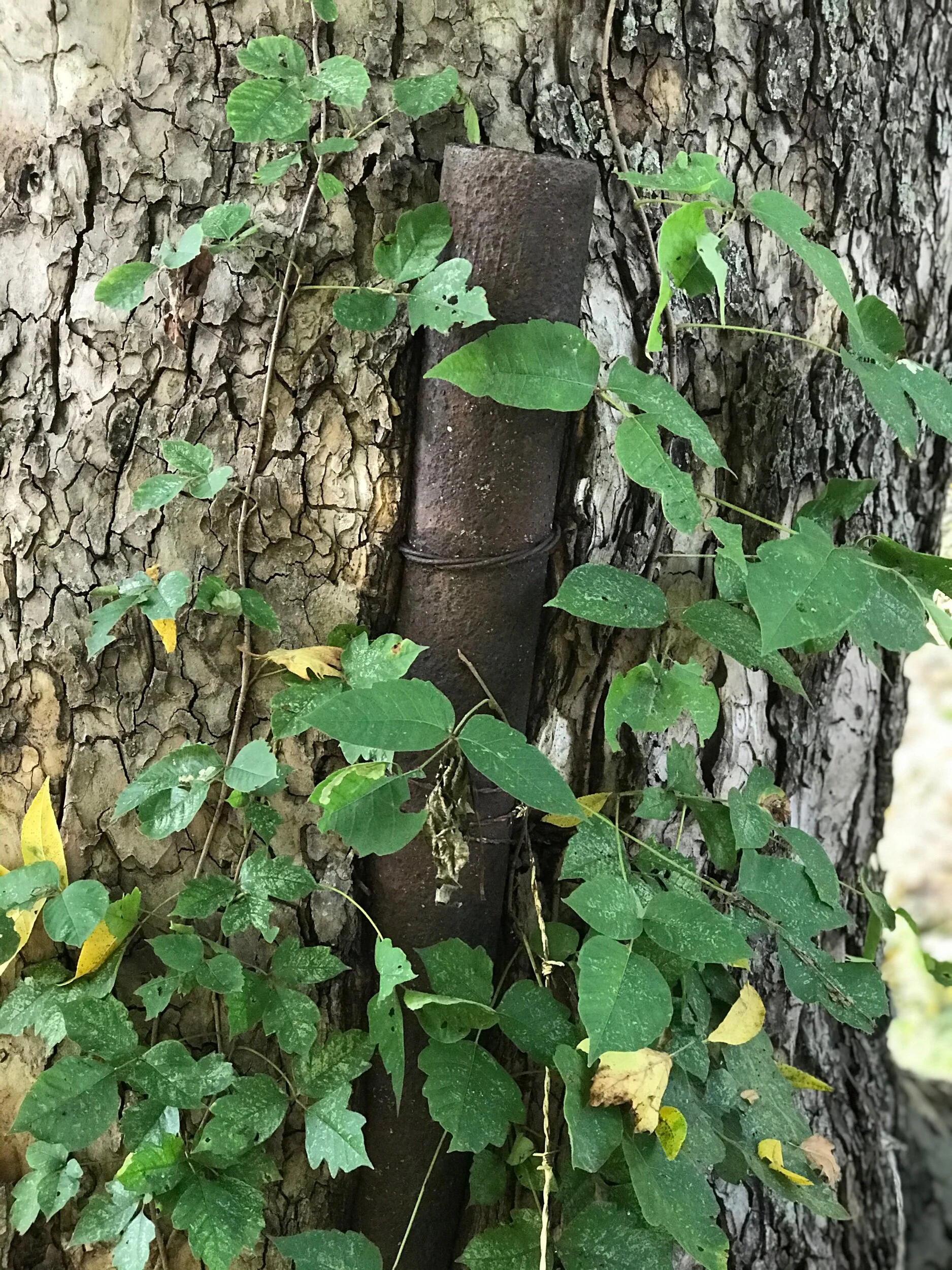
I cannot guess how old that Old Man sycamore is, but can tell you that Patrick and I could not clasp hands and fully encircle him. A round and rusty cast iron fence post, from the previous residents’ dairy farming days decades ago, looks as if it’s sinking slowly into the bark at the base of this tree’s magnificent trunk, a strange sort of vertical quicksand illusion. Bits of razor wire hold fast to the cold metal, barnacle-like and crusty, and a coiling vine of determined poison ivy snakes up the length of the post on its way to a branch that hangs over the creek. It all looks excruciatingly painful and yet, there’s a feeling of patient acceptance; this Grandfather has withstood worse and kept on growing. A metaphor of grieving moves across my thoughts’ path and comes to rest: tempting as it is to cut that fence post out from the thick bark in that massive trunk, such a thing would be more harm than help. Best to leave it be. Old Man has made this post part of himself and moved on. So it is with the losses that leave their mark on us. We grow around the hurt and bring it with us on the journey.
Will trees ever stop teaching us? Oh, I hope not.
The cricketsong is nonstop now, in classic symphonic end-of-summer fashion, the soundtrack of leaves falling in random showers and wind-swirls. It will be cold and silent all too soon, so in spite of my tinnitus, I welcome the continuous rhythmic scratchety music of these invisible relatives and send up another bucketload of thanks for the surgeon who fixed my otosclerosis back at the turn of the century. Most certainly a gift that has kept on giving, loud and unmistakably wonderful. I took Friday off, an early present to myself, and spent the morning clearing path through the woods between the fasting site and the trail up the Hill. Lopers in hand and under the tender supervision of a patient tree frog who watched my every move, I cut back thickets of tenacious multiflora rose vines, collected fallen black walnut and sassafras branches and broke them across my knee, and pulled Virginia creeper vines from the trunks of young saplings with my gloved hands. I lost all sense of time and sank into the woods like a fairy creature. It was simply splendid.
That I even get to keep marking this day, year after year, is not a casual occasion for me. I’ve had my share of knife’s-edge moments, and for reasons known and unknown, have been given the privilege of twenty-four more hours over and over and over until I land on this birth anniversary again, looking over my shoulder at a pile of miracles and peering into the mist of a mysterious future not promised to me or anyone else. When I do the math and add up the sunrises, the winters-into-springs and even the trips to the grocery store for Fuji apples, I’m stunned down to my socks at the sheer unrelenting abundance of the life I’ve been given to live.
In the shelter of an Old Man’s leafy and knowing arms, a canopy of history filtering the sun that woke me up this morning, I sit in silent mouth-open awe once more, buckled up for what this next trip will bring. If that sun keeps coming up, I’m gladly and gratefully along for the ride.

A Meadow's Reassurance
Each drop of dew hangs perfect and patient, knowing their fate in the hours to come, giving themselves over to it anyway.
My eyes are awash with goldenrod glow as I look out the bathroom window and across the eastern field. It’s a gently waving sea of nonstop saffron-topped stalks, fluffy and ethereal, beckoning more than a quick glance. Not to be left out, the sun lifts its face over the tall cornstalk horizon, filtering through a row of volunteer sycamores and sending gilded sliding board beams downward, every silken spider-spun strand backlit by this morning crescendo. An ode to Yellow if ever I saw one. Each drop of dew hangs perfect and patient, knowing their fate in the hours to come, giving themselves over to it anyway.
For going on three and a half weeks now, I’ve been walking every morning because I don’t want to miss this first performance on the land’s perpetual stage. There’s something soul-filling, starting one’s day in the company of trees and light. When my feet reach the meadow, after stepping carefully atop the moss and late-summer clover on the paths to the north, a mixed grove of black walnut, cherry and more sycamores soar past my head and I receive their presence with an appropriate sense of smallness. It’s funny—we still call this stretch of land “the meadow”, though it no longer meets the criteria for such a classification. When we arrived, it did. Trees lined the creek but they were youthful saplings then, still figuring out their future, and the open expanse of grass and wildflowers compelled me to add more gossamer dresses and skirts to my wardrobe, just so I could traipse through on an early summer afternoon, plucking wild raspberries from their thorny stems (in slow-motion, of course; don’t want to be snagging cuffs or sleeves). Yes, we really do live like this.
Now, the “meadow” is well-established as another section of woods on the land, with the vein of a creek pulsing through it. We maintain the open space as best we can, and allow for a bit of thicket-creep along the banks so the birds and rabbits can hunker down when the thunder and rains move through. But where did the time go these past twenty years? As I walked this morning, I grew wistful remembering the early weeks of this year’s summer, with the 10’ canopy set up just on the other side of the mulberry stand off the front deck, and how we sat in its shade for hours, reading or sewing or just talking about whatever mattered most that particular day. During my two-week vacation in late June, I took my lunch there, while the kittens competed for my attention or napped at my feet. I worked on a bee-themed embroidery project beneath that canopy, and sat in uncomfortable “what’s next?” contemplation and fervent prayer when the protests began. In July, a six-day string of thunderstorms and wind prodded us to put the canopy and chairs away; we simply moved our outdoor living to the deck, huddled beneath the narrow overhang where only a slight misting of rain would reach us and dampen our shirtsleeves. It’s just water, it’ll dry soon enough.
When I would visit my dad at the nursing home where he spent his final years, I wondered what his fellow residents remembered about their lives, what they missed or what made them feel wistful in light of their current circumstance. If I were in such a place right now, today, with my mind firing on most pistons most days, I think I’d go mad within the week, and hope that should my life’s events turn in such a direction, I’ll be pleasantly confused as we take that final trip down the gravel driveway, across the bridge and past the buckeyes. We all have our worst imaginings; this is one of mine. I quickly reassure myself that it’s Sunday, early morning, I’m healthy and upright in the meadow-turned-woods, and I can still feed myself.
In fact, and to my surprise, the longer I stood beneath a rickety stand of older mulberries at a middle spot in the meadow, the more I felt safe and happy as I recalled the earlier days of summer. I stretched out full length on the soft bed of those memories, feeling content as the wistfulness evaporated, not a trace of melancholy left behind. My immediate future held a bowl of steaming cooked oats with fresh apple chunks and a generous spoonful of peanut butter, finished off with a drizzle of my friend Jonna’s honey (traded for a couple bags of granola. I got the better end of that deal; I owe her another bag or two). The rest of the walk ends on a lighter note, and I send up buckets of gratitude that my memories of The Canopied Summer of 2020 are vivid and intact. Perhaps as I keep collecting the days and years ahead of me, I’ll choose gratitude for what was over regret for what is, whatever that “is” might be. So far in my life, even in the middle of a worst imagining made real, there has always been something to be thankful for, some crack in the dark mortar of despair that can’t hold back the light determined to break through.
How can a simple morning walk yield such a rich harvest of meandering thoughts?
Um…I think that’s what walks are for.
And the sun still shines over the goldenrod to the east, a symphony of reassuring yellow and spiderweb strands. Life is good, no matter what.