
The Daily "Lucky"
For seventeen mornings I looked at the top half of that blue spruce through the rectangular frame of our upstairs bedroom window.
When we cut down the diseased and dying blue spruce just off the front deck three years ago, I knew the gaping hole it left behind in the sky would make me all melancholy and wistful. It had been well-established by the time we unpacked and moved our stuff inside the closet-less rooms of our new-old bungalow farmhouse. The tree anchored the front yard and stretched its spiny arms beyond the metal roof. Our first and beloved kitten, Scout (god, we miss him still, after five years gone) figured the view was better from the top, so up he went until he ran out of branches. He perched, wobbly but brave, amidst the gray-green needles, mewling until we noticed and brought him down on the business end of a long-handled straw broom stretched out via Patrick’s arm. He jumped, slid along the handle to our waiting hands, and trotted off to his food dish by the stove. One of many Scout adventures that year (remind me to tell you about the time a turkey vulture almost carried him off. Or have you heard that one already? No matter—it’s just as good as a rerun).
For seventeen mornings I looked at the top half of that blue spruce through the rectangular frame of our upstairs bedroom window. I watched sparrows disappear into its thick-needled protection, saw snowflakes land soundless and still until enough accumulated to soften those needles’ points with frozen fluff. It was good for the soul to wake up to green—evergreen—every day of the year. While we still had a wood burning stove, I’d have to look around and past the silver cylindrical chimney that ran up the side of the house and exactly in the center of the window’s view on its way past the roof, but I didn’t mind. I was warm and could still see the branches move as one in a blizzard.
Five years ago, it started to look thinner and sickly—lower branches lost their needles completely and the nakedness spread upward rather quickly. We knew what was coming. If you’ve ever cut down a tree this size, it’s not something you tackle in between breakfast and lunch, or after a few moments of post-workday decompression. You plan, you prep the tools and equipment, you take time to consider everything that could go wrong, you recruit your team of helpers, and then you suit up: long sleeves and long pants (this is not a job for shorts and the favorite gardening t-shirt), thick gloves, sturdy work boots and a distressed ball cap you purchased while vacationing in the Badlands one hot July. All done thoughtfully and with great respect for the weight of the massive trunk, and a keen eye on the landing place. We moved both trucks to the other side of the chicken coops some 200 yards away.
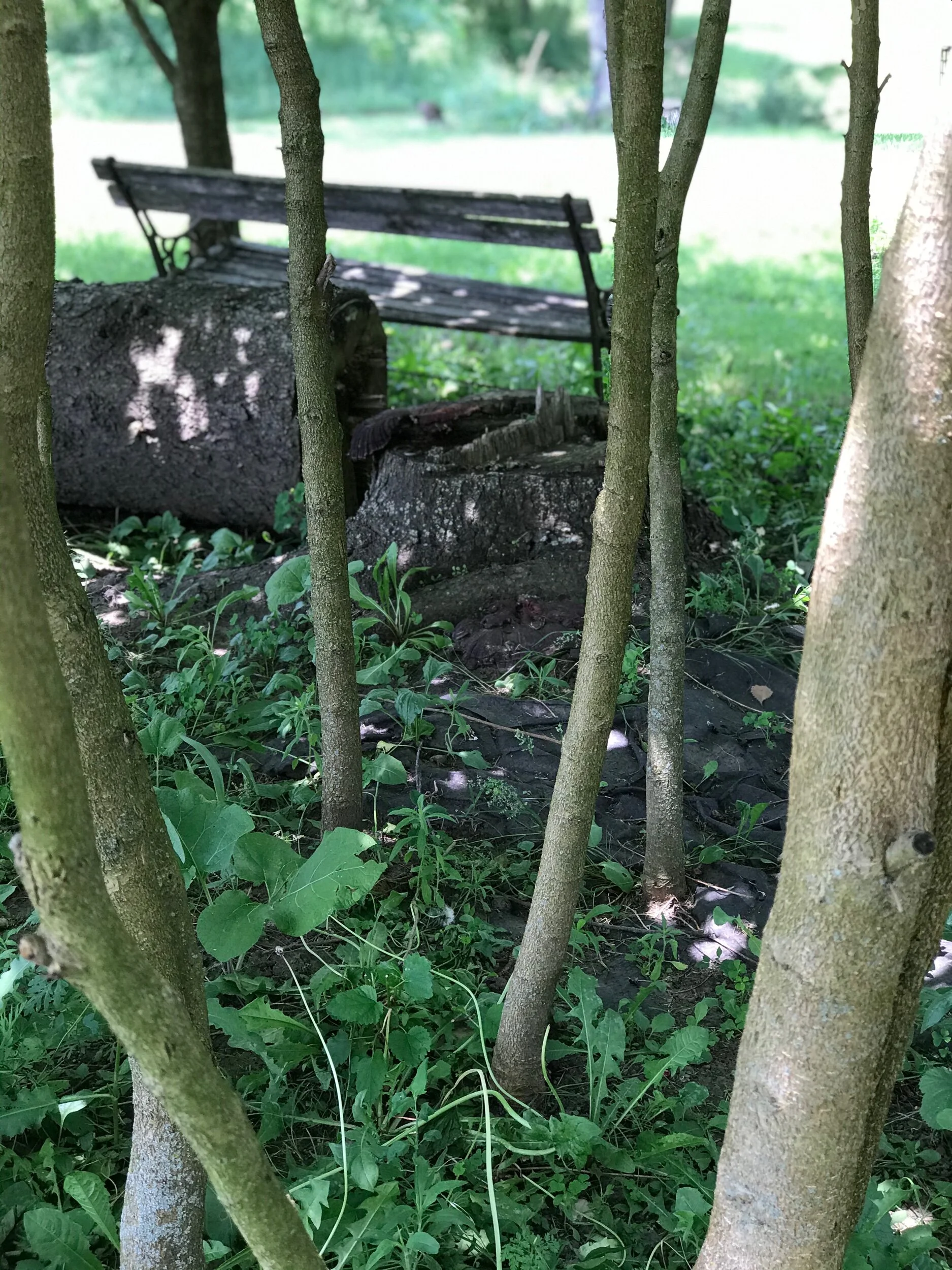
The old guy came down easily, exhaling its own version of tree relief, and we let it be for the rest of the season that year. Patrick cut most of the trunk that landed to the south of its original standing place into chunky slices and left the pieces for me to repurpose into the current landscaping, but the remaining nine feet of trunk still rests close to the stump, a bit weathered and sporting a most spectacular maroon cap of fungus. We placed an auction-scored wooden bench next to it, facing the west and the mouth of the sprawling meadow. The kittens stretch out full length in the summer and nap there for hours.
It didn’t take long for the mulberry saplings to claim the space at the feet of the Great Fallen, forming a near-perfect and almost reverent circle around the pine’s final resting place. Resembling a more cheerful band of professional mourners, they left the wooden bench alone, not trying to grow up through it or anything, which I considered good form on their part. Mulberries are the rabbits of the arboreal world for their proclivity to reproduce and plant themselves in any open patch of grass or untended field. They’re not the sturdiest of trees over time, and we have several in the wooded part of the meadow that are clearly dead, waiting for the right wind to come along (or at least Patrick and his merciful chainsaw skills). But while they are young and green and loaded with fruit, it’s the best part of early summer to walk beneath them, barefoot (so the overripe drops in the grass can stain the bottoms of your feet a splotchy and glorious purple) and reach up to pluck the darkest and sweetest ones from the branches in front of your face. Our wild birds lay claim to the ones beyond our grasp, and leave us post-mulberry “calling cards” on the deck of the palest and prettiest lavender. A five-gallon bucket and scrub brush take up residence on the porch for the better part of the season.
Yesterday morning, just as the early light of the longest day of the year hoisted itself over the sycamores to the east, the view out the bedroom window was a study in lush green; the topmost branches of those fruited saplings now filled the space where gray-green needles had once lived. Heart-shaped and still a just-unfurled fresh, the leaves could not hide the orange and black of an oriole having his breakfast while I contemplated mine. A familiar prayer filled each chamber in my heart, I get to live here…I get to live here.
Every day, something changes here. Everything that dies makes room for its successor. Last year’s leaves compost the garden and nourish us eventually in the kale we’ve grown and sautéd for dinner. The milkweed in the fields doubles in size and quantity, and the monarchs will find it, I promise. The sheer abundance of life that continues in both the gentlest and harshest of circumstances pauses our steps and our minds so that our hearts can take it all in and hold it close. We dance happily in the tension between the reliability of the seasons and the impermanence of every living thing. Every day, I feel lucky. Every day, I grow in my ability to take fewer and fewer experiences for granted.
For as long as they last, I will enjoy the mulberries.
The View From Here
Food that good ought to be eaten with reckless abandon for all the work it took to get it to the table.
There are some days you can’t see from where you were standing three months ago.
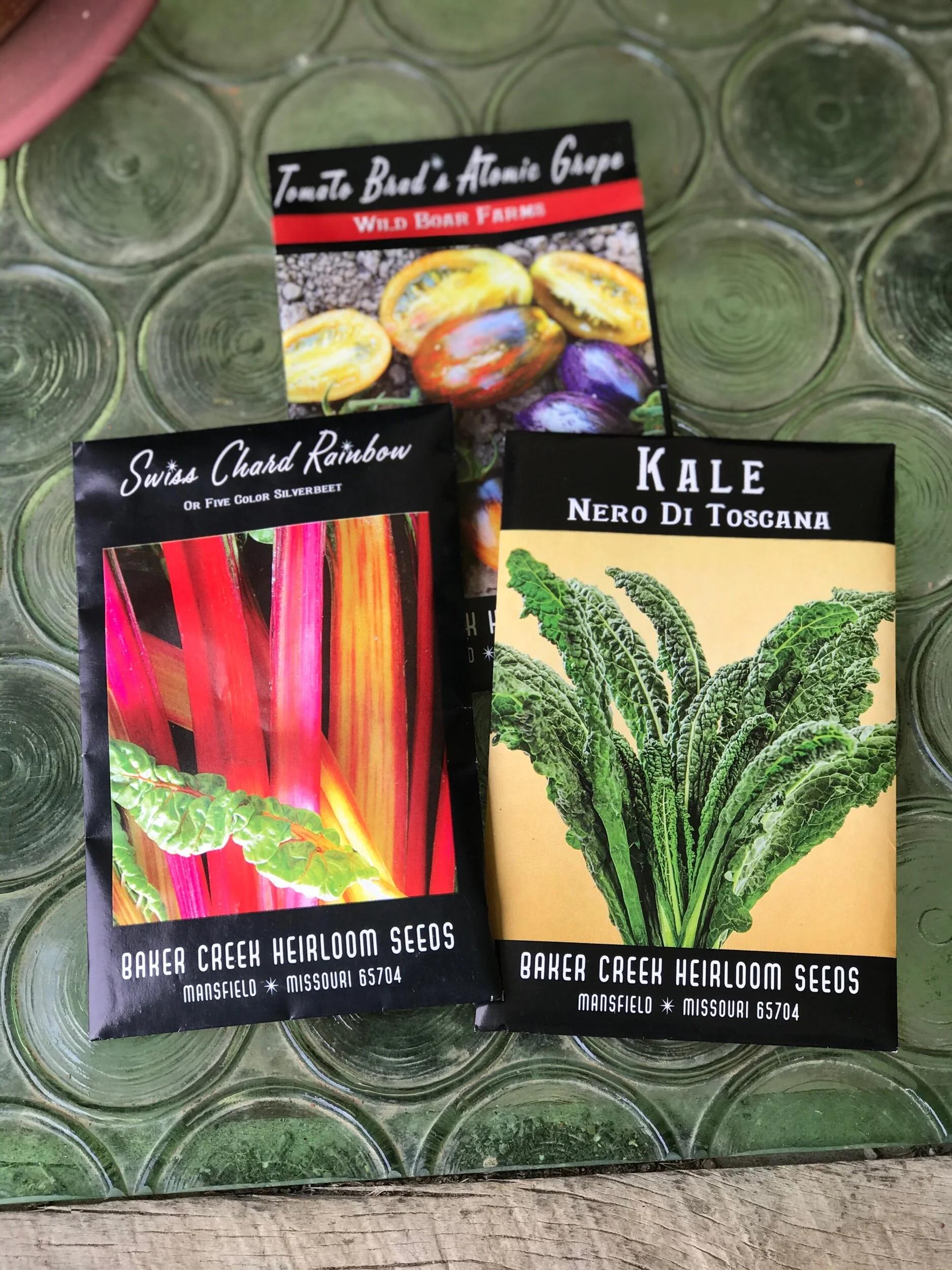
On our plates last night were the first harvested tender leaves of kale and chard from the garden, softened a bit by steam and wrapped spring roll-style around a tasty melange of shredded cabbage, tiny carrot pieces, onion, seasoned TVP, and chunks of plant-based protein all stir-fried with sesame oil, minced garlic and ginger, and crowned with a Korean BBQ-spiced peanut sauce. Oh, and brown rice and charred red bell peppers found their way inside those rolls too. Spilling out the ends like just-popped British Christmas crackers, the filling made it to its final destination without fork or spoon. I’m sure we’re more cautious about eating with our fingers these days, but my hands were CDC-inspection clean so I risked it. Food that good ought to be eaten with reckless abandon for all the work it took to get it to the table.
Back in March, those gorgeous dark green leaves were but an idea buried within a hopeful tiny seed sunk into a rather chilly soil-and-compost mix, side dressed with our imaginations and dog-eared pages of reliable cook books. I’ve always leaned toward a life guided by preparedness—before Field of Dreams gave us the brilliantly quotable “If you build it, they will come” line—because I want to be ready for what could happen, and give myself the best possible chance for success. That works well mostly when the combined elements of any plan are within my control, or at least responsive to my influence. But it rained and rained and rained this spring, pushing our spring planting goals well into the end of April and creating a small muddy moat around the most viable of our raised beds. All the seedlings would need to stay put for a couple more weeks, and they grew impatiently leggy in their confining pots. We distracted them with repositioning toward the gray light of day, and sang to them only the most hopeful and positive of songs. Kale and chard spring rolls in June weren’t anywhere on the horizon; we didn’t even know such a meal was possible. But we kept true to the plan to at least have a garden.
Winter-into-spring tests the depths of our trust and optimism that the ground will indeed dry out enough to put the potatoes in or walk the field line without plunging one foot into the soggy and camouflaged front door of a groundhog’s den, pulling off one’s boot in an attempt to keep walking (sending a few well-rehearsed oaths into the air, hoping said groundhog understands what we’ve come to call “barn words”). No matter what the setback, the disappointment, the unmet expectation, we push aside the strongest of our doubts and send all our hope into the very heart of a seed, aligning our dreams with its tiny power to use what’s given to it—a dark blanket of dirt, water, warmth and eventual light—and become something so spectacularly huge by comparison, it makes the wise and observant person sit down in silence and awe. That’s why I sing to our garden at sunset. There’s just no other appropriate response to such well-designed magic.
Three months ago, I figured I’d have come down with the Virus before spring was over, and I didn’t let my imagination go much past that point. On this particular day in June, I’m fine. In fact, I’ve been fine every day this month and the three months before that, save for the requisite anxiety and edgy-ness that any global pandemic will bring. The remedy is to not saturate myself with news and speculation-based op-eds. So far that approach, and keeping up with well-established wellness routines (fistfuls of the right supplements, fresh air, exercise, gratitude for at least five things every day, laughing at Carol Burnett Show blooper reels) have kept me on the kinder side of this whole ordeal. Masks and physical distancing seal the deal and are not negotiable. And while I probably entertain too many thoughts and imaginings of where we’ll all be by October, I work hard to limit such mental meanderings, letting my eyes rest on the freshly-cleared ridge by the house, or watch as some hidden vacuum within the vintage camper-style birdhouse seems to suck the wrens inside just as the kittens swipe their paws from a precarious perch on the branch above.
It’s been a hard and sometimes breathless dance, balancing our current horrors and heartbreaks with those sweet present moments that are innocently detached and free of worry. I feel guilty for taking a break while others sweat on, and then I remember that my shoulder will be to the wheel soon, and the respite I give myself is yet another healthy strategy to keep my core values in play. What matters deeply to us requires the effort to sustain it. Perhaps your mileage is different, but I’ve not yet found a way to enjoy the good stuff without working for it.
There’s one raised garden bed that’s struggling. The tomato plants look hearty enough, but the zucchini and okra look pale and resigned. I suspect the soil isn’t giving them the nutrients they need, and consider gently transplanting them into a better mix. When I close my eyes, I see them thriving, putting another sublime meal on our plates in August. What do they need today, to get them to that future?
Indeed. Where do we want to be in three weeks or two years? And what will get us there?
Hmmm…imagine.

Unmasked
If I was the one who spoke the words “could things get any worse??” out loud a week ago, I deeply apologize.
A little after 3:20pm ET on Saturday, May 30, United States astronauts Robert Behnken and Douglas Hurley rocketed themselves away from our roiling planet, heading toward the International Space Station with an ETA of 10:29.m. ET, Sunday, May 31.
If I weren’t so claustrophobic, I’d envy them.
I woke up this morning before the sun did, with the kind of sick stomach feeling only anxiety can create. Peppermints and ginger, my usual go-to remedies when I feel like this, were useless, like tossing bricks into the Grand Canyon. I curled up under the blankets and waited for the first shreds of dawn to pull me into a walk through the fields and back to the woods where the mockingbirds and goldfinches were noisily commuting from one treetop to another, completely unaware that Nashville’s historic courthouse was set aflame last night. I put the tube of mints in the back pocket of my jeans just in case.
I realize every single word I write, every description in this post and others, comes from a comfortable seat of privilege. I have a safe place to take my fears, a job and health insurance and food in the fridge and cats I can afford to feed and a rich nurturing marriage with a really good and decent person. I have running water and soap to wash my hands each time I use the bathroom or handle raw chicken. I’m thriving on the other side of a few hardships that are the stuff of other people’s worst imaginings, and that others have experienced but didn’t survive. I know I have a lot more to learn, more than a handful of unexamined biases to unpack and heal, a much deeper level of humility to carve out within me. In this current written moment, with images of vehicles on fire and the pain on brothers’ and sisters’ faces (from point-blank mace and lifetimes of not being seen or heard at all) still indelible in my mind, I am praying desperately for this awareness to nudge me, or rocket me, beyond what I think I know into what I need to know. I am willing to be uncomfortable. I already am.
If I was the one who spoke the words “could things get any worse??” out loud a week ago, I deeply apologize.
A week ago, I was sewing face masks, wishing everyone would embrace the compassionate act of wearing one and reflecting on how an 8” x 4” piece of fabric covering half of our faces still had the ability to reveal so much about who we are as individuals trying to be community during a pandemic. Our shrouded mouths still speak volumes and our eyes now carry the additional weight of formerly full-faced messages conveying our character, our values, our fears and our longings. We’re new to most of this, the logistics and external mechanics, that is. We’re having to repeat ourselves across a 6’ space, talking through cotton and plexiglass to make a simple bank deposit or mail a letter. It’s awkward and we don’t like it. We want to be good at it in an instant, or better still, return to the days of unfettered access to conversations and the smiles of strangers. But that’s gone for now, and we’re grieving it across a continuum of grace and ferociousness, much like other losses in our lives.
Tomorrow, George Floyd will have been preventably and needlessly dead for a week. The good people of Minneapolis and Columbus and Philadelphia will walk past the bordered-up storefronts in their respective neighborhoods, crunching remnants of glass and livelihoods beneath their shoes and sandals. They’ll maintain their resolve to rebuild and restart their businesses and somehow keep moving forward into a pandemic that still hasn’t been contained or managed, and a justice paradigm still entrenched and intentionally skewed to favor only a few of us. Parents will struggle to find the words to explain to their eight-year-olds what’s going on. Some of us will venture out timidly to pick up milk and bananas, others will unknowingly infect the ones around them but remain asymptomatic. We’ll poke around in our broken routines for shards of the familiar, and try to mosaic them back together into something less familiar but workable, perhaps even slightly redemptive.
Back in March as COVID began to take up residence in our lungs and our psyches, I asked a few friends “who do you think we’ll be as a society when this is all over?”, but now, the question is “who are we becoming as all this continues?”, with the follow-up query “what is this showing us about who we’ve been all along?” insistently tagging along like all important questions do. There may not be precise answers to these but can we at least start the discussion in an attempt to find them, to land on a better path than the one we’re currently on?
Behind whatever mask we’re wearing, I know the face of love exists somewhere.
Please find it, dear fellow humans.
Please…

A Reason to Live
Six years ago, I promised I wouldn’t buy anymore fabric, but do thrift store cotton shirts count?
At 7:30 this morning, I made a batch of pumpkin donut holes that turned out like crap. I followed the recipe precisely but they still turned out gummy and almost tasteless. They aren’t even good enough to lure a raccoon into the live trap under the maple tree outside the kitchen window. I won’t be offended if the chicken turns her beak up at the one I tossed off the front porch. She’ll eat worms and grubs and bury her little face in the crumbly soil for a tick or two, but even she has a “never-gonna” list. I respect that.
The donut recipe was not on my long weekend’s long list of What I Am Going To Accomplish Before I Go Back To Work On Tuesday, drafted on my lunch hour last Thursday, and modified (read “inflated”) as Friday became Sunday afternoon became Monday at 3:00a.m. when it was too hot to sleep. In no particular order, here are the other non-donut tasks I set for myself to usher in the unofficial start to summer:
Clean out the studio.
Sort and downsize all the fabric in the primitive chippy yellow-painted cabinet on wheels in the corner of the room.
Move Aunt Louise’s armless and ornately carved oak chair (also on casters) from in front of the primitive chippy yellow-painted cabinet to the upstairs guestroom.
Make 60 face masks.
Bake six mini chocolate brownie bundt cakes.
Put the potatoes and onion sets in the ground just to the south of the cattle panel trellises I installed seven years ago.
Wash all the throw rugs in the house. All of them.
Finish a new blog about the backstories behind select items from my ongoing list of things I’m grateful for, started on February of 2015.
Make sun-blocking curtains for the west-facing living room windows out of old white cotton EMS blankets still miraculously white after retrieving them from the trash bin behind a local volunteer outpost.
Pull all the weeds along the ridge, especially the ones under the bird feeders where the kittens hide with their little faces looking hopefully upward.
Run a load of donations to the Goodwill four miles away.
Pick enough wild garlic mustard to make pesto, and then make pesto.
Clear the weeds in the old chicken run and reinforce the coop in readiness for a new small flock of layers.
You don’t see pumpkin donut holes anywhere on that list, do you? It just kept evolving as the weekend unfolded, and, undaunted, I pushed forward with such high hopes and a dreamy look on my face. It didn’t matter than I’m not thirty anymore (or forty, or fifty, or…well, let’s just stop there, shall we?) and I like sleeping past 5:00a.m. now, or that we still don’t have an outdoor spigot to hook up the garden hose and water the raised beds 60 yards away from the house (picture a series of 5-gallon buckets filled from the tap in the mudroom, then carried to the edges of the garden plot, emptied and refilled oh, maybe three times). I completely trusted that a recipe for baked donuts would equal or exceed in its outcome one requiring a vat of oil and much frying and transferring those little crispy spheres of pumpkin wonderfulness to the paper-toweled plate next to the stove. And then I’d wash the dough and cinnamon sugar from my fingertips and pin the pleats into those 60 face masks. All before lunch.
From the list above, I think I crossed off maybe three items. At this point, it doesn’t matter which ones they are, as the final hours of our long weekend evaporate, and Patrick and I flip a coin to decide who’s going to be chef this evening. I make pretty good oven-baked steak fries, seasoned with rosemary and garlic (the pantry curtains are closed indefinitely on any future donut escapades, thank goodness). We got a lot done, but scratch our heads at what, exactly, and how. Anything unfinished before the sun slips below the cottonwoods to the west will be waiting for us on our next long weekend. Plus all of their farm project friends. It never ends, ever.
Implied somewhere in that to-do list was a “once-and-for-all” clause that keeps getting run over by reality. Perhaps you know how this goes: once I empty that cabinet of all it’s fabric, reorganize it according to color and yardage and put it back in rainbow order, I’ll keep it that way, honest. I believe it with my whole soul, that the beautiful bare brown patch of soil that I just cleared of its weeds for an hour before breakfast will remain clear until sometime in late August. Then my curiosity pulls my attention down the hill to the creek where the old tire swing still dangles from the knob of a branch on the sycamore we affectionately call the “Old Man Tree” (its silhouette just after sundown looks like an old man bowing his head in deference to all at his feet. It’s touching and towering all at once), and I find a salamander or a stone speckled with flecks of quartz, and the weeds laugh behind my back as they regrow everything I just ripped from the ground eight weeks ago. Once-and-for-all is elusive at best, a myth I keep chasing, joined by its twin sisters Someday and Later. I continue to invite them to this party of a life we’re living here at Naked Acres, and they insist they’ll come, but they never do. Six years ago, I promised I wouldn’t buy anymore fabric, but do thrift store cotton shirts count? I was planning to make them into smart-looking throw pillows for the couch, all crisp in their blue-and-white stripes. I did get as far as disassembling them from their sleeves and collars (save the buttons because, well, just in case…) and then a friend showed me how to do bookbinding. Ahh well…we have enough throw pillows anyway. A writer can never have too many handmade journals.
The weekend I planned and the weekend I experienced aren’t miles apart, but neither are they holding hands. Living in an old farmhouse on a land-locked rectangle of paradise has taught us to be more adaptable than I would have thought possible. Our best-laid plans, with or without mice and men, often fall beneath the weight of what’s more important and right in front of us. Heavy rains rearrange the shape of the creek, stalwart trees lay themselves down at the behest of a dry hurricane wind in September, we uncover a neglected set of raised garden beds we built during a long-ago Memorial Day weekend and decide to give them another life. The list changes, the agenda turns an unexpected corner, and—thank God for our curiosity—we turn with it, setting our shoulders to a new wheel of skills promised, harvests hoped for, and recipes untried. The laundry still gets hung on the line and Aunt Louise’s ornately carved oak chair will eventually make it up the stairs to it’s new place in front of the window with a view of the seven rescued arbovitaes we planted back in March (see? “Someday” actually came for those little trees; they sat in pots on the porch for most of the winter).
With each season that arrives on our doorstep, we’ve learned a tiny sliver more about setting our sights without being too attached to them. It’s not about simply being flexible. It’s about a more deeply-set surrender to a rhythm that brings the birds to the feeders when the sun has just crested the eastern horizon, a power that pushes burdock through the clay-rich soil and pulls the creek waters over and around the exposed roots of an osage orange tree. When we signed the mortgage, we agreed to notice these things and tend to them when they needed us.
If we never do anything else but that, we can fall asleep knowing a solid purpose to our lives.
Donuts are optional.