

Little Things
We never know who our roommates are in this old and crevice-filled abode.
A wasp has joined me at my perch on the couch this morning, its onion-skin wings folded tightly and in perfect alignment with the rest of its sharp and angular little 1” body. It meanders across the brown arm of the sofa, changing direction, doubling back, nearing the edge and retreating. Almost the same color as the pretend leather fabric, I wouldn’t know it was there save for catching its jerky walk on its spindly legs in my peripheral vision. The kittens are fixed in fascination from their spot below on the carpet, their yellow eyes following its every slow and painstaking move to some unknown destination.
I’m paying close attention as well, having administered in the past my share of baking soda poultices to soothe stings that neither of us had planned (looking back, I’m sure it was my fault and not the wasp’s). I’m not going to kill it. I just want to keep it in sight. They’re less aggressive in the winter, and when they do make an appearance in some room of the house, they resemble a hungover party guest trying to figure our where he put his socks and his car keys. We’ve all been there, so we don’t make a scene; we just work our daily comings and goings around them, and keep a careful eye on where they wander off to next. As I look past this one through the living room windows and into the snowy landscape on the ridge, I don’t begrudge him his decision to tuck in somewhere warm. I return my eyes to the arm of the sofa, and he’s gone. Well. Ok. Shake out the lap throws and turn over the pillows. And walk carefully across the multi-colored boho patchwork area rug that’s a perfect hideout for anything brown with legs.
We never know who our roommates are in this old and crevice-filled abode. Mostly, they remain unseen and silent, especially the insects. We have a rather unsettling fondness for our spiders; they keep the fly and no-see-um population in perfect check, so it seems unwise to evict or execute them simply because their many legs and small size put others off a bit. They work hard for a living and teach us daily that patience is essential for survival. But to put a houseguest at ease, we will employ the cup-and-index-card evacuation tactic so that the rest of the visit can unfold in peace. We don’t judge, just accommodate.
But these little lives that intersect with ours are precious to us, even when the sight of them in swarms or many-legged gangs make our skin crawl. We’re awed at their organized communities. We watch as they gather food, survive the sub-zero winters, care for their offspring, perform the tiniest of mating dances and sometimes simply buzz about our heads for no apparent reason. I remember one afternoon in May when Patrick and I were outside on the grass, stripping cedar branches of their needles to dry and use in ceremony, when a flock of dragonflies (“swarm” just isn’t the right word here, though it is probably the more entomologically correct one. Allow me a bit of poetic license here) zigged and zagged inches from our ball-capped heads. We could hear them, there were that many that close by. Draw whatever conclusions you wish on the spiritual meaning of this encounter. We were charmed and delighted right down to our skivvies and now look for them each spring, with or without the scent of fresh cedar on our fingertips.
I get why most folks cringe or look for the nearest shoe to use as a weapon when dealing with all manner of creeping and crawling things. They’re small, they can get into places we’d rather not have them (the classic “they’ll find their way up my trouser leg” fear), and once they’re in there, bite things we’d rather they didn’t bite. Plus, when they reproduce they do so with seeming teeming reckless abandon. Clearly no one in insect circles teaches abstinence or any form of birth control. Have you ever seen those moving columns of gnats or mosquitoes just suspended in mid-air when you’re out for your morning walk? We’re outnumbered and always have been. Entomophobia seems a healthy fear to allow, if not actually nurture, in our two-legged nuclear family species.
But one five-minute segment of the evening news is all I need to put spiders in perspective. If I’m gonna work up the energy to fly off the couch in a panic, it will be about the Big Scary Things, too large to go unnoticed, too big to crawl up a trouser leg and catch me unawares, too heavy to scoop up in a glass and relocate in the hydrangeas outside. And I’ve lived through Big Scary Things, so I’m not romanticizing the contrast here. Tiny living things demand our attention in a different way, inviting our observant eye to notice how they manage in a world so much bigger than they are. They take their place on a vast food chain beyond their control, hunker down and get about their buggy business without complaint. And in large numbers, they command our respect, sometimes from a safe distance, lest we think we were here first. We’re bigger, sure, but not always better. It’s good to remember that every now and again.
If humility I must learn, give me a wasp on the arm of a sofa any day.
Lost and Found
I peeled off the price tag, snapped the ends together and headed off with Patrick to buy shrimp by the pound.
What began as a snowfall so light, I could count each flake coming down, has turned into a horizontal straight line wind show outside the south-facing guest room window, snowflakes on the ride of their little fluffy lives. I can almost hear a collective “Wheeeeeee!!!” as they zip on by. I admire their free spirits.
We decided not to set up at the Market yesterday. An after-midnight midnight snow squall turned into freezing rain and sleet, slicking up the roads nicely right around the time we would have had to leave. In milder weather, we can make the trip in about 40 minutes. But in the dark, with landmine patches of black ice waiting menacingly to catch our tires and send us off into some sleeping cornfield, we might have arrived about thirty minutes before closing, after being discharged from the ER. It seemed the wiser choice to spare our bones and leave them sleeping safely between warm layers of blankets and promises of next week’s Market.
Of course, I’d packed the truck at 5:30, before we made the call, and as a dark sky lightened to grey, I didn’t relish the idea of unpacking totes and glass sample jars across a slippery front deck. It was supposed to warm slightly by mid-morning, but we were miles from that at 6:45. The branches and delicate fingers of each mulberry tree were sheathed in ice and clacked softly against each other as the wind pushed them around. Behind them, a taller yellow maple swayed heavily, its topmost branches touching the blue spruce nearby in a tender arboreal act of reassurance. There there…it’s almost over.
At last week’s market, as we were packing up, I must have caught the snap closure to a cherished bracelet on something because when I pushed back the cuff of my coat sleeve reaching into my purse for a mint, my wrist was bare. My heart sank and I retraced my steps from the truck back through the mall where the indoor market is held, past the shops to the area where our booth stood. Nothing. I looked through the totes that held our different granola flavors, the blue and yellow IKEA bags that carry our supplies, the capped back of the truck, shoving aside the folding tables and the wheeled hand truck. Still nothing. Crestfallen, I climbed back into the driver’s seat and slumped my way through the trip home.
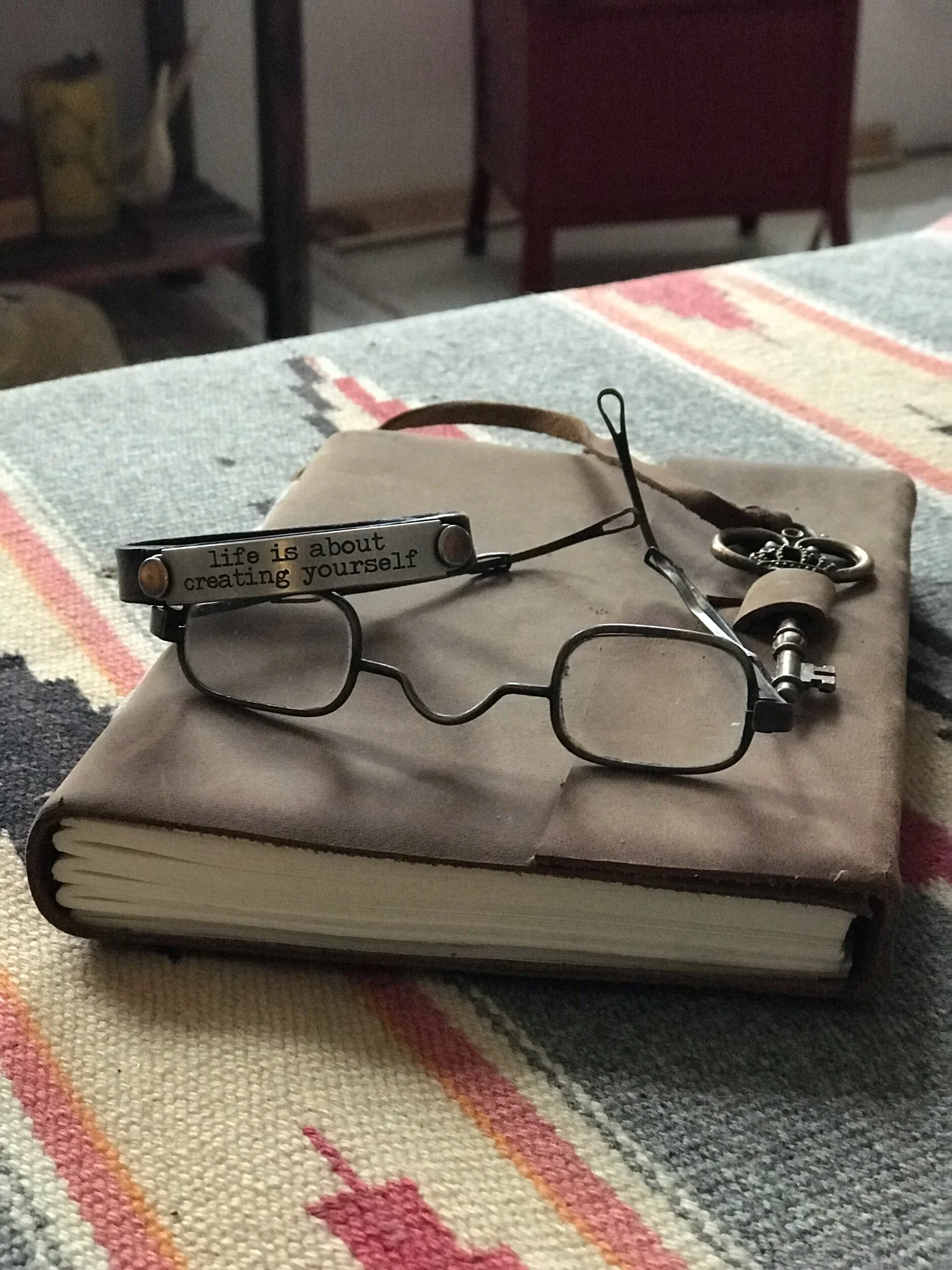
It’s a humble leather band with a riveted metal strip on which is stamped “Life is about creating yourself”. I smiled as I plucked it off the rack at a little shop on Tybee Island back in 2016, slid my debit card into the chip-reader and made it mine from that moment forward. Having pushed through to the other side of a dark, dark time in my life (another story for another post), this small bit of wrist-wisdom was now a talisman, a reminder that the path ahead was mine to shape. I peeled off the price tag, snapped the ends together (it fit my tiny wrist as if custom-made while I waited), and headed off with Patrick to buy shrimp by the pound.
I’ve lost this bracelet more than once. Over time, the snap has become looser, and when the cuffs of my shirts move up and down in the normal course of the day’s activity, it’s just enough pressure to push the two ends of the strap apart. I’ve found it up my sleeve near the elbow, at the bottom of my purse, on the floor mat of the truck, tucked down in between the driver’s seat and the console. Each time, there’s been that heart-sinking feeling of “gone forever” followed by sheer delight at our joyous reunion, and whispered promises to be more careful. I’ve chosen not to wear it certain places (festivals and other one-day events) knowing that the chance of finding it again if I lost it there would be nonexistent.
But I do keep wearing it, and sometimes lose it, and it keeps coming back. I wholeheartedly embrace the irrational and magical thinking that this tiny bit of more-than-a-piece-of-jewelry is exactly that. It’s a teacher. A muse. Some conduit between me and the lesson to which I must cling as if my very existence depends on it: Life is about our willingness to be made new more than once. To be lost and found over and over, wrapping our arms around the despair and the triumph with equal passion and pulling them close, dancing on the line between the familiar and the uncomfortable, and trusting that both will carve out even deeper places in our beings for love to take root. Isn’t that why we’re even here at all? A bracelet and I say yes.
In the dark and icy moments of an uncertain market morning, I reached into the one place I hadn’t searched—one of those reusable six-sectioned totes that you get from Kroger when you buy more then one bottle of wine, which we use to carry the mason jars of our granola samples. There, underneath Nate’s Blueberry Almond made with certified gluten-free oats, my little leather-and-stamped-metal strap of encouragement lay waiting patiently for the student to re-appear.
It’s always the last place you look.
(Editor’s note: I bought the leather-bound journal in the photo that accompanies this post at a lovely shop, Old Mr. Bailiwick’s, just off the square in Mt Vernon, Ohio. Josh and Becky specialize in plant-based remedies, tonics, adaptogens and other resources to help keep a body whole and healthy. So, of course they carry journals. I highly recommend their products and wisdom.)
To Be Continued
One spring afternoon, I yanked open the even more-rusty door and startled a ground-nesting vulture sitting on three eggs.
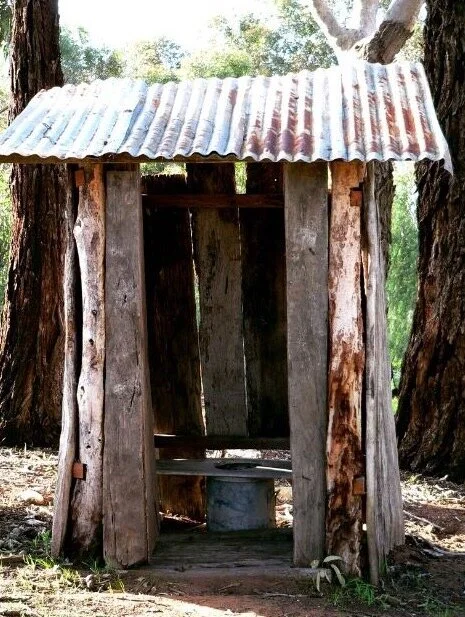
The outhouse in our woods has to be more than twenty-five years old, and hasn’t served it’s original intended purpose for at least that long (we haven’t used it, not once, since we’ve been here, I can tell you that). It’s standard-issue: tall plywood walls, corrugated tin roof, one-seater, latch on the inside, and a thin horizontal rectangular-shaped window/air vent cut into the door about twelve inches from the top.
I don’t know exactly when our 1914 farmhouse celebrated the installation of indoor plumbing, but legend has it that on or near that indulgent and life-changing day, the free-standing privy was dragged ceremoniously (more or less) across the seventeen acres of cut cornfield and another ten or so yards into the woods to be used as a deer blind (the business end of the rifle would be poked through the window/air vent slit in the door—perfect, except that the user had to be standing if he wanted to get a decent shot at his quarry. Sitting down would have pointed the rifle upward into the trees, and who wants to sit in an abandoned outhouse aiming at crows? No one). Pinterest did not invent the art of re-purposing. Not by a mile.
Of course, on our inaugural land walk the week we moved in here, we spotted and explored every inch of that al fresco loo, swung the door back and forth on its rusty hinges, took turns looking through the narrow window slit while the other pretended to walk past the door in deer-like fashion to test the structure’s propensity for muffling sounds. If the leaves were dry and crunchy, and the hunter’s reflexes sharp and in working order, dinner was a single well-aimed shot away. We made up all sorts of stories about the history of this ingenious reassignment of place and purpose on the walk back to the house, most involving clever deer and those overhead crows besting the poor but hopeful rifle-wielder inside. Then we left it alone for years, with only the occasional check-in to monitor its condition. One spring afternoon, I yanked open the even more-rusty door and startled a ground-nesting vulture sitting on three eggs. We both reacted appropriately per our respective species (meaning, lots of feather-flapping, hollering and jumping about) and parted soon after. Who knew a simple functioning outhouse would have so many other lives? Re-purposing at its organic and creative finest.
We arrived here twenty-one years ago with the roots of a solid frugal lifestyle well-established, and were delighted at the opportunities this land set down at our feet to keep such a practice going. My parents understood the challenges of raising five children on a single income, and in our tender youth, we knew that the box of Carnation non-fat dry milk on the kitchen counter meant dad’s paycheck had been stretched to its limit that week. I muscled through the mushy dregs of my bran flakes anyway, grumbling a bit and trying as any seven-year-old can to understand, all the while dreaming of the triumphant return of milk in a plastic gallon jug the way the gods intended. But don’t let me paint a misleading picture—we were warm and clothed and loved and had three solid meals every day. Frugality was a helpful tool born of the marriage between circumstantial necessity and relentless creativity. Mom made it a game to invent something new by using what was ready-to-hand, and taught me everything I know about leftovers. On those days, saving money was an added bonus, not the goal in mind. I come by my adherence to thriftiness naturally.
In our first few months here, we came to understand that the land’s previous residents (who knows how far back?) employed their own frugal and creative powers to manage their daily routines, including burying their trash behind the shed out back (not environmentally responsible, but…frugal). Perhaps sanitation pickup fees were out of their reach, but they couldn’t keep every discarded leaving in a bag in the kitchen, so they did the next best thing. I suspect they tried to at least recycle their plastics, as evidenced by a mountain of milk jugs and soda bottles in the old hay bale side of one of the barns which greeted us when we arrived as prospective buyers with the realtor. But clearly, the pile outstripped their ability to keep up and just accumulated. Near the shed by the house, an industrious groundhog would regularly dig up all manner of items, from lidded plastic carryout containers (one with the chicken bones still in it) to toy action figures—some minus their heads—and shards of pottery. I cleaned a few of these up (the pottery shards, not the headless He-Man action figures) and glued them to clay plant pots in random mosaic patterns. I felt good about it.
During our initial tour of the house, we saw more evidence of kindred frugal spirits—canning jars, newspaper insulation stuffed into the cracks between door frames, and a barn filled with all manner of items dreaming of a second life just as useful as the first one. Rusty mattress springs, piano keys, mismatched Hartstone pottery and old ceramic field tiles all piled on top of each other, patiently waiting their turn at rebirth. I thought the tiles would make lovely landscape accents once I potted them with some nasturtium and ferns. Maybe that’s what the folks moving out had in mind too.
After all the closing paperwork was signed and notarized, we moved in and made mortgage payments on a home and acreage with a thrifty vibe, picking up where all the previous owners had left off. When the old dairy barn started to sag, we pulled the inside planks of gorgeous weathered oak and used them as wainscoting in our kitchen remodel (bonus: the cats can sharpen their claws on it and it doesn’t even show. It’s that old and that hard. So, money saved on a scratching post). Grapevines from pretty much everywhere we walk are cut down and twisted into wreaths that hang from the t-posts propping up and connecting sections of the garden’s border fencing. It looks rustic and decorative, especially when the goldfinches perch and pose. And while I know Patrick prefers to use virgin wood for just about any building project, he’s also quite up to the challenge of heading down to the barn mid-project to see if a scavenged piece of our friends’ former pool decking (treated and everything!) will do in a pinch. When we finally install the floating shelves in the living room, we’ll post close-ups of that final section of weathered oak, carefully ripped and cut, that the kitchen remodel didn’t need, with some objet d’art placed carefully and whimsically on top.
Giving things a new life, a different functional iteration, hones and validates the creative hum that pulses through each and every one of us. It’s our human tendency to keep the story going, to add new chapters by using that inherent creativity to turn something ordinary into something extraordinary (or at least something differently ordinary). I firmly don’t believe that some of us have this hum and some don’t, and I’ll lovingly challenge anyone who says “Oh, I’m not creative. I haven’t got a creative bone in my body” (see previous post entitled “Make Something” for more on this topic). Of course we’re all good at creating something. The question is what? And how? And when? And with what?
For some imaginative hunter-gatherer who lived at Naked Acres before we got here, the answers were:
Deer blind.
Drag it across a field.
After the new plumbing is installed inside.
Use the outhouse.
Soft Stories
In the late fall and right through until spring, I sleep beneath the quilt I made for my parents’ 45th wedding anniversary.
Hanging primly over the open door of a yellowish grey painted primitive cabinet that Jackie gave me is a crib-sized quilt made from pastel 1930’s reproduction feed sack fabric and creamy ivory muslin sashing. The effect is charming, and if you’re ever a guest at our home, you’ll get to wake up to this bit of simple creativity looking at you from your comfy place in the antique oak sleigh bed (also from Jackie) in the downstairs guest room. I didn’t have anyone in mind as I was making it—no friend expecting her first child, or a niece on the way. I just found the prints cheering, and wanted to try my hand at something as simple as the pinwheel block pattern. I started it the autumn before I was diagnosed with Graves’ disease, and put the last hand stitch in the binding the following spring, after my thyroid had been shrunk into oblivion by less than an ounce of radioactive iodine. That was over twenty years ago; thyroid still gone, quilt still here.
On the opposite wall from the primitive cabinet hangs my first attempt at art quilting, inspired by a rather dark set of circumstances in my life that needed to be released from my broken heart and made tangible. It has all the elements of a good cry, mingled with the tiniest scrap of hope for healing and better days to come—a dark pine green fabric for the background, in the lower left hand corner, brown and mother-of-pearl seed beads stitched down with an occasional seashell to mimic the beach, and in the upper right hand corner, a rust-colored sunburst made from a scrap of upholstery fabric from which dangles a jet black crow’s feather I found in a cemetery in Quincy, Michigan. A curved line of marbleized pink glass heart-shaped beads connects the sunburst-and-feather to the beaded beach to portray the ebb and flow of grief. A length of ivory satin cord, the kind you’d see on a fancy throw pillow, wraps the edges in a soft but sturdy binding. Every time I look at it I see endurance and strength and the importance of knowing we’re all in the middle of some grand movie that is our lives. Best not to walk out before we see how it ends.
Somehow, the little misshapen patchwork pillow I made when I was nine, from squares of the wildest 70’s fabric you’ll ever see, made it through my single-digit years and survived clear through to the other side of my adolescence, college degrees, and former boyfriends and was packed away in who knows what box for who knows how long until we were reunited quietly a few years before we landed here at the acreage. Now it holds a dignified and eclectic place of prominence on my grandmother’s armless rocking chair by the bed (yep, that same guest room on the first floor. You’re really gonna love staying here, I promise).
In the late fall and right through until spring, I sleep beneath the quilt I made for my parents’ 45th wedding anniversary. It’s full-size plus, hanging off the sides of the bed to hide what’s stored underneath. In the design phase, I asked each sibling and their children to select a die-cut fabric heart from a sample batch I bought (with no particular plan in mind) so that I could appliqué their selections to the quilt top and hand-embroider their names below these hearts, creating a warm and functional testimony to their love across the decades. Of course mom kept it folded at the end of their bed and refused to wash it for a long time, until I told her it had already been washed before I gave it to them. That old “save it for special occasions” approach…I was touched that she cherished it so.
In my closet upstairs is a lined collar-less jacket made from fabric depicting the manual alphabet in American Sign Language, each letter framed in its own box and set into a purple and blue batik-like ombré of rich colors. I bought yards of the stuff, once again with no plan in mind save for this reckless spark of an idea that I wanted to make something other than a four-sided straight-edged flat piece that someone would only see if they spent the night underneath it. So naturally I asked our 80-plus postmistress to help me. Went to her house a few farms away with my fabric and jacket pattern and iron and everything so she could guide me through the treacherous and picky steps of in-setting the sleeves (sewing friends, is that even the right terminology??). I left her home four and a half hours later with the jacket hanging proudly on the little hook just above the back window of my truck as I headed to the local thrift store to find the perfect shirt to wear with it. All because dad worked at the state school for the deaf and was going to smile broadly when he saw me wearing it.
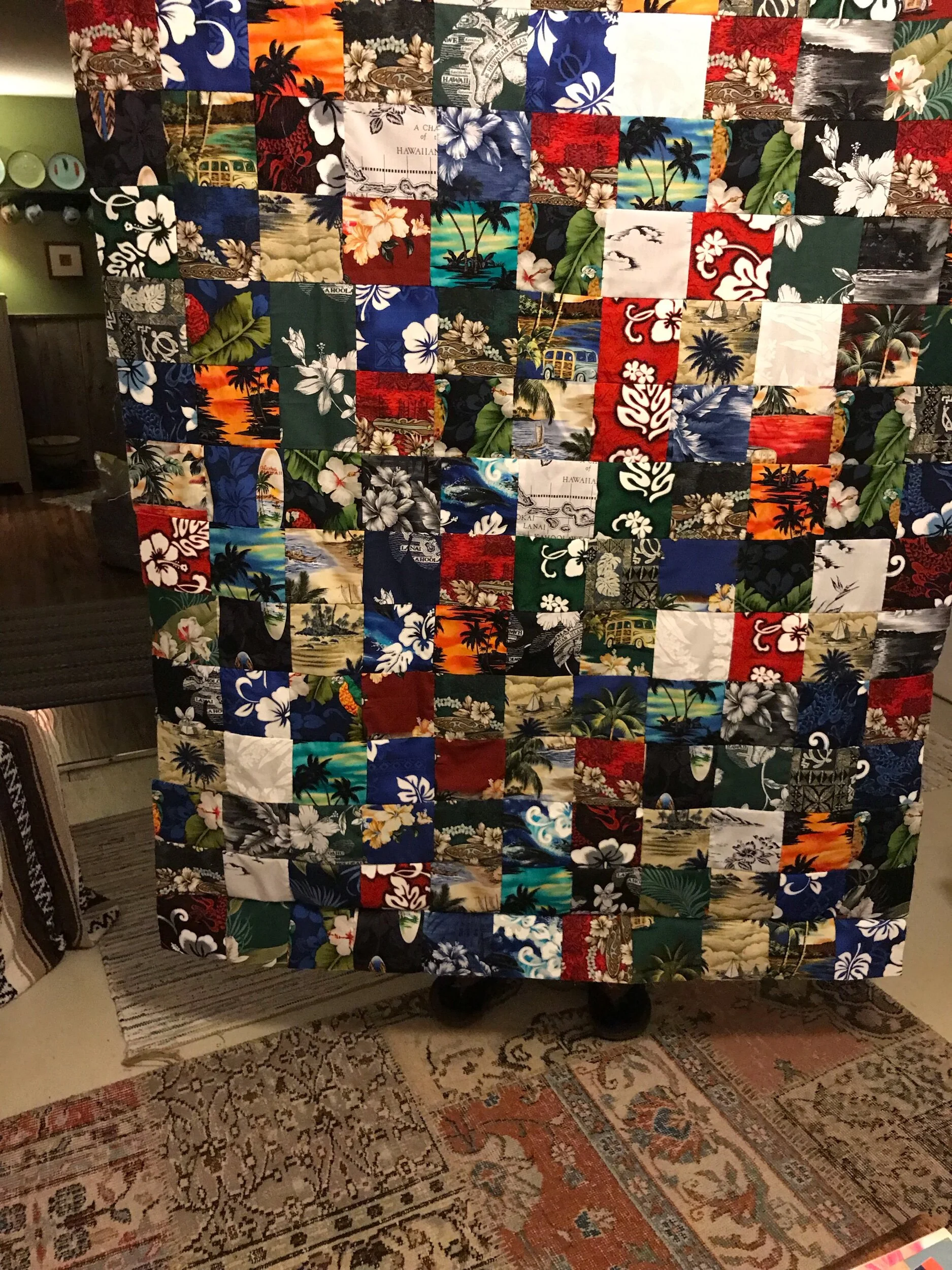
Each room in our home has something soft and handmade, containing layers of perspective and stories as rich as any fully-funded archaeological dig. Sometimes I’m so surrounded by them, immersed in them, I forget they’re there and who I was when I first made that slightly off-kilter placemat, or put out my hands to accept the gift of two knife-edge throw pillows for our couch that still remind me of the dear friend who spent time selecting the fabric and poly-fil and squinted to thread the needle of her Singer some rainy Saturday afternoon.
In some practical part of my brain or heart, I know they’re just things and will probably outlive me (they’re all that well-crafted). But for now, on a chilly mid-winter evening, their warm comforting presence beckons me to pause and recall the relationships that brought them into being.
Not a bad way to close off the weekend.